Taxonomy & naming
Petrotilapia genalutea was described by A. C. Marsh in 1983 in a taxonomic study of the genus published in the Ichthyological Bulletin of the J. L. B. Smith Institute of Ichthyology, with Monkey Bay at the southern end of Lake Malawi as the type locality. In the same work Marsh split what had been treated as a single polymorphic species, Petrotilapia tridentiger Trewavas 1935, by also naming P. nigra and revising the generic diagnosis. The genus name combines Latin petra, "stone," with the Bechuana (Tswana) word thiape, "fish" — a rock-dwelling tilapia-like cichlid — while the species epithet genalutea points to the yellow (Latin luteus) cheek (gena) of breeding males.
Petrotilapia belongs to the mbuna, the Chichewa name Malawian fishermen use for the rock-dwelling cichlids of the lake, and the genus contains the largest-bodied of that assemblage. Authorities including FishBase, the Catalog of Fishes, and the IUCN all treat genalutea as a valid species with no junior synonyms. Field workers and exporters have at times muddied the picture: the species has been shipped under the trade label "Petrotilapia Tridentiger," and a northern form once circulated as P. sp. 'chitande.' Petrotilapia species are separated chiefly by the live coloration of breeding males, with only limited divergence in body measurements and meristics, so coloration is the practical key to telling them apart; Ruffing, Lambert & Stauffer (2006) used morphometric and meristic analyses to help support the distinctness of these species. The genus is informally sorted into three habitat-linked groups named for representative species; genalutea heads the "P. genalutea group" associated with sediment-rich and intermediate (mixed rock-and-sand) habitats.
Appearance
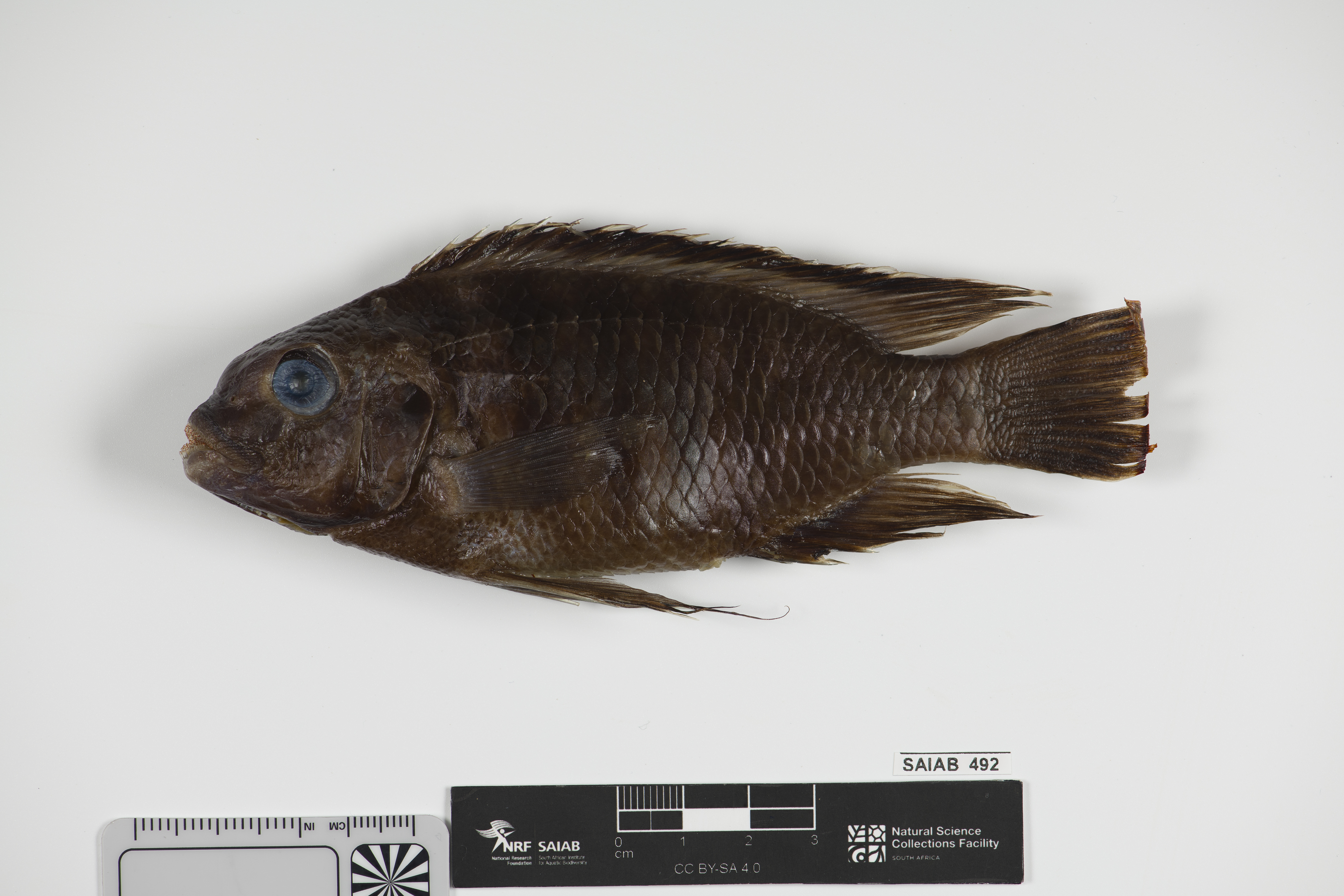
Like all Petrotilapia, genalutea is instantly recognizable underwater by its broad, fleshy lips densely packed with long, slender, flexible teeth that remain visible even when the mouth is shut — a built-in comb for stripping algae. It is a substantial mbuna: the type and museum series run to roughly 13 cm (5 in) standard length, and adults reach about 15 cm (6 in) total length in the wild, with males the larger sex. Aquarium specimens grow bigger still; one husbandry account gives full-grown males around 17 cm (6.7 in) and females near 14 cm (5.5 in).
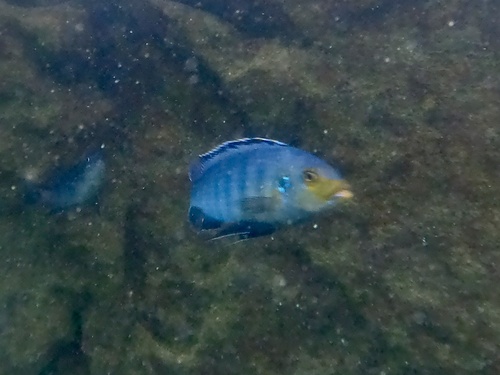
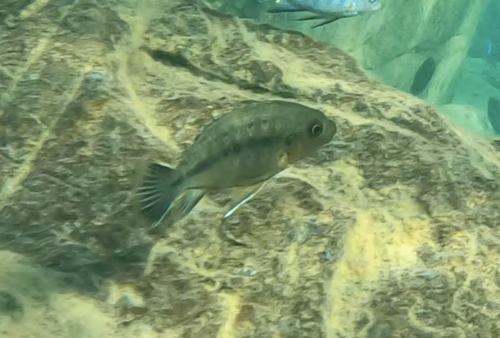
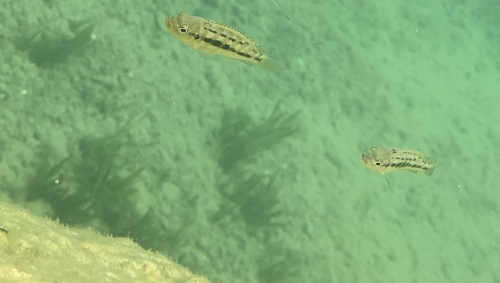
The sexes look quite different. Territorial males show a dull blue to blue-grey body broken by five to seven dark vertical bars, with orange along the flanks and the diagnostic yellow wash across the throat and cheeks; the dorsal and anal fins carry thick black submarginal bands, and dominant males may darken their barring during display. Females and juveniles are pale — white to light beige — patterned with two rows of spots along the flank (the lower row including a few larger blotches) and a black submarginal band in the dorsal fin. Juveniles are notably yellow. Because coloration is the main field character, separating genalutea from sympatric congeners means reading the males: P. nigra males are mostly black with seven to ten gray-brown bars, P. microgalana males are bright blue rather than dull, and only genalutea pairs the dull-blue ground with orange flanks and yellow cheeks.
Range & habitat
Petrotilapia genalutea is endemic to Lake Malawi (also called Niassa or Nyasa), the lake the species and this site are really about. It is among the most broadly distributed mbuna in the lake: FishBase reports it widespread south of Ruarwe on the western shore and as far north as Makanjila on the eastern side, with records reaching the Tanzanian coast at Londo. The IUCN notes only a handful of places where it is conspicuously absent — Likoma, Chizumulu, Chinyankwazi, and Chinyamwezi islands. Across this range it varies enough in male color that hobbyists track it by collection point: 'Mdowa,' 'Boadzulu Island,' 'Thumbi West Island,' 'Magunga,' and many more.
True to its group, the fish favors medium-to-large rocks and intermediate zones where rock grades into sand, rather than the pounding surf or the deepest reefs claimed by its relatives. It is a shallow-water animal: it usually stays above about 8 m (26 ft), though it has been recorded down to 18-20 m (60-66 ft) at Boadzulu Island. Depth use is also sexed — females are most abundant in the extreme shallows, while males concentrate around 3 m (10 ft). FishBase records the in-situ envelope as warm and hard-alkaline: roughly 23-27 °C (73-81 °F), pH about 7.4-8.4, and high carbonate hardness, the stable rift-lake chemistry typical of Malawi's rocky shores.
Ecology & diet
Functionally, P. genalutea is an aufwuchs grazer — "aufwuchs" being the German term mbuna keepers borrow for the felt of attached algae, diatoms, and small invertebrates that coats sunlit rock. Rather than scraping the substrate hard like some mbuna, Petrotilapia uses its dense comb of slender teeth to brush loose algal filaments and the small animals living among them; FishBase places it at a low trophic level around 2.0. It is best described as a grazing omnivore: adults work the rock film but also take plankton when it is abundant, and juveniles are reported to feed primarily on plankton before shifting onto the rocks.
The species is a familiar part of the rocky-shore community and frequently forages in large, loosely organized schools — gatherings that can swell when food is scarce and that sometimes mix in a few other Petrotilapia. This shoaling, combined with broad habitat tolerance, helps explain why genalutea is so common and so widespread where it occurs. Its near-total morphological overlap with congeners, alongside clear ecological partitioning by habitat and depth, makes the genus a textbook example of how Malawi's cichlid flock packs many similar species onto the same shoreline by dividing up the microhabitats and breeding assortatively.
Behavior & breeding
Petrotilapia genalutea is a maternal mouthbrooder, like the rest of the Malawi mbuna. The pair bond lasts only as long as spawning: a male displays over his territory, the female lays and immediately takes the eggs into her mouth, fertilization follows, and she then incubates the clutch for roughly three weeks before releasing free-swimming fry. There is no biparental care; the female alone shelters and broods the young.
Socially, only a minority of males hold territories at any time, and those that do defend breeding areas — reported on the order of 20 m² — chiefly against rival conspecific males. Females, juveniles, and non-territorial males are far less tied down, living singly or drifting in the water column in schools that can reach into the hundreds. Notably for a rock cichlid, genalutea is described as comparatively mild: it is aggressive mainly toward its own kind and generally tolerant of other species, which fits the lived experience of keepers and importers who note that Petrotilapia, despite their size, tend not to be the bullies of an mbuna tank.
In the aquarium
Petrotilapia genalutea is an uncommon sight in the hobby, and the reason is mostly its size and old reputation rather than any real difficulty. These are among the largest mbuna, and that — plus memories of boisterous wild imports from the early days of small tanks — has kept them niche; experienced specialists point out there is little reason a suitably large tank can't house them well. A footprint-driven setup is the priority: hobby guidance lands around 130 US gallons (about 500 L) or more, with the emphasis on length and rockwork rather than sheer volume, since this is a shallow-shore grazer that wants stone to work and broken sightlines.
Match the wild water chemistry — hard, alkaline water around pH 7.8-8.4 and warm tropical temperatures — and feed as the herbivore-leaning omnivore it is. Algae- and spirulina-based foods suit it; keepers caution against leaning on rich, soft protein foods such as bloodworms, blackworms, or adult brine shrimp, which mbuna of this feeding guild digest poorly over the long term and which invite bloat. On temperament, the consistent signal across keepers and rift-lake retailers is that Petrotilapia are surprisingly even-tempered for their bulk — far less of a problem than many Tropheops or Pseudotropheus — though aggression still runs hottest male-to-male within the species, so give them a group with enough females and space to diffuse it. Keep a single Petrotilapia species per tank to avoid hybridization, the perennial pitfall of maintaining look-alike mbuna together.
Conservation
The IUCN Red List assesses Petrotilapia genalutea as Least Concern (assessed 20 June 2018; Konings & Kazembe, errata 2019), with a stable population and a wide lake-wide distribution that underpins that rating. The assessors flag only minor, localized pressures specific to the fish: sedimentation of its rocky habitat and irregular, small-scale collection for the aquarium trade, where it is sometimes mislabeled "Petrotilapia Tridentiger." It is of no importance to subsistence fishers, and part of its range falls within Lake Malawi National Park. In short, the species itself is not currently threatened.
That said, a secure species can still live in a strained lake, and it is honest to say so. The basin-scale review by Chavula and colleagues (2023, Journal of Great Lakes Research 49(6):102241) documents mounting anthropogenic and climatic stress across Lake Malawi/Niassa/Nyasa: heavy over-fishing and the well-known collapse of the chambo (Oreochromis) fishery, rising sediment and nutrient loading washing off deforested catchments, an estimated warming of roughly 0.7 °C in the shallow water column that strengthens stratification and reduces the mixing that drives productivity, and the looming risk of invasive species. For a shallow rocky-shore endemic like genalutea, the most direct of these is sedimentation — silt smothers the rock film it grazes and the clear, hard water its breeding displays depend on — exactly the threat the IUCN singles out, now amplified by catchment erosion. The species' broad range and shallow-water flexibility give it real resilience the lake's narrow-range endemics lack, but its long-term security is tied to the health of Malawi's rocky coastlines, not separate from it.
Sources
- Petrotilapia genalutea — FishBase species summary
- Catalog of Fishes (Eschmeyer) — Petrotilapia genalutea
- Petrotilapia genalutea — IUCN Red List (Konings & Kazembe 2018, errata 2019)
- Ruffing, Lambert & Stauffer (2006) — Description of a new species of Petrotilapia (P. microgalana), with comparisons to P. genalutea
- Lundeba, Stauffer & Konings (2011) — Five new species of Petrotilapia; habitat groups (reported in Practical Fishkeeping)
- Chavula et al. (2023) — Lake Malawi/Niassa/Nyasa basin: Status, challenges, and research needs, J. Great Lakes Res. 49(6):102241
- malawi.si — Petrotilapia genalutea gallery & locations
- malawi.si — Petrotilapia genalutea 'Mdowa' biotope, husbandry & breeding notes
- The Cichlid Stage — Dave Schumacher interview (Petrotilapia size & temperament in the hobby) — community/anecdotal
- Cichlid Room Companion — Petrotilapia genalutea profile (public page)
- FishBase — Fish identification list for genus Petrotilapia
- Pfeil Verlag — Lundeba, Stauffer & Konings (2011), Ichthyol. Explor. Freshwaters 22(2):149-168 (PDF)
- University of Hull repository — impacts of the ornamental fish export trade on Lake Malawi species (PDF)