Taxonomy & naming
Petrotilapia microgalana was formally described in 2006 by Renea Ruffing, Angela Lambert, and Jay Stauffer Jr. in the Proceedings of the Biological Society of Washington, based on fish chased into hand nets by SCUBA divers off Nkhata Bay. The holotype, an adult male of about 104 mm standard length, was collected on 14 March 1995. The genus name Petrotilapia pairs the Latin petra (stone) with a southern African word for fish, an apt label for cichlids that spend their lives over rock.
The genus contains the largest of the mbuna, the Malawian fishermen's collective name for the lake's rock-dwelling cichlids. For decades Petrotilapia was treated almost as one variable species until Marsh's work in the early 1980s split it apart; by the time microgalana was named there were only four described species but roughly a dozen more recognized but unnamed. In 2011, Lundeba, Stauffer, and Konings described five more, underscoring how finely this genus is partitioned along the lake's rocky coast.
What makes microgalana unusual taxonomically is that its describers folded three locally recognized color forms from the Nkhata Bay area, the small blues, browns, and a smaller yellow form, into a single species. In the hobby it had circulated as Petrotilapia sp. 'small blue,' and a separate northern population sold as P. sp. 'ruarwe' is now generally regarded as the same fish, which extends its known range. It belongs to the informal P. nigra species group, the deeper-water assemblage within the genus.
Appearance
This is a medium-sized mbuna by Petrotilapia standards. The type series topped out at about 114 mm standard length, roughly 4.5 in, and FishBase lists a maximum of 11.4 cm SL; aquarium keepers report considerably larger animals, with males said to reach 16 to 17 cm total length in the wild and occasionally close to 20 cm (about 8 in) in tanks, the gap reflecting both the difference between standard and total length and the tendency of captive fish to outgrow their wild measurements.
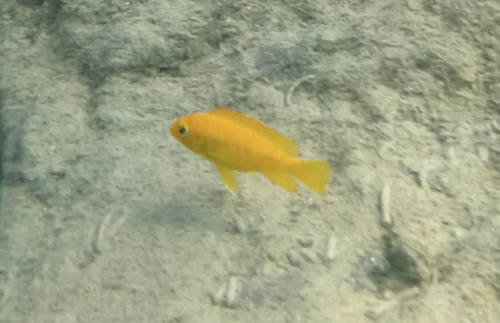
Color, not body shape, separates the Petrotilapia. Territorial males are a clean bright blue along the flanks with five to seven faint dark bars and a blue head; the chest and belly can flush yellow or orange, and there is a black submarginal band running through the dorsal fin. That band is the species' signature, present in males, females, and juveniles alike, and it cleanly separates microgalana from P. tridentiger and P. chrysos, which lack it. The bright-blue male also rules out P. genalutea, whose males are duller blue with orange flanks, and P. nigra, whose males are mostly black with up to ten bars. Females are light brown to bright gold with faint bars and a row of dark mid-lateral blotches, and juveniles are vivid yellow, a useful field mark because the two sympatric congeners at Nkhata Bay do not have yellow young. Fin counts run to 17 to 19 dorsal spines and three anal spines, with mostly tricuspid teeth in 6 to 10 rows.
Range & habitat
Petrotilapia microgalana is a Lake Malawi endemic confined to the lake's northwestern Malawian shore. The type specimens all came from Nkhata Bay, and Konings has put the natural range from roughly Bandawe Point to Cape Manulo, a stretch of about 84 km of coast; the IUCN assessment records it from Charo to Kande Island, and the reassignment of the 'ruarwe' population pushes the documented range further along the western shoreline.
It is strictly a rock fish, tied to the rocky and sediment-influenced rocky biotope rather than sand or open water. Among its congeners it is the deeper dweller: breeding males patrol territories at an average depth of about 10 to 15 m (33 to 49 ft), while females and juveniles tend to stay shallower, with the species most commonly encountered between roughly 5 and 10 m. Where rock and shelter are abundant it shares the habitat with other Petrotilapia, but in deeper or more sparsely structured zones it is often the dominant representative of the genus. Lake Malawi's rocky shallows are warm, around 24 to 28 C (75 to 82 F) seasonally, alkaline, and hard, with a stable pH in the high 7s to low 8s, the chemistry a fishkeeper has to reproduce.
Ecology & diet
The whole anatomy of Petrotilapia points at one job: scraping the aufwuchs, the felt-like turf of algae and the diatoms, invertebrates, and detritus living within it that coats every sunlit rock in the lake. The broad lips and dense brush of slender, mostly tricuspid teeth let the fish comb diatoms and loose algal strands off stone rather than rasping like the harder-toothed grazers, and microgalana works that film as its primary food. It is best described as an algae-comber with a flexible, slightly omnivorous streak, also taking plankton and the small animals living in the algal mat; juveniles begin feeding directly from the aufwuchs almost as soon as they are released. FishBase places its trophic level around 3.4.
Within the rocky community this is the kind of partitioning that drove Malawi's cichlid radiation in the first place. Several Petrotilapia can occur on one reef precisely because each favors a slightly different depth and sub-habitat, dividing the same algal resource finely enough that they coexist and, importantly, mate assortatively, an isolation that helps keep the sibling species distinct.
Behavior & breeding
Petrotilapia microgalana is a maternal mouthbrooder with a polygynandrous mating system, the standard mbuna pattern taken to an aggressive extreme. Adult males hold territories, reported at roughly four meters across, usually centered on a cave among the rocks, and defend them year-round; non-territorial males, females, and juveniles range over the reef singly or in loose schools. Spawning happens inside the male's cave, and a receptive female may visit several males, so a single brood's paternity is not guaranteed to one fish.
After spawning the female takes the eggs into her mouth and incubates them for about three weeks, hiding among the rocks and not feeding while she broods. Fry are released at the same depth the adults occupy and start grazing aufwuchs almost immediately. The aggression is real and worth flagging: experienced keepers liken these fish to Melanochromis chipokae in temperament, with territorial males that will not tolerate a rival and females that can themselves be combative. Reports of these fish as gentle giants are not borne out by people who have actually housed them.
In the aquarium
This is not a beginner mbuna, and the honest advice from people who keep it is consistent. Plan on a six-foot tank at minimum; hobby references suggest around 500 liters (about 130 gallons) with a footprint near 200 cm, and most keepers would not attempt it in a four-foot tank. Keep a single male with a generous group of females to spread his attention, and do not expect to run two males together in anything but exceptional, heavily structured setups. Aquascape with a great deal of rock built up toward the surface to create many territories and break lines of sight, including retreats too small for the male so females have somewhere to escape.
Water should match the lake: hard, alkaline, pH around 7.8 to 8.5, temperature in the mid-70s to low-80s F (24 to 28 C). Feed a spirulina-rich, vegetable-based diet in keeping with its algae-combing biology and avoid protein-heavy foods that mbuna digest poorly. Tankmate-wise, pair it only with similarly robust, aggressive mbuna; gentle species and peacocks are a mistake, and the four errors keepers most often make, undersized tanks, too little rockwork, too few females per male, and mixing in passive fish, are exactly what turns a workable Petrotilapia tank into a problem one. It reaches the trade fairly regularly, often labeled 'Petrotilapia Small Blue,' though it remains a specialist's fish rather than a common one.
Conservation
The IUCN Red List assessed Petrotilapia microgalana as Least Concern in 2018 (assessment by Konings and the FishBase team RMCA), with a population judged stable and no major widespread threats identified; the fish is common in the rocky habitats within its range. Two pressures are flagged specifically for it: sedimentation, and extraction for the aquarium trade, where it is regularly collected. Because it lives in close contact with rock, it largely escapes the gill nets of the lake's food fishery, which are not usually set in its habitat. So the species itself is not, on present evidence, in trouble, and it would be wrong to imply otherwise.
That said, a rocky-shore endemic with a coastline range of well under 100 km is exposed to the lake's broader decline rather than buffered from it. The basin review by Chavula and colleagues (Journal of Great Lakes Research, 2023) documents a Lake Malawi under real strain: heavy over-fishing and the collapse of the chambo tilapia fishery, rising sediment and nutrient loading washing off deforested catchments, and roughly 0.7 C of warming in the shallow water that strengthens stratification and cuts the mixing that brings nutrients up, lowering productivity, alongside the looming risk of invasive species. For a fish whose entire existence depends on clear, well-lit rock and the thin algal film growing on it, sedimentation is the pressure that bites hardest: silt smothers the aufwuchs it grazes and clouds the water its color-based mate recognition needs. None of that has yet moved its status off Least Concern, but the right framing is a stable species living in a stressed lake, and the localized aquarium-trade collection and shoreline sediment that the assessors singled out are exactly the kinds of pressure that a narrow-range rock dweller has the least room to absorb.
Sources
- Petrotilapia microgalana - FishBase species summary
- Catalog of Fishes (Eschmeyer), genus/species records via FishBase
- Ruffing, Lambert & Stauffer (2006). Description of a new species of Petrotilapia, from Lake Malawi. Proc. Biol. Soc. Wash. 119(4):534-539
- Lundeba, Stauffer & Konings (2011). Five new species of the genus Petrotilapia, Lake Malawi. Ichthyol. Explor. Freshwaters 22(2):149-168 (PDF)
- Practical Fishkeeping: Five new species of Petrotilapia cichlid described
- Petrotilapia microgalana 'Nkhata Bay' - malawi.si species profile
- Petrotilapia microgalana - Cichlid Room Companion (public profile, Ad Konings)
- All fishes reported from Malawi - FishBase country checklist
- IUCN Red List: Petrotilapia microgalana (Least Concern, 2018)
- Chavula et al. (2023). Lake Malawi/Niassa/Nyasa basin: Status, challenges, and research needs. J. Great Lakes Res. 49(6):102241
- Petrotilapia discussion thread - Cichlid-Forum (keeper accounts of aggression and tank needs) — community/anecdotal