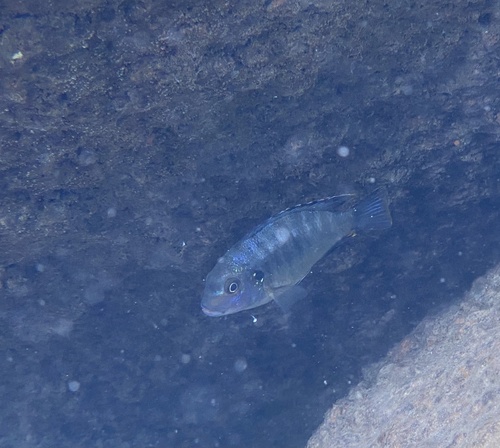
Taxonomy & naming
Petrotilapia mumboensis was formally described in 2011 by Mary Lundeba, Jay R. Stauffer Jr. and Adrianus (Ad) Konings, in a paper in Ichthyological Exploration of Freshwaters (22(2): 149-168) that named five new Petrotilapia at once. The species epithet refers to Mumbo Island in Lake Malawi, the type locality and the spot where the holotype (an adult male, 106 mm standard length) was collected in February 2003. Long before it had a Latin name, hobbyists and field workers knew it as Petrotilapia sp. 'mumbo blue', a label that traces back to Ribbink and colleagues' landmark 1983 survey of the lake's rock-dwelling cichlids.
The genus Petrotilapia (Trewavas, 1935) belongs to the mbuna, the small rock-dwelling haplochromines of Lake Malawi, and contains the largest-bodied mbuna. Every Petrotilapia shares the same unmistakable signature: broad, fleshy lips densely packed with slender, three-cusped (tricuspid) teeth that remain visible even when the mouth is shut. Most rocky shores in the lake host three different Petrotilapia at once, each in its own sub-habitat, and the genus is usually carved into three groups (the P. tridentiger, P. nigra and P. genalutea groups) defined by habitat and female pigment pattern. P. mumboensis is the odd one out: Lundeba and colleagues found it fit none of the three cleanly and suggested it may represent a fourth grouping.
Appearance
This is a medium-large mbuna. The type series ran from about 79 to 127 mm standard length, and FishBase lists a maximum of 12.7 cm (5 in) SL; in total length, field observers report males reaching roughly 6.7 in (17 cm) and females rarely exceeding about 5.5 in (14 cm). The body is fusiform with the deep, blunt-headed look typical of the genus, the lips thick and tooth-covered. Lower-jaw teeth sit in 9 to 21 rows, tricuspid in the outer and inner rows. Fin counts run XVI-XVIII dorsal spines with 8-10 soft rays, and three anal spines with 7-9 rays.
Color is where the species announces itself. Breeding males are light blue over the head, body and fins, marked with eight to ten darker blue vertical bars, a light-blue cheek, and a pale blue-to-gray throat. Females are gray-brown to light brown. The single most useful field mark, present in both sexes, is a dark submarginal band running through the spiny part of the dorsal fin (and the anal fin) - the feature that separates P. mumboensis from look-alikes such as P. tridentiger, P. xanthos, P. flaviventris and P. palingnathos, all of which lack that band. The blue male coloration and pale throat further distinguish it from the darker-throated P. genalutea, P. nigra, P. chrysos and others. As with most mbuna, the species is told apart mainly by live male color rather than by body proportions, which vary little across the genus.
Range & habitat
Petrotilapia mumboensis is a Lake Malawi endemic with a notably patchy, disjunct distribution. It is very common at its type locality, Mumbo Island, and also turns up at nearby Thumbi West Island and at the isolated Mbenji Islands - all in the southern part of the lake, with no records linking the populations across the intervening open water and sand. That kind of island-hopping, gap-filled range is a recurring theme among rock-restricted mbuna, which cannot cross sand or deep water and so become stranded on their home reefs.
Within those reefs it occupies a tight niche: the upper, sediment-free rocky habitat, favoring vertical rock faces in very shallow water with heavy wave action. It is rarely seen deeper than about 16 ft (5 m), which places it among the most surf-exposed of the lake's cichlids. Lake Malawi's rocky shallows are warm, alkaline and well-oxygenated - broadly around 76-84 degrees F (24-29 C), pH on the order of 7.7-8.6, with moderate hardness - and a fish living against breaking waves on bare boulders is adapted to that bright, turbulent, low-sediment zone in particular.
Ecology & diet
Like all Petrotilapia, this is an Aufwuchs grazer - 'Aufwuchs' being the felt of diatoms, filamentous algae and associated micro-organisms that coats sunlit rock. The genus's brush-like rows of tricuspid teeth and fleshy lips are built to comb and rake that film and the loose algal strands within it from the rock surface, and feeding leaves characteristic cleaned patches on the substrate. FishBase places the species at a trophic level near 3.4, consistent with an algae-dominated diet that also takes in the small invertebrates living in the algal turf.
Its ecological role is that of a shallow-reef herbivore and a competitor for grazing space. Studies of sympatric Petrotilapia on Malawi rock show that males defend feeding-and-breeding territories yet actually graze only a small fraction of the area they control, and that coexisting species partition the rock by micro-habitat. P. mumboensis fits this pattern by specializing on the wave-washed uppermost zone, sharing that surf habitat at Thumbi West and Mbenji with a member of the P. tridentiger group while up to three other Petrotilapia occupy adjacent depths on the same reef - a fine-grained division of one rocky slope among several thick-lipped grazers.
Behavior & breeding
Petrotilapia mumboensis is a maternal mouthbrooder, the standard reproductive mode for Malawi's haplochromine cichlids. Territorial males hold and defend areas in the rocky habitat - reported on the order of 5 m across - typically centered on a cave or crevice with a top entrance among the boulders, where spawning takes place. After laying, the female takes the eggs into her mouth, incubates eggs and developing larvae for roughly three weeks while sheltering alone among the rocks, then releases free-swimming fry that fend for themselves and begin grazing Aufwuchs straight away. There is no biparental care; the male's contribution ends at the cave.
Temperament tracks the genus's reputation. Petrotilapia are widely regarded by experienced keepers as among the most aggressive mbuna - one long-time hobbyist likened their disposition to that of Melanochromis chipokae, and the males are strongly territorial, especially when breeding. That aggression is the everyday currency of life on a crowded rock face, where space, females and grazing turf are all contested.
In the aquarium
P. mumboensis is an uncommon sight in the hobby and is best regarded as a fish for experienced mbuna keepers with real space. The aggression and adult size mean a four-foot tank does not work; keepers and field references point to a six-foot (about 200 cm) or larger aquarium as the realistic minimum. The reliable formula for the genus is one male to a harem of several females - a second male is hard to maintain - inside a tank loaded with rock right up toward the surface, so that sightlines are broken and subordinate fish and brooding females have retreats the dominant male cannot easily reach.
Water should mirror the lake: hard, alkaline (pH roughly 7.8-8.6), and warm, around 77-82 degrees F (25-28 C), with strong filtration and current to match a fish that evolved against breaking waves. Tankmates should be other robust, aggressive mbuna rather than peaceful species or peacocks, which get bullished. The classic mistakes keepers make with this temperament class are an undersized tank, too little rockwork, too few females per male, and mixing in passive species - any one of which turns a manageable fish into a problem. None of this is care-sheet flattery: it is a handsome, demanding rock cichlid, not a community fish.
Conservation
The IUCN Red List assesses Petrotilapia mumboensis as Least Concern (assessed 22 June 2018, published 2018; assessors Konings and the FishBase team at the RMCA), with a population trend listed as stable. The justification is straightforward: the species is endemic to Lake Malawi, known from three island localities (Mumbo, Thumbi West and Mbenji), and no major widespread threats specific to it have been identified. It carries no targeted commercial-fishery or heavy ornamental-collection pressure, and as a rock-glued grazer it is largely outside the path of the seine and beach fisheries, though it could be caught incidentally in gillnets set near rocks.
That clean species-level status sits inside a lake under real strain, and honesty requires holding both at once. The basin review by Chavula and colleagues (Journal of Great Lakes Research, 2023; DOI 10.1016/j.jglr.2023.102241) documents over-fishing and the collapse of the chambo (Oreochromis) fishery, rising sediment and nutrient loading off deforested catchments, and warming of roughly 0.7 degrees C in the shallow water that strengthens stratification and trims the lake's productivity, alongside invasive-species risk. For a shallow rocky-shore specialist, sedimentation is the pressure that bites hardest: P. mumboensis depends on the bright, sediment-free upper rock and the algal film that grows there, and silt smothering nearshore boulders degrades exactly that habitat and food base. Its narrow, island-restricted range gives it little room to relocate if a reef is fouled. The fish is not currently threatened - but its security is tied to a small number of southern reefs in a lake whose nearshore zone is under mounting human pressure.
Sources
- FishBase: Petrotilapia mumboensis
- Eschmeyer's Catalog of Fishes (species entry, via FishBase)
- Encyclopedia of Life: Petrotilapia mumboensis
- GBIF occurrence records: Petrotilapia mumboensis
- Lundeba, Stauffer & Konings (2011), Five new species of the genus Petrotilapia, Ichthyol. Explor. Freshwaters 22(2):149-168 (PDF)
- Lundeba, Stauffer & Konings (2011), Five new species of Petrotilapia (ResearchGate)
- Marsh, Ribbink & Marsh: Feeding-site utilization in three sympatric species of Petrotilapia from Lake Malawi
- Resource Control by Territorial Male Cichlid Fish in Lake Malawi (JSTOR)
- Ruffing, Stauffer & Konings: Description of a new species of Petrotilapia (Penn State, PDF)
- Chavula et al. (2023), Lake Malawi/Niassa/Nyasa basin: Status, challenges, and research needs, J. Great Lakes Research 49(6):102241
- IUCN Red List: Petrotilapia mumboensis (Least Concern, 2018)
- malawi.si: Petrotilapia mumboensis 'Mumbo Island' (Konings photos, habitat & care notes)
- Practical Fishkeeping: Five new species of Petrotilapia cichlid described
- Mindat taxon: Petrotilapia mumboensis
- Cichlid-Forum.com: keeping Petrotilapia (Lake Malawi Species thread) — community/anecdotal
- UKAPS forum: keeping mbuna cichlids (harem/aggression discussion) — community/anecdotal