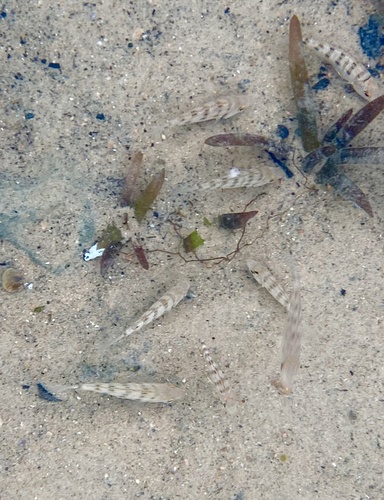

Taxonomy & naming
The species was described by Albert Günther in 1894 (the work appeared in the 1893 Proceedings of the Zoological Society of London) as Chromis johnstoni, from material the explorer and colonial administrator Sir Harry Hamilton Johnston shipped out of British Central Africa — hence the species epithet, which honors him. It was later reassigned to the genus Placidochromis, erected by Ethelwynn Trewavas; the genus name pairs Latin placidus, 'tranquil,' with the old fish-name element chromis, a nod to the calm bearing of these haplochromines.
The most-cited synonym is Haplochromis sexfasciatus Regan, 1922, sunk into P. johnstoni by Eccles and Trewavas in their 1989 reclassification of the Malawi haplochromines. That history matters for hobbyists because the fish is still sold almost everywhere as 'Haplochromis johnstoni' (and in Malawi as 'Kachimanga'), a holdover from the era when nearly every Malawi non-mbuna was lumped into Haplochromis. Placidochromis is a large, somewhat heterogeneous genus within the lake's vast haplochromine flock, and several undescribed sand-dwellers still ride along under provisional 'Placidochromis sp.' labels.
Appearance
P. johnstoni is a moderately deep-bodied hap with the streamlined, slightly down-turned mouth of a fish that works the bottom. Reported maximum size differs between sources worth flagging: FishBase lists 20 cm (about 8 in) total length, while the IUCN assessment gives 16 cm (about 6 in); in aquaria, males commonly reach roughly 6 to 7 in (15 to 18 cm) and females stay smaller. The discrepancy is the usual one between an old museum maximum and a field-survey figure, so treat 6 to 8 in as the honest range.
Color is strongly sex- and mood-linked. A dominant, breeding male develops a metallic blue-to-turquoise sheen over the head and flanks, often broken by darker vertical barring (the 'sexfasciatus' name referenced six bars) and edged with yellow or orange in the fins. Females and subordinate males are a plainer silvery-tan with faint bars — easy to mistake for any number of generic 'haps.' Keepers consistently report that subdominant males stay washed-out: color here signals social rank as much as maturity, so a male that 'won't color up' is usually being suppressed rather than mis-sexed.
Range & habitat
This is a true lacustrine endemic of the Lake Malawi system with one of the widest ranges in its genus. FishBase and the IUCN both describe it as occurring lake-wide, and it extends into Lake Malombe and the upper Shire River that drains the lake's southern end; the IUCN puts its estimated extent of occurrence near 29,600 km2. Within the basin it spans the three riparian states — Malawi, Mozambique, and Tanzania — and is recorded inside Lake Malawi National Park.
It is a fish of the soft-bottom, intermediate, and vegetated shallows rather than the rocky reefs the mbuna own. Sources agree it favors sheltered, shallow areas with patches of vegetation, but it also ranges over open sand and mud/silt bottoms and the transitional zones between rock and sand, only rarely venturing onto rock proper. That puts it squarely in the lake's warm, well-oxygenated surface layer; Lake Malawi's epilimnion runs roughly 75 to 82 °F (24 to 28 °C), hard and alkaline at around pH 7.7 to 8.6, which is the chemistry this fish evolved in and the target for keeping it.
Ecology & diet
Placidochromis johnstoni is a generalist bottom forager — a mid-trophic-level predator rather than an algae-grazer. FishBase places it at trophic level ~3.5 and notes it feeds on invertebrates while moving in small groups; the IUCN account adds small fishes to the menu, taken alongside invertebrates sifted from the bottom sediments. A recent identification treatment of the Malawi 'hap' radiation independently describes smaller predators hunting in mixed packs that include P. johnstoni, pursuing small fish and foraging through sediment — useful corroboration that this is a sediment-working opportunist, not a strict specialist.
Its ecological signature is the loose foraging group. Individuals fan and probe the substrate, and several sources describe them moving in small shoals — sometimes single-species, sometimes mixed with other sand-dwellers — which is a common strategy among Malawi's intermediate-zone cichlids for flushing prey and diluting predation risk. That flexible diet (invertebrates plus the occasional small fish) is part of why the species is so widely distributed: it isn't tied to a single food source or biotope.
Behavior & breeding
Like the overwhelming majority of Lake Malawi cichlids, P. johnstoni is a maternal mouthbrooder. Field observations summarized by the IUCN describe a telling social structure: within a group of its own kind, only a single male shows full breeding coloration at a time, and mouthbrooding females tend to stay together. That single-dominant-male pattern is exactly what aquarists run into — in a mixed tank, suppressed males simply never fire up.
Spawning follows the standard Malawi script. A dominant male clears or claims a small patch of open substrate, displays, and the female lays and immediately collects her eggs into her mouth, where they are fertilized and incubated. FishBase records clutches of up to about 120 eggs, modest for the lake. The female broods the eggs and then the free-swimming fry for roughly three weeks before release, fasting through much of it; hobbyist breeders report raising broods of fry from a single colored male and a harem of females, consistent with the wild social setup. Generation length is short — the IUCN estimates one to two years — which underpins the species' high resilience and quick recovery potential.
In the aquarium
This is a sensible, mid-difficulty Malawi 'hap' rather than a beginner's first fish or a specialist's prize. Because males reach 6 to 8 in and want room to forage and display, a single male with a few females is realistically a 4-foot, 55- to 75-gallon project at minimum, and bigger is better in a community; hobbyist accounts and trade notes converge on tanks of roughly 50 to 100 gallons depending on tankmates. Give it a sand bottom it can sift, open swimming room, and some structure, and hold the hard, alkaline 'rift-lake' chemistry the fish evolved in (high-70s to low-80s °F, pH around 8).
Temperament is moderate by Malawi standards — territorial when spawning but not a relentless bully. Two repeated, real cautions come out of the forums. First, color is socially gated: keepers describe males staying drab for years when housed below larger, pushier haps and peacocks, so if you want to see a male in full dress, don't bury him at the bottom of a crowded mixed tank. Second, do not mix it with congeners — multiple keepers warn that two Placidochromis species together are likely to hybridize and color poorly, so keep one Placidochromis per tank and avoid look-alike sand-dwellers. The 'OB' (orange-blotch) line sold under this name is a tank-developed color morph, not a wild form.
Conservation
Placidochromis johnstoni is assessed by the IUCN as Least Concern (assessment dated 20 June 2018, by Konings and Kazembe; errata 2019), with a stable population trend. The justification is straightforward: it is widespread throughout Lake Malawi with no known major widespread threats, common in the shallow vegetated zones, and present inside Lake Malawi National Park. The one species-specific pressure noted is collection for the ornamental trade — it is regularly exported as 'Haplochromis Johnstoni' / 'Kachimanga' — but at current levels that harvest is not flagged as a population-level concern, and its short generation time gives it high resilience.
That said, a species can be secure while its lake is not. The basin review by Chavula et al. (2023, Journal of Great Lakes Research 49(6):102241) documents real, accumulating strain on Lake Malawi/Niassa/Nyasa: over-fishing and the well-known collapse of the chambo (Oreochromis) fishery, sediment and nutrient loading washing off deforested catchments, surface warming of roughly +0.7 °C that strengthens stratification and suppresses the nutrient mixing that drives the lake's productivity, and the risk of invasive species. For a shallow, soft-bottom, vegetation-and-sand forager like P. johnstoni, the most direct exposure is to shoreline pressures — sedimentation that smothers the intermediate habitat it forages over, and degradation of the vegetated shallows it favors. So the honest framing is the one the data support: this fish is currently Least Concern and not in trouble itself, but it lives in a lake under genuine and growing stress, and its security depends on that wider system holding.
Sources
- FishBase — Placidochromis johnstoni summary
- Eschmeyer's Catalog of Fishes (CAS) — Haplochromis sexfasciatus, synonym of Placidochromis johnstoni
- Cichlid Room Companion — Placidochromis johnstoni (taxonomy, synonymy, original description)
- IUCN Red List — Placidochromis johnstoni (Konings & Kazembe 2018, errata 2019)
- Chavula et al. 2023 — Lake Malawi/Niassa/Nyasa basin: Status, challenges, and research needs (J. Great Lakes Res. 49(6):102241)
- Identification of the Cichlid Fishes of Lake Malawi/Nyasa, Part 1: Cyrtocarina (benthic/'hap' sub-radiation)
- GBIF — occurrence dataset including Placidochromis johnstoni (Günther, 1894)
- FishBase — Placidochromis johnstoni point-data occurrences (GBIF/MRAC)
- Cichlid Forum — 'Placidochromis sp. Johnstoni Solo' (color-up and social suppression, keeper reports) — community/anecdotal
- Cichlid Forum — Placidochromis phenochilus thread (congener hybridization / color caution) — community/anecdotal
- Reddit r/Cichlid — Placidochromis johnstoni keeper photos and notes — community/anecdotal
- Wharf Aquatics — Günther's Mouthbrooding Cichlid (trade common name, tank-size note) — community/anecdotal
- African Cichlid Breeders group — Placidochromis johnstoni breeding male with fry — community/anecdotal
- Goliad Farms — Breeding African Cichlid Mouthbrooders (maternal mouthbrooding mechanics)
- Live Fish Direct — peacock cichlid tankmates (P. johnstoni keeping notes)