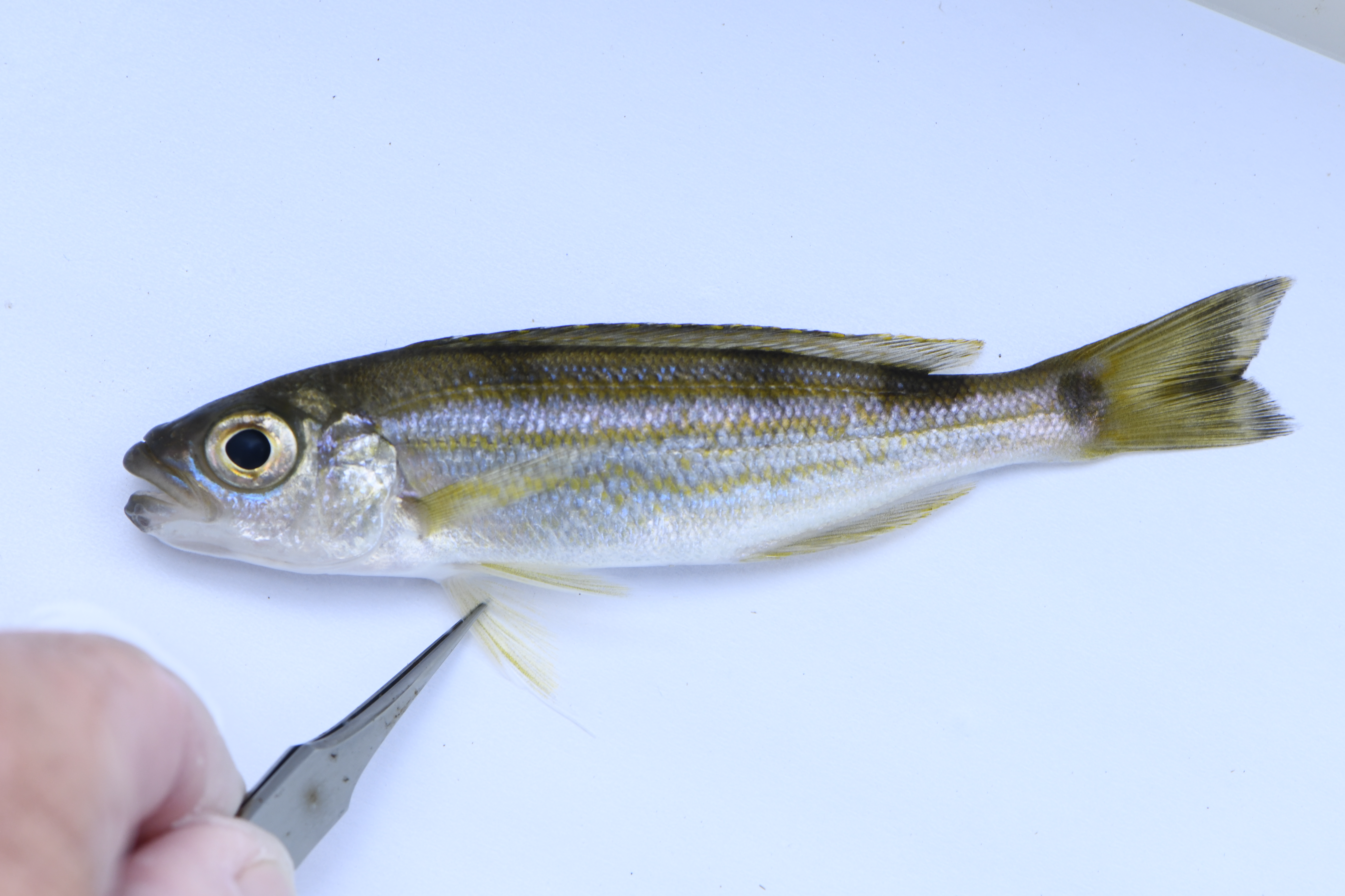

Taxonomy & naming
Max Poll described this fish in 1949 from specimens taken at the extreme northern tip of Lake Tanganyika, between Usumbura (modern Bujumbura) and the mouth of the Ruzizi River, during the Belgian Hydrobiological Mission of 1946–1947. The genus name Plecodus comes from the Greek plekein ("to fold") and odous ("tooth"), a nod to the strange, folded, blade-like dentition that defines the scale-eaters. The species epithet honors Captain Elavia Nairman, who commanded the steamer Baron Dhanis that carried Poll's expedition across the lake.
Nomenclature here is genuinely unsettled, and it is worth being precise about it. The fish entered the literature and the hobby as Plecodus elaviae, and FishBase still lists it that way. But Eschmeyer's Catalog of Fishes — the standard authority for fish names — currently treats it as valid under Perissodus elaviae (Poll 1949), following Ad Konings' 2015 and 2019 treatments, which sink Plecodus into the older genus Perissodus. Both names point to the same fish; we lead with the long-used Plecodus elaviae and flag Perissodus elaviae as the name a taxonomist is increasingly likely to use. Either way it belongs to the tribe Perissodini, a tight cluster of roughly nine species (the genera Perissodus and Plecodus) that together represent one of the most peculiar feeding guilds in all of cichlid evolution.
Appearance
P. elaviae is a moderately elongate, laterally compressed cichlid reaching about 13 in (32 cm) total length, which makes it the giant of the scale-eating tribe — most of its relatives top out well under 8 in (20 cm). Live and market specimens are a fairly plain silvery-grey, sometimes with a faint pattern of darker bars or a dusky overlay, the kind of muted, countershaded coloration you expect from an open-water fish that needs to be inconspicuous as it stalks prey rather than a gaudy rock-dweller advertising a territory.
The diagnostic feature is in the mouth. Like all Perissodini, it carries specialized, outward-tilted, blade- or hook-shaped teeth set in a jaw built to rasp scales off a living flank — not to crush snails or graze algae. Many scale-eaters also show a subtle but real asymmetry of the head, twisted slightly left or right, an adaptation tied to which side of the prey they prefer to attack. That left/right "handedness" has been studied most closely in the congener Perissodus microlepis; the degree to which P. elaviae shows it is less well documented, so it is best described as a tribe-wide tendency rather than a confirmed trademark of this particular species.
Range & habitat
The species is endemic to Lake Tanganyika — the world's second-deepest and second-oldest lake, shared by Burundi, the Democratic Republic of the Congo, Tanzania, and Zambia — and is found nowhere else on Earth. Records and market specimens span much of the lake's length, from the far northern type locality to the southern Zambian end around Mpulungu, where it turns up in commercial catches.
Unlike the many Tanganyikan cichlids glued to a particular rock face, P. elaviae is a demersal, schooling fish of more open water. FishBase classes it as demersal across the lake's tropical 3°S–9°S band; in practice the scale-eaters patrol over and along the bottom and into the water column, shadowing shoals of other fish rather than holding a reef territory. The lake itself sets the physical envelope: warm surface water around 75–82°F (24–28°C), hard and alkaline (pH roughly 8.6–9.2), and famously oxygen-stratified, with a permanently anoxic deep below a few hundred feet. A mobile, prey-following predator like this one is therefore confined, like everything else, to the oxygenated upper layer where its prey live.
Ecology & diet
This is the fish's whole story: it is a lepidophage, an obligate eater of fish scales. Adults rasp scales from the bodies of other living fish, swallowing them whole; FishBase places it at a trophic level of about 4.4, firmly predatory. The behavior was first documented in the Perissodini by Marlier and Leleup in 1954 in a paper memorably titled "A Curious Ecological 'Niche' among the Fishes of Lake Tanganyika," who found their captive scale-eaters would refuse earthworms, fish powder, and insects, accepting nothing but the scales of live fish.
The mechanics are a small marvel of natural selection. A scale-eater typically approaches a target fish from behind and to one side, striking the flank and tearing off a mouthful of scales before the victim can react — scales being a renewable resource, the prey usually survives. The classic work of Michio Hori (published in Science in 1993) on Perissodus microlepis showed that the population maintains roughly equal numbers of left- and right-mouthed individuals through negative frequency-dependent selection: whichever "handedness" is rarer enjoys better hunting success because prey are less guarded against it, so the ratio oscillates around fifty-fifty over time. That landmark study used a congener, not P. elaviae directly, but it illuminates the evolutionary logic of the guild this species belongs to. As the largest member of that guild, P. elaviae can presumably take scales from larger prey than its smaller relatives, a plausible route by which the tribe partitions its bizarre niche.
Behavior & breeding
P. elaviae forms schools, a habit that fits a mobile predator working open water and the edges of prey shoals rather than defending a fixed patch of substrate. Schooling may also help with the hunt itself — a loose group of scale-eaters mixing left- and right-mouthed individuals keeps prey unable to predict which side the next strike will come from.
Reproductively, the scale-eaters break from the maternal-mouthbrooding pattern that dominates Lake Tanganyika and Lake Malawi. P. elaviae is reported to be a bi-parental mouthbrooder: both the male and the female carry and guard the developing young, a comparatively rare and labor-intensive strategy among African cichlids. Beyond that broad outline, finely detailed field accounts of its spawning — clutch size, pair-bond duration, brood-care timeline — are thin in the accessible literature, and we would rather say that plainly than dress up guesses. What is clear is the combination: a schooling, open-water scale specialist that nonetheless invests in shared parental care of its brood.
In the aquarium
Be honest with yourself before chasing this one: P. elaviae is a specialist's specialist and effectively never appears in the general trade. The scale-eaters that do reach hobbyists are usually the smaller, showier Plecodus straeleni or the much-studied Perissodus microlepis, and even those carry a giant asterisk — feeding. An obligate scale-eater does not switch happily to flake and pellets. Keepers of the smaller species report that captive specimens can sometimes be coaxed onto frozen and prepared foods over time, but many continue to harass tankmates for scales, and a fish that bites chunks out of its neighbors is a poor community citizen. For P. elaviae specifically, reliable husbandry accounts are scarce; treat any "easy to keep" claim with deep suspicion.
If one were ever kept properly, the requirements would be substantial: this is a fish that can reach about 13 in (32 cm) and schools, so realistically a very large tank measured in hundreds of gallons, with hard, alkaline Tanganyikan water (pH around 8.5–9.0, high mineral hardness) and strong filtration. Tankmates are the central problem rather than an afterthought — anything housed with a scale-eater is, by definition, on the menu for its scales. This is not a beginner fish, not a community fish, and not a fish to buy on impulse; it is one to admire in the lake and in the literature.
Conservation
P. elaviae has no specific trade or fishery pressure of its own: it is not a food fish of any importance, not a collection target, and FishBase rates its fishing vulnerability as low. It falls under the recent IUCN reassessment of Lake Tanganyika's endemic fishes, and like the great majority of the lake's non-commercial endemic cichlids that are not narrow-range rock specialists, it is best understood as a wide-ranging, lower-concern species rather than a threatened one. We flag it that way honestly: the species itself appears secure, even as the lake around it is under real strain.
That lake-level strain is the part worth taking seriously. Lake Tanganyika is warming, and that warming has biological teeth. O'Reilly et al. (2003, Nature; DOI 10.1038/nature01833) linked rising temperatures to stronger stratification and weaker vertical mixing, estimating a roughly 20% decline in primary productivity over the latter twentieth century with knock-on losses of around 30% in fish yields. Cohen et al. (2016, PNAS; DOI 10.1073/pnas.1603237113) found that warming has already cost the lake on the order of 38% of its oxygenated benthic habitat, squeezing the livable zone for bottom-associated fish upward. Add the sedimentation and nutrient loading that degrade the rocky littoral where so many cichlids feed and spawn (Cohen et al. 1993), and the commercial pelagic fishery — the clupeids Stolothrissa tanganicae and Limnothrissa miodon plus their Lates predators, feeding four nations — and you have a basin under cumulative pressure, managed jointly through the four-country Lake Tanganyika Authority.
For a scale-eater, these pressures bite indirectly but unavoidably: P. elaviae is a parasite on the rest of the fish community, so its fate is tethered to the prey shoals it shadows. A thinner, more compressed, more variable fish community — fewer scales to eat, in a shrinking oxygenated layer — is a quieter long-term threat than a net or a bulldozer, but it is the kind of threat this particular fish cannot escape. Least concern as a species; far from carefree as a member of this lake.
Sources
- Eschmeyer's Catalog of Fishes — Plecodus elaviae (valid as Perissodus elaviae)
- FishBase — Plecodus elaviae summary
- GBIF — Plecodus elaviae occurrence search
- tanganyika.si — Perissodus elaviae / Plecodus elaviae (images & localities)
- Evolution of feeding specialisation in Tanganyikan scale-eating cichlids (Perissodini phylogeny)
- Evolutionary history of Lake Tanganyika's scale-eating cichlid fishes (Mol. Phylogenet. Evol.)
- MIT Press Reader — Lessons From Lake Tanganyika's Scale Eating Fish (Hori frequency-dependence)
- Practical Fishkeeping — Tanganyikan scale-eating cichlids studied
- The Cichlid Stage — The scale eating cichlid
- FishBase — Plecodus straeleni (congener scale-eater, comparison)
- Cichlid-Forum.com — community discussions (scale-eater keeping, anecdotal) — community/anecdotal
- O'Reilly et al. 2003, Nature — Climate change decreases aquatic ecosystem productivity of Lake Tanganyika
- Cohen et al. 2016, PNAS — Climate warming reduces fish production and benthic habitat in Lake Tanganyika
- IUCN Red List — Lake Tanganyika freshwater fish reassessment context
- FAO — Pelagic fishery of Lake Tanganyika (clupeids & Lates context)
- Landscape Genomics — Lake Tanganyika sardines (Stolothrissa, Limnothrissa)