

Taxonomy & naming
The species was described by the British ichthyologist Ethelwynn Trewavas in 1935 as Haplochromis fenestratus, in her landmark "A Synopsis of the Cichlid Fishes of Lake Nyasa" (Annals and Magazine of Natural History). The type material was collected at Chilumba toward the northern end of the lake; a lectotype (BMNH 1935.6.14.679) was later designated by Eccles and Trewavas in their 1989 reclassification of the Malawian haplochromine genera. That 1989 work is what moved the fish into Protomelas, where Eschmeyer's Catalog of Fishes and FishBase both keep it today as the valid Protomelas fenestratus (Trewavas, 1935).
The genus name combines the Greek protos ("first") and melas ("black"), a nod to the dark markings that run through the group. The species epithet fenestratus means "windowed" or "latticed" — a fitting reference to the grid of crossing stripes that defines the fish. Protomelas is a modest genus of about fifteen described species, all of them endemic to Lake Malawi, its catchment, and the upper Shire River that drains it. P. fenestratus sits among the non-mbuna haplochromines — the open-water and sand-associated radiation, distinct from the rock-grazing mbuna that get most of the attention. In the trade it has long been muddled with the "steveni" complex and is sold as "Haplochromis Steveni Thick Bars" or under the "Steveni Taiwan / Taiwan Reef" labels, names that lump together several distinct fish and have fed a steady supply of hybrids.
Appearance
P. fenestratus is a compressed, fusiform cichlid of moderate size. FishBase lists a maximum of about 5.5 in (14 cm) total length, while the IUCN assessment cites 7 in (18 cm); the truth likely sits between, with wild fish smaller than well-fed aquarium specimens, so reports of maximum size genuinely vary. The fin counts are typical of the genus: roughly 15–16 dorsal spines over 10–11 soft rays, three anal spines, and 31 vertebrae.
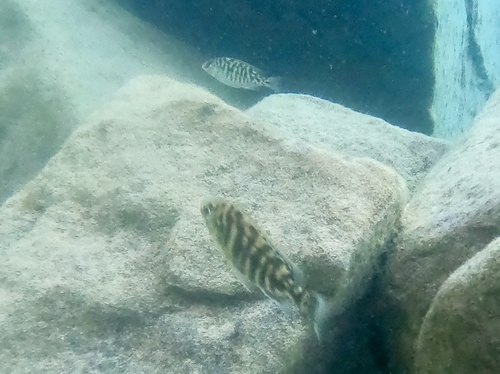
The defining feature is the pattern the name promises — a strongly marked grid of horizontal and vertical black stripes that breaks the flanks into a window-like lattice, more boldly expressed than in the otherwise similar P. taeniolatus. Dominant males overlay this with metallic blue on the head and body and warm yellow or orange in the fins, the usual haplochromine sexual dimorphism: females and subordinate males stay a plainer silvery brown with the barring showing through. Beyond color, Trewavas and later workers separated it from look-alikes on hard anatomy — it carries fewer but larger teeth in the outer row of the upper jaw, fleshier lips that partly hide the rear teeth, and fewer, lower, blunter gill rakers than P. taeniolatus, and it lacks the enlarged inner pharyngeal teeth seen in P. virgatus.
Range & habitat
The fish is endemic to Lake Malawi. The IUCN assessment describes a lake-wide distribution spanning the Malawian, Mozambican, and Tanzanian shores, with an estimated area of occupancy near 470 sq mi (1,220 km²) inside a far larger extent of occurrence; FishBase frames it more narrowly around the northern end and the south-west arm. Whichever framing one prefers, this is a shallow, near-shore cichlid tied to a specific biotope: the interface where rocky reef meets open sand, particularly where the rocks wear a layer of fine sediment and biocover.
That intermediate habitat is more than a footnote — it shapes the species' biology. A 2004 microsatellite study by Pereyra and colleagues (Molecular Ecology) compared population structure across three Protomelas with different habitat ties: the strictly rock-bound P. taeniolatus, the sand-and-weed P. similis, and P. fenestratus at the rock–sand seam. P. fenestratus showed intermediate genetic structuring — more connected than the rock specialist, less freely mixing than the sand dweller — evidence that it crosses stretches of open bottom more readily than a true reef obligate but still treats long sand or deep-water gaps as partial barriers. Lake Malawi is alkaline and hard, and this species sits comfortably in the lake's near-shore chemistry, with FishBase noting a pH around 8 and water temperatures in the low-to-mid 70s F (about 22–26 °C).
Ecology & diet
P. fenestratus is a benthic invertebrate-picker with a distinctive feeding method. Rather than rasping algae off rock like the mbuna, it works the sediment that settles on and between the stones, blowing jets of water to lift the loose material and then picking out the prey it exposes — chiefly insect larvae and small crustaceans sheltering in the biocover and detritus. The behavior is well enough established that both FishBase and the IUCN assessment describe it the same way, and Konings documented it in the field.
This puts the fish in the modest-carnivore guild rather than among the algae specialists or open-water plankton feeders; FishBase estimates a trophic level of about 3.2. Functionally it occupies the productive but cluttered transition zone of the littoral, turning over sediment and recycling the small invertebrate fauna that accumulates where current drops sediment against the rocks. It is not itself a major fishery target — FishBase rates its fishing vulnerability as low — though, like most Malawi haplochromines, it forms part of the artisanal near-shore catch.
Behavior & breeding
Like nearly all of Lake Malawi's haplochromines, P. fenestratus is a maternal (female) mouthbrooder, and its breeding follows the lek-like script of the group. Territorial males stake out and defend a patch of substrate, building a shallow nest among small stones and rocks. A receptive female enters, the pair spawns, and she takes the eggs into her mouth almost immediately, fertilizing them there as the male displays. She then carries and incubates the developing young for roughly three weeks before releasing free-swimming fry — and, per the IUCN account, continues to guard them for a time after release, a degree of post-release care that is not universal in the group.
Males color up hardest when holding territory, and the species' generation length is short — the IUCN puts it at one to two years — which underlies FishBase's "high resilience" rating. In keeping experience, the species reads as moderately aggressive rather than a tyrant: forum reports across the broader Protomelas complex consistently describe the larger members (P. taeniolatus, P. spilonotus) as the genuine bruisers, with the fenestratus-grade "Taiwan/Steveni" fish closer to the middle of the pack — territorial when spawning, but not the fish that empties a tank.
In the aquarium
This is a Lake Malawi "hap" for a roomy tank, not a starter community fish. A male will hold a territory and pester rivals, and because the species reaches well over the 6 in (15 cm) mark, experienced keepers point at a four-foot tank as a realistic floor and a six-foot tank as where it actually relaxes — forum threads are full of people discovering that a 4-ft, ~75-gallon setup is workable only for the smaller, calmer Protomelas and quickly overcrowded once several large, similar-looking males are added. The water should match the lake: hard, alkaline (pH around 8), and warm. As a sediment-sifter it appreciates a sand bed it can work, with rockwork to break sightlines and define territories.
The honest pitfalls here are two. First, identity: this fish swims in the trade under "Haplochromis Steveni Thick Bars," "Steveni Taiwan," and "Taiwan Reef," labels that cover several distinct species and a great many hybrids — keepers regularly report buying "Taiwan Reef" stock that turns out crossed, betrayed by off coloration like a stray yellow anal fin. If accurate identity or breeding matters to you, buy from someone who can name a collection point. Second, the all-male-tank temptation: mixing several Protomelas (and similarly patterned peacocks and haps) in one display is doable only with space and a willingness to rehome, because look-alike males target each other and aggression escalates as they mature. Females held together breed readily; the species is not difficult to spawn, only to house well.
Conservation
The IUCN Red List assessed P. fenestratus as Least Concern (assessment dated 20 June 2018, by Konings and Kazembe; an errata version followed in 2019), reaffirming an earlier Least Concern listing from 2006. The reasoning is straightforward: it is endemic to Lake Malawi but widespread and common across it, with no major species-specific threats. The one pressure singled out is the aquarium trade, which "regularly" collects it — under the "Haplochromis Steveni Thick Bars" name — though at a level the assessors judged sustainable for a common, lake-wide fish. Its population trend is listed as unknown.
That clean bill of health belongs to the species, not to the lake it depends on, and the distinction matters. The basin-scale review by Chavula and colleagues (Journal of Great Lakes Research, 2023) documents a strained system: heavy and rising fishing pressure, with catches of the larger species such as the chambo tilapia in long decline; increased sediment and nutrient loading washing off deforested catchments; warming of roughly 0.7 °C in the shallow water that strengthens stratification, slows mixing, and tends to cut productivity; and the looming risk from introduced species. Each of those bears on a near-shore, sediment-feeding fish in a specific way. P. fenestratus lives exactly where eroded sediment and nutrients first reach the lake, so the catchment-driven loading that smothers its rock–sand habitat is the threat to watch even though its own trophic style depends on a sediment layer; warming that reduces near-shore productivity erodes the invertebrate base it picks at; and as a fish of a narrow shoreline band it has nowhere to retreat as the littoral changes. The fair summary is the one the data support: the species itself is not currently of conservation concern, but it lives in a lake that is, and its security rests on the health of a shoreline under growing human pressure.
Sources
- Eschmeyer's Catalog of Fishes — Protomelas fenestratus (Trewavas, 1935)
- FishBase — Protomelas fenestratus (Fenestratus)
- GBIF — Protomelas fenestratus (Trewavas, 1935)
- Pereyra, Taylor, Turner & Rico (2004), Variation in habitat preference and population structure among three species of the Lake Malawi cichlid genus Protomelas, Molecular Ecology 13:2691–2697
- Trewavas (1935), A Synopsis of the Cichlid Fishes of Lake Nyasa, Annals and Magazine of Natural History (10)16:65–118 (via Cichlid Room Companion reference archive)
- Cichlid Room Companion — Protomelas fenestratus species profile (curated by Ad Konings)
- IUCN Red List — Protomelas fenestratus (Konings & Kazembe 2018, errata 2019), Least Concern
- Chavula et al. (2023), Lake Malawi/Niassa/Nyasa basin: Status, challenges, and research needs, Journal of Great Lakes Research 49(6):102241
- Impact of Land Use on Sediment and Nutrient Yields to Lake Malawi/Nyasa (ResearchGate)
- JRS Biodiversity — Red List Assessment of Lake Malawi Finds Fish Species Threatened by Overfishing
- Cichlid-Forum.com — "Mixing Protomelas?" (Lake Malawi Species board; keeper experience on size, aggression, all-male tanks, Taiwan Reef hybrids) — community/anecdotal
- Cichlid Room Companion forum — "Protomelas fenestratus which reef?" (public thread) — community/anecdotal
- Goliad Farms — Breeding African Cichlid Mouthbrooders (maternal mouthbrooding, male breeding territories)
- Aquarium Co-op forum — managing African cichlid aggression (stocking density and all-male tanks) — community/anecdotal