
Taxonomy & naming
Albert Günther described this fish in 1894 as Chromis kirkii, working from specimens that H. H. Johnston sent back from what was then Lake Nyasa and the upper Shire River. The lectotype (BMNH 1893.11.15.7) was later fixed by Eccles and Trewavas in their 1989 monograph on the Malawi haplochromines, the same work that erected the genus Protomelas and moved the species into it. Eschmeyer's Catalog of Fishes carries it today as the valid Protomelas kirkii (Günther 1894), with a trail of historical combinations behind it — Ctenochromis, Cyrtocara, Haplochromis and Tilapia kirkii all appear in the older literature.
The genus name blends the Greek protos, "the first," with melas, "black"; the species honours Sir John Kirk (1832–1922), the Scottish physician and naturalist who accompanied David Livingstone on the Zambezi expedition. Within Protomelas, kirkii sits in an informal cluster Malawians call the Kambuzi — small, sand-dwelling, snail-eating species that grade into one another. Pinning down which Kambuzi you are looking at is a genuine taxonomic headache, and several names in the group remain provisional.
Appearance
This is a medium-sized haplochromine. FishBase gives a maximum of about 7 in (18 cm) total length for males; females stay smaller, commonly cited around 5.5 in (14 cm), and field observers at Mbamba Bay put adult males nearer 6.5 in (16 cm). Fin counts run to 14–16 dorsal spines with 9–11 soft rays, three anal spines with 8–10 rays, and 30 vertebrae.
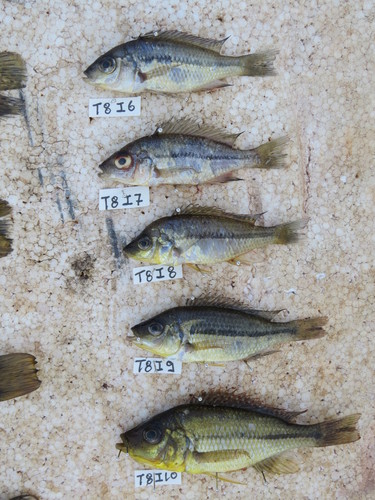
Colour is strongly sex-linked, as it is across the Malawi flock. A breeding male flushes blue to turquoise, often with red-edged scales behind the head and red flecking in the dorsal and caudal fins; his anal fin carries the yellow-orange egg-spots typical of mouthbrooders. Females and non-territorial males are a muted silver-brown crossed by a dark lateral band that is broken into two segments — a useful field mark, since the band fades almost to nothing on a dominant male. Faint vertical bars show on juveniles and females.
Telling kirkii from its Kambuzi relatives comes down to hardware in the throat and the shape of the face. FishBase notes it differs from P. marginatus and P. similis in having a group of enlarged pharyngeal teeth, and from P. labridens in its straight snout profile and larger mouth, the lower jaw running a third or more of the head length. P. similis, by contrast, shows an unbroken lateral stripe.
Range & habitat
Protomelas kirkii is endemic to the Lake Malawi basin, but the exact footprint depends on which source you trust. FishBase restricts it to the south-east arm of the lake and the upper Shire River. Hobby and field references — including the Slovenian survey site malawi.si and the Dutch reference AquaInfo — describe a wider range around the lake's shores, extending into Lake Malombe and down the Shire River to the Kapachira Falls. The conservative reading is that it is firmly documented in the southern lake and its outflow; reports of a lake-wide distribution may fold in similar Kambuzi forms.
Whatever the precise limits, the biotope is consistent: very shallow, sheltered, vegetated water over sand. Adults are typically seen in roughly 3–16 ft (1–5 m), often around patches of the eelgrass Vallisneria in calm bays, with breeding taking place in the shallowest reaches. This is soft-bottom, weed-edge habitat — not the wave-washed rocky shore of the mbuna — which places kirkii squarely among the sand-and-vegetation cichlids of the lake. Like all of Malawi's fish it lives in hard, alkaline water, with a pH around 7.7–8.6 and stable warm temperatures.
Ecology & diet
Kirkii is a benthic invertebrate-feeder with a particular taste for snails. FishBase records it picking small invertebrates from the inshore shallows, including the tiny operculate gastropod Gabbiella stanleyi, a snail only a few millimetres across that lives among the Vallisneria. Field accounts add that it grazes the aufwuchs — the film of algae, detritus and small animals — coating submerged roots and tree trunks, taking the snails and other invertebrates embedded in it. Its trophic level is estimated at about 3.4, placing it as a low-order carnivore rather than a pure algae-grazer.
Those enlarged pharyngeal teeth are the ecological key. A throat armed with crushing dentition lets the fish process hard-shelled prey that softer-mouthed congeners cannot exploit, a textbook example of the fine-grained trophic partitioning that lets dozens of related cichlids share one lakeshore. In the wider community it occupies the shallow sand-and-weed guild, neither a deep-water plankton-picker nor a rock-scraper.
Behavior & breeding
Like the overwhelming majority of Malawi haplochromines, P. kirkii is a polygamous maternal mouthbrooder with no pair bond. Males are seasonally territorial — field notes from the lake report breeding concentrated around July to September, when territorial males gather in loose colonies and clear small bowers, or sandcastles, in roughly 6 ft (2 m) of water. A male courts by flaring his fins, intensifying his blue-green colour and quivering to draw a female onto his cleared patch.
Spawning follows the classic egg-spot routine: the female lays a clutch on the sand and immediately takes the eggs into her mouth, snapping at the dummy egg-spots on the male's anal fin and drawing in his milt to fertilise the brood she already holds. She then leaves to brood alone, joining loose schools of other holding females. Incubation runs on the order of three weeks, during which she does not feed; she releases free-swimming fry into the sheltered shallows, where the Vallisneria gives them cover. The males contribute nothing beyond the territory and the genes.
In the aquarium
Kirkii reaches the trade as a wild import and as farm-raised stock, sometimes under names like "green similis." It is a reasonable haplochromine for an experienced Malawi keeper but not a small-tank fish. With males approaching 7 in (18 cm) and turning sharply territorial when in colour, the practical baseline is a tank around 6 ft (180 cm) long, set up Malawi-style: a sand substrate it can sift, some rockwork for broken sightlines, and ideally room for the Vallisneria-edged shallows it favours in the wild.
The consistent advice across hobby sources is one male to a tank, kept with a harem of two or more females so his attention is spread and no single female is harassed to exhaustion; two males will fight until one is left. Aggression is otherwise described as moderate and directed mainly at conspecifics and very similar species, so it tends to leave dissimilar tankmates alone. Hard, alkaline water suits it — roughly pH 7.5–8.5 and 72–79°F (22–26°C) — with regular water changes. It is an unfussy eater that takes prepared foods readily, but lean toward an invertebrate-based diet over algae wafers given its snail-crushing natural ecology; like other Malawi cichlids it should not be overfed protein-poor or excessively fatty foods. The recurring mistake keepers make is treating any Kambuzi-group Protomelas as interchangeable, then crossing visually similar species — a real risk to maintaining clean lines of a fish that is hard to identify in the first place.
Conservation
The IUCN Red List assessed Protomelas kirkii as Least Concern on 20 June 2018, reflecting a relatively wide distribution in the southern lake and outflow and no evidence of a species-specific decline. It carries some commercial value — taken in artisanal fisheries and traded for the aquarium hobby — but neither appears to be pushing the population toward threat. So at the species level the honest statement is simply that it looks secure.
That security sits inside a lake under mounting strain. The basin review by Chavula and colleagues (Journal of Great Lakes Research 49(6):102241, 2023; DOI 10.1016/j.jglr.2023.102241) catalogues the pressures on Lake Malawi/Niassa/Nyasa: heavy over-fishing, headlined by the collapse of the prized chambo (Oreochromis) fishery; sediment and nutrient loading washing off deforested catchments; roughly +0.7°C of warming in the shallow water, which strengthens stratification and cuts the mixing that drives productivity; and the looming risk of introduced species. For a shallow, inshore, sand-and-weed fish like kirkii, the most direct of these is what happens at the shoreline — sedimentation and nutrient runoff that smother vegetated bays and degrade exactly the Vallisneria habitat it breeds and feeds in, plus the indiscriminate inshore netting that takes small haplochromines as bycatch. None of that has yet moved its Red List status, and it should not be overstated: a Least Concern fish is not an endangered one. But "Least Concern" describes the species, not the lake, and the trajectory of the shallows is the variable worth watching.
Sources
- Eschmeyer's Catalog of Fishes — Protomelas kirkii (Günther 1894)
- FishBase — Protomelas kirkii (Günther, 1894)
- GBIF — Protomelas kirkii occurrence and taxonomy
- IUCN Red List — Protomelas kirkii (Least Concern, 2018)
- Günther, A. (1894). Second report on the reptiles, batrachians, and fishes transmitted by Mr. H. H. Johnston from British Central Africa. Proc. Zool. Soc. London (original description as Chromis kirkii)
- Chavula, G.M.S. et al. (2023). Lake Malawi/Niassa/Nyasa basin: Status, challenges, and research needs. J. Great Lakes Research 49(6):102241
- malawi.si — Protomelas kirkii 'Mbamba Bay' (biotope, breeding, Kambuzi group)
- AquaInfo — Protomelas kirkii (care, identification, Kambuzi group)
- Cichlid Room Companion — Protomelas genus profile (Eccles & Trewavas, 1989)
- Cichlid Fish Forum (cichlid-forum.com) — Protomelas breeding practices thread (community/anecdotal) — community/anecdotal
- Capital Cichlids forum — stocking African haplochromines, large tanks (community/anecdotal) — community/anecdotal