
Taxonomy & naming
Charles Tate Regan described this fish in 1922 as Haplochromis similis, in his landmark account "The Cichlid Fishes of Lake Nyassa" (Proceedings of the Zoological Society of London). The type material came from Domira Bay on the lake's western shore; a lectotype (BMNH 1921.9.6.118) was later fixed by Eccles and Trewavas in their 1989 revision of the Malawian haplochromine genera, which is also where the species was moved into the genus Protomelas. Eschmeyer's Catalog of Fishes treats Protomelas similis (Regan, 1922) as the valid name, with Cyrtocara similis as a now-disused recombination.
The genus name Protomelas blends the Greek protos ("first") and melas ("black"); the species epithet similis simply means "similar," a nod to how easily Regan's contemporaries confused it with other plain, striped lake haplochromines. Protomelas is a genus of roughly two dozen Malawi endemics spanning very different lifestyles — from the open-water utaka-like plankton feeders to leaf-biters like this one — and the group is still being worked on, with new members such as the paedophagous P. krampus described as recently as 2022. In the trade and older literature the fish is often still labeled by its original combination, "Haplochromis similis."
Appearance
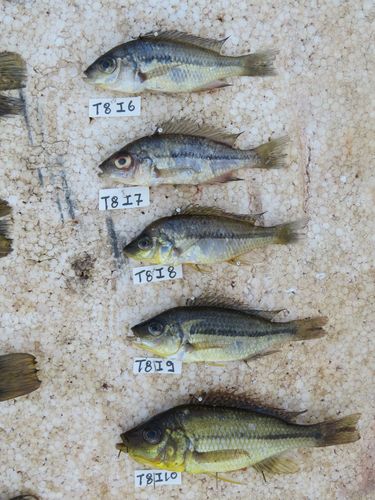
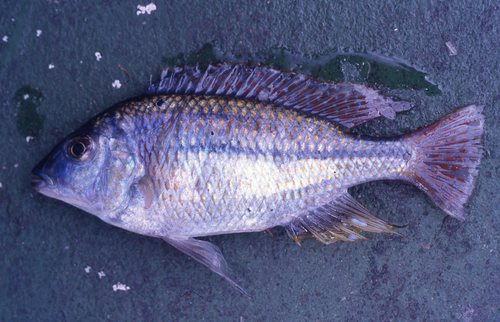
This is a fusiform, laterally compressed cichlid of fairly ordinary build, reaching about 6.5 in (17 cm) in total length; FishBase lists a maximum of 18 cm. The defining mark is one — sometimes two — dark horizontal stripes running along an otherwise silvery body, a restrained pattern compared with the electric blues and yellows of better-known Malawi haps. Fin counts run to 16 to 17 dorsal spines with 9 to 11 soft rays, three anal spines, and 31 vertebrae.
The most reliable diagnostic feature is internal: the lower pharyngeal bone (the throat tooth-plate) is somewhat inflated toward the rear and carries numerous small bicuspid teeth, a structure tied to its plant-grazing habits. Externally it is separated from look-alike congeners by proportion — a relatively larger mouth than P. labridens or P. pleurotaenia, and a shorter snout and shallower body than P. kirkii. Sexual dimorphism is muted. Breeding males darken and intensify, while freshly caught females are recognizable by yellow pelvic fins; outside of breeding condition the sexes look much alike, which is part of why the fish reads as understated rather than ornamental.
Range & habitat
Protomelas similis is endemic to the Lake Malawi system, occurring throughout the lake proper and in downstream Lake Malombe; the IUCN assessment lists it as extant in Malawi, Mozambique, and Tanzania, the three nations that share the lake's shoreline. No geographic races or local color forms are recognized, which is unusual for a Malawi cichlid and points to a fish that disperses readily across the lake's varied shores.
Its biotope is the seam between habitats rather than open rock or open sand: shallow, vegetated zones near rocks, or the transitions where weed beds meet rocky margins and isolated boulders. It is strongly associated with beds of the eelgrass-like macrophyte Vallisennia, where it both feeds and shelters. In situ the upper, sunlit water it occupies sits around 24 to 26 degrees C (75 to 79 degrees F) — warm, alkaline, hard, mineral-rich water typical of the great rift lake. Because it is a creature of shallow vegetated shallows rather than the deep rocky reefs, its fortunes are tied to the inshore weed beds that line the lake's gentler shores.
Ecology & diet
This is a herbivore, and a fairly specialized one. It forages within plant beds and bites pieces from the leaves of higher plants to get at the algae and biofilm growing firmly attached to them, frequently swallowing fragments of leaf along with the meal. Its sharp, closely packed outer teeth are built for plucking material from vegetation, and the inflated, fine-toothed pharyngeal mill behind them grinds the plant matter down. FishBase places it at a trophic level of about 2.0 — squarely a primary consumer.
That puts P. similis in a different feeding guild from the great mass of Malawi cichlids that scrape aufwuchs off bare rock (the mbuna) or hunt invertebrates and other fish in the open. By exploiting the algal turf on living macrophyte leaves, it taps a food source most of the lake's species ignore, which helps explain how a plainly colored fish holds its own in one of the most crowded fish faunas on Earth. As a small-bodied weed grazer it is itself prey for the lake's larger predatory haplochromines and piscivores.
Behavior & breeding
Like the rest of Lake Malawi's haplochromine radiation, Protomelas similis is a maternal mouthbrooder: after spawning, the female takes the fertilized eggs into her mouth and broods them there, and develops them through to free-swimming fry without a substrate nest. During the breeding season males turn territorial and defend a spawning arena — a small cleared circle, roughly 8 to 16 in (20 to 40 cm) across, scraped down to the sand within a Vallisennia bed, sometimes built up with sand into a slight slanted cone. In some southern localities males instead establish sites on open sand. Brooding females retreat into the surrounding weed, where the dense foliage hides them and their fry.
The fish's signature behavior is caution. Reports from divers and the natural-history literature describe it as a secretive, watchful animal that keeps close to cover and dives into the weeds when alarmed rather than facing down an intruder. That wariness in the wild flips to persistent aggression in confinement: males are described as almost permanently territorial and react sharply to similarly colored or similarly shaped fish, which is the central fact to plan around for anyone keeping it.
In the aquarium
Protomelas similis turns up only irregularly in the hobby and is far from a household name, but the keeping picture that emerges from hobbyist accounts is consistent. It needs hard, alkaline Rift-lake water (high pH and mineral content) and warmth around the mid-70s F, plus the footprint to absorb a territorial male — keepers of Malawi haps converge on a six-foot tank as the realistic baseline for housing this kind of fish with appropriate company. The single most repeated piece of advice is not to keep more than one male: they are nearly always territorial in a tank and respond aggressively to rivals and to similar-looking species, so two Protomelas of any sort in the same tank is asking for trouble.
The usual Malawi-community tactics apply: stock the tank well to spread aggression rather than letting one fish fixate on a single target, give it line-of-sight breaks, and avoid pairing it with peacocks or other haps that share its silvery, striped look. Diet should lean herbivorous, matching its wild plant-grazing — a vegetable-based prepared food rather than a protein-heavy one. None of this makes it a beginner fish, but it is also not a notorious bruiser; treated as a one-male, well-spaced Malawi hap, it is a manageable and genuinely interesting weed-bed specialist rather than a showpiece.
Conservation
The IUCN Red List assesses Protomelas similis as Least Concern (assessed 20 June 2018 by Konings and Kazembe; an amended version was published in 2019 to add point-locality data). The justification is straightforward: it is widespread throughout lakes Malawi and Malombe with no major species-specific threats identified, and its population trend is simply unknown. The only direct pressure noted is the aquarium trade, which collects it irregularly under the old name "Haplochromis similis" — a minor draw, not a population-level threat. So the honest headline is reassuring for this particular fish.
That said, a Least Concern species can still live in a strained lake. The Lake Malawi/Niassa/Nyasa basin review by Chavula and colleagues (Journal of Great Lakes Research, 2023; DOI 10.1016/j.jglr.2023.102241) flags a convergent set of pressures on the system: over-fishing and a falling fishery (the collapse of the prized chambo, a Nyasalapia tilapia, being the emblem of it), heavy sediment and nutrient loading washing off deforested catchments, climate warming that strengthens the lake's stratification and trims the productivity feeding the food web, and the looming risk of invasive species. For P. similis the most direct link is habitat: as a fish of shallow, inshore weed beds, it is exposed to shoreline sedimentation and to the destruction of vegetated margins by beach-seine fishing. The Cichlid Room Companion's profile notes exactly this — that although beach seines have damaged its habitat, the species has so far kept finding refuge among the plants in intermediate zones. The reasonable read is that the fish itself is not currently in trouble, but its security rests on the health of the very inshore habitats the basin is steadily losing.
Sources
- Eschmeyer's Catalog of Fishes — Protomelas similis (Regan 1922)
- FishBase — Protomelas similis (Regan, 1922)
- ITIS — Protomelas similis report
- GBIF — Protomelas similis occurrence records
- Regan, C.T. 1922. The Cichlid Fishes of Lake Nyassa. Proc. Zool. Soc. London (original description; CRC reference)
- Protomelas krampus, a new paedophagous cichlid from Lake Malawi (European Journal of Taxonomy, 2022)
- Two new species of Mylochromis from Lake Malawi — context on Eccles & Trewavas (1989) haplochromine revision (PMC)
- Cichlid Room Companion — Protomelas similis species profile (Ad Konings; public conservation note)
- malawi.si — Protomelas similis 'Likoma Island' (biotope, diet, breeding, diagnostics; photo © Ad Konings)
- Konings, A. — Lake Malawi Cichlids in Their Natural Habitat (ResearchGate listing)
- IUCN Red List — Protomelas similis (Konings & Kazembe 2019, amended; Least Concern)
- Chavula et al. 2023 — Lake Malawi/Niassa/Nyasa basin: status, challenges, and research needs (J. Great Lakes Research 49(6):102241)
- Chavula et al. 2023 — basin review (ResearchGate copy)
- Cichlid Fish Forum (cichlid-forum.com) — Malawi hap stocking and tank-size discussion — community/anecdotal
- Cichlid Fish Forum — avoiding two Protomelas of the same genus in one tank — community/anecdotal
- ACE Forums (Australia) — peacock/hap community keeping P. similis — community/anecdotal
- African Cichlid Breeders group — Protomelas similis species/care notes (community, anecdotal) — community/anecdotal