
Taxonomy & naming
The species was described by Ethelwynn Trewavas in 1935 as Haplochromis spilonotus, in her synopsis of the cichlid fishes of Lake Nyasa (Annals and Magazine of Natural History). The type material was collected at Chilumba on the lake's northwestern shore; Eccles and Trewavas later designated a lectotype (held at the Natural History Museum, London) when they revised the Malawi haplochromines in 1989 and moved the species into the genus Protomelas. Catalog of Fishes and FishBase both treat Protomelas spilonotus (Trewavas, 1935) as the valid name. The genus name combines the Greek protos, "first," with melas, "black" — a nod to the ancestral, or plesiomorphic, dark markings that members of the genus carry.
This is a name worth getting right, because the aquarium world has tangled it badly. As Ad Konings has documented, true P. spilonotus is a single species spread across many sites — Chilumba and Ruarwe in the north, Mbenji Island and Eccles (Chimwalani) Reef in the south, Magunga Reef in Tanzania, and Lumessi in Mozambique — all of which he considers the same fish. Around and between those populations, however, sit very similar but distinct, still-undescribed forms that occupy the same niche: P. sp. "spilonotus tanzania" (south of the Ruhuhu River), P. sp. "spilonotus mozambique" (Undu Reef, Wikihi, Londo), and P. sp. "spilonotus likoma" (Likoma and Kande Islands). Much of the "spilonotus" chatter on forums — the bright-yellow "Liuli" included — actually concerns these undescribed relatives, not Trewavas's species. In the trade the true fish has long been mislabeled "Haplochromis ovatus," a name that belongs to a different cichlid entirely.
Appearance
Protomelas spilonotus is a fusiform, laterally compressed hap of modest size. Reports of maximum length disagree: FishBase gives 16.7 cm (about 6.6 in) total length, citing the CLOFFA checklist, while the IUCN assessment lists a maximum of 25 cm (about 9.8 in) TL — a wide enough gap that the honest answer is "somewhere in that range," with most aquarium and field specimens falling toward the smaller end. The fin counts are typical of the genus: about 17 dorsal spines with 10–11 soft rays, and three anal spines with 9–11 soft rays.
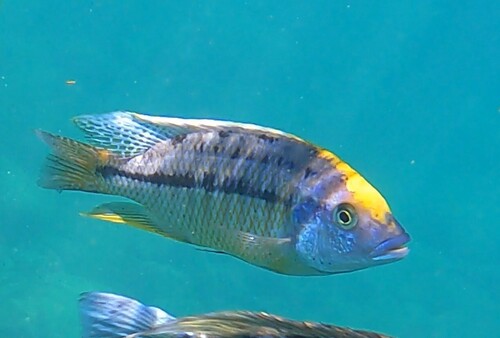
What sets it apart from its relatives is subtle and best appreciated by specialists. It retains the plesiomorphic (ancestral) melanin pattern shared by several Protomelas, but carries a higher gill-raker count (roughly 16–18) and shows a stronger emphasis on the dark blotches running along the back. It is separated from the similar P. marginatus by the more rearward position of the deepest part of the body. Sexual dimorphism follows the usual haplochromine script: dominant males develop bright coloration — yellow along the underside and lower flanks, sometimes a yellow cap or crest on the nape — while females and non-territorial males stay a comparatively plain silvery-grey marked with the dorsal blotches. Keepers of the related undescribed forms note that color intensity and body depth vary noticeably between collection points, which is exactly why the group is so easy to confuse.
Range & habitat
The species is endemic to Lake Malawi and, despite the muddle over its relatives, is genuinely widespread. The IUCN range description places it along nearly the entire western shore, from Chitande Island south to Monkey Bay (including the Mbenji and Maleri island groups), on the northeastern coast between Lupingu and Magunga in Tanzania, and down the eastern shore from south of Minos Reef in Mozambique to Chimwalani Reef in Malawi.
The habitat is specific and consistent. P. spilonotus favors sediment-free rocky coasts, particularly places where the rock drops away steeply into deeper water. Rather than hugging the rocks like a true mbuna, it holds in open midwater — typically about a meter off the substrate and often just below the surface — and is rarely found deeper than about 5 m (16 ft). In-situ temperatures in this shallow rocky zone sit around 24–26 °C (75–79 °F). That preference for clear, well-oxygenated, sediment-free water over rocky drop-offs is the single most important fact about where this fish lives, and it ties the species directly to the health of Malawi's near-shore rocky reefs.
Ecology & diet
Functionally, P. spilonotus is a midwater micropredator rather than a rock-scraper. It feeds on small invertebrates taken from the water column and on terrestrial insects that fall onto the surface — a foraging style that suits a fish hanging in open water off a steep reef rather than grazing the algal film on the rocks. FishBase places it at a trophic level of about 3.4, consistent with a mostly carnivorous, invertebrate-based diet.
Within Lake Malawi's enormous cichlid species flock, fishes like this one fill an important niche between the rock-bound mbuna and the open-water, sand-dwelling and pelagic haplochromines. The genus Protomelas spans a range of feeding modes across the lake, and P. spilonotus represents the water-column-feeding end of that spectrum on the rocky habitat. Its diet leaves it dependent on the productivity of the sunlit upper few meters of water, the same zone whose clarity and biological output are sensitive to sediment and nutrient inputs from the catchment.
Behavior & breeding
Like the great majority of Lake Malawi haplochromines, P. spilonotus is a maternal (ovophilous) mouthbrooder. The IUCN account notes that breeding males can be found throughout the year rather than in a single tight season; spawning takes place among the rocks, after which the female incubates the eggs and, once the fry are released, continues to guard them — a degree of post-release care that is not universal among the lake's mouthbrooders. Generation length is given as roughly two years.
In social terms the fish is territorial when breeding but, by the standards of large Malawi haps, comparatively restrained. Experienced keepers of the species and its close relatives consistently describe it as "laid-back" or "top dog without being a bully" — able to hold a dominant position in a community without the relentless aggression of, say, an over-stimulated Sciaenochromis fryeri. As always with cichlids, that is a tendency, not a guarantee: individual temperament varies, and a crowded or undersized tank will turn even a placid hap nasty.
In the aquarium
This is a fish for a large tank and a keeper who wants an active, open-water swimmer rather than a wall of color. The honest minimum is a six-foot tank — a 125 gallon (about 470 L) footprint or larger — because the species spends its time cruising midwater and genuinely uses the swimming room. In smaller tanks it both looks wrong and behaves worse. Water should be hard and alkaline with a stable, basic pH, matching the lake; temperatures in the mid-70s °F (around 24–26 °C) suit it. Aim for a group with a single dominant male and several females, or fold it into an all-male Malawi display where its relatively even temper is an asset.
The commonest mistakes are two. The first is identity: much of what is sold as "spilonotus" is actually one of the undescribed Tanzania/Mozambique/Likoma forms, so buyers chasing a specific look (the lemon-yellow "Liuli," for instance) should know they are usually not buying Trewavas's P. spilonotus at all, and should never cross these forms in breeding projects. The second is over-housing it with hyper-aggressive tankmates that exploit its mellower disposition. Sex it patiently — males color up and show their yellow only at a decent size — and buy a group of juveniles if you want a good shot at a quality male, since they are typically traded young and hard to sex small. It is not a difficult fish to keep; it simply needs space and accurate labeling.
Conservation
The IUCN Red List assesses Protomelas spilonotus as Least Concern (assessed 20 June 2018 by Konings and Kazembe; errata version 2019, carried in the 2025-2 Red List). The justification is straightforward: the species is endemic to Lake Malawi but widespread around its shores, with no known major widespread threats and an unknown but presumably stable population trend. The threats the assessors do flag are specific and local — sedimentation of near-shore rocky areas, and regular collection for the aquarium trade, where the fish is taken from numerous sites and often sold under the wrong name. For a species whose entire life is spent over shallow, sediment-free rock, that first threat is the one to watch.
That species-level reassurance has to be read against the strain on the lake itself. The basin review by Chavula et al. (2023, Journal of Great Lakes Research 49(6):102241) documents a system under real pressure: over-fishing across the lake and a long decline of the chambo tilapia fishery; heavy sediment and nutrient loading from catchments stripped by deforestation, biomass burning and overgrazing; and measurable warming — roughly 0.7 °C in the shallow waters over six decades against about 0.18 °C in the deep water — which strengthens the lake's permanent stratification and can suppress the mixing that drives productivity. Invasive species are a further flagged concern. None of these target P. spilonotus directly, but they bear on exactly the habitat it depends upon. A fish tied to clear, sunlit, sediment-free rocky drop-offs and to the productivity of the upper few meters of water is precisely the kind of species exposed to shoreline siltation and to climate-driven changes in near-surface biology. The accurate summary is the careful one: the species is Least Concern today, but the rocky near-shore lake it lives in is not without stress, and continued monitoring of its populations is the action the assessors call for.
Sources
- Eschmeyer's Catalog of Fishes: Protomelas spilonotus (Trewavas, 1935)
- FishBase: Protomelas spilonotus
- FishBase: Protomelas insignis (congener comparison)
- IUCN Red List: Protomelas spilonotus (Konings & Kazembe 2018, errata 2019)
- Chavula et al. 2023, Lake Malawi/Niassa/Nyasa basin: Status, challenges, and research needs, J. Great Lakes Res. 49(6):102241
- Ribbink et al. 1983, A preliminary survey of the cichlid fishes of rocky habitats in Lake Malawi
- Cichlid Room Companion: Konings species profile, Protomelas sp. 'spilonotus tanzania' (abstract)
- Cichlid Room Companion: Konings species profile, Protomelas sp. 'spilonotus mozambique' (abstract)
- Marine Species Traits / WoRMS: Protomelas spilonotus (Trewavas, 1935)
- JRS Biodiversity: Red List assessment of Lake Malawi finds fish species threatened
- IUCN/SSC Lake Malawi/Nyasa/Niassa catchment freshwater assessment (RL-2019-001)
- Australian Cichlid Enthusiasts Forums: Protomelas spilonotus Chimawalani Reef (Konings quotes on species limits) — community/anecdotal
- Cichlid-Forum.com: Protomelas sp. 'Spilonotus Tanzania' Liuli (keeping experience, temperament) — community/anecdotal
- Reddit r/Cichlid: Protomelas spilonotus Tanzania — community/anecdotal
- Capital Cichlid Association forum: trade listing noting 'Mbenji Island / Haplochromis ovatus' name — community/anecdotal