
Taxonomy & naming
Ethelwynn Trewavas named this fish Haplochromis virgatus in her 1935 "Synopsis of the Cichlid Fishes of Lake Nyasa," working from a single specimen — the holotype, BMNH 1935.6.14.1011 — collected at Monkey Bay in the lake's far south. The species was later moved into the genus Protomelas when Eccles and Trewavas reorganized Malawi's haplochromine genera in 1989, and Eschmeyer's Catalog of Fishes today lists Protomelas virgatus (Trewavas, 1935) as the valid name.
The genus name combines the Greek protos ("first") with melas ("black"); the species epithet virgatus is Latin for "striped" or "rod-like," a nod to the row-of-spots pattern along its body. Protomelas belongs to the vast non-mbuna or "hap" side of Lake Malawi's cichlid flock, and within that, P. virgatus sits in the cluster of sand- and rock-edge feeders that hobbyists loosely call the "steveni" group. That informal grouping is a frequent source of confusion: the popular aquarium fish sold as Protomelas sp. 'Steveni Taiwan' (the "Taiwan Reef" hap) is an undescribed species, not P. virgatus, even though both wear the "steveni" label in the trade. The fish exported as the true P. virgatus usually travels as "Haplochromis Green Steveni."
Appearance
Protomelas virgatus is a medium-small hap. FishBase gives a maximum of about 5.5 in (14 cm) standard length, and field observers report territorial males averaging roughly 5 in (13 cm) total length, with females a couple of centimeters shorter. The body is the standard fusiform, laterally compressed cichlid shape, carrying 16 dorsal spines and 11 soft rays.
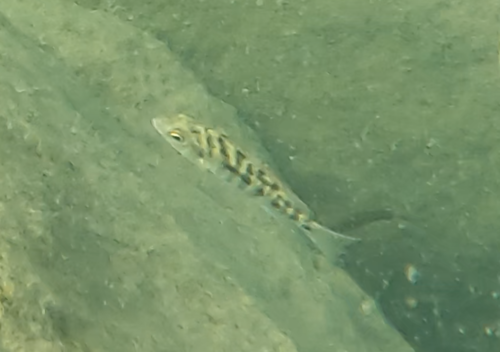
The most reliable field mark is the melanin pattern: three longitudinal rows of irregular dark spots or blotches running along the flank, the trait that gave the fish its "striped" name. Color is strongly sex- and mood-dependent. Breeding males take on the greenish-blue sheen that earned the "Green Steveni" trade name, while females and subordinate, non-territorial males stay drab and silvery — a typical maternal-mouthbrooder arrangement where only dominant males advertise. The feature that actually separates P. virgatus from its near-twins P. fenestratus and P. taeniolatus is internal: a more specialized jaw, with the tooth-bearing arch of the upper jaw narrow at the front but flaring outward at the rear, comparatively long front teeth, and noticeably enlarged crushing teeth on the pharyngeal (throat) jaws.
Range & habitat
The species is endemic to Lake Malawi and, within it, narrowly distributed. The IUCN assessment places it along the southwestern shore between Chia and Nkhudzi, on the mainland coastline in suitable habitat but absent from most of the islands in between — the exceptions being Namalenje, Harbour and Kanchedza Islands. Konings' field records and aquarium-trade collections cluster around the southern locales of Monkey Bay, Nkomo Reef, Gome and Makanjila Point. Older FishBase notes flag how sparse the sightings have been: a single positively identified specimen from Nkomo Reef in 1988, and a few more seen (but not caught) at Makanjila Point in 1989.
P. virgatus is a fish of the "intermediate" zone — the transitional ground where sand meets scattered rock rather than the pure rock reefs of the mbuna or open sand flats. It favors very sediment-rich, shallow water, normally no deeper than about 33 ft (10 m), where the rocks wear a coat of fine silt and algae. That choice of a shallow, turbid, rock-strewn margin shapes nearly everything else about the fish, from its feeding to where it is and isn't exposed to the lake's pressures.
Ecology & diet
Functionally, P. virgatus is a biocover grazer. It spends most of its day picking at the aufwuchs — the felt of algae, diatoms and small invertebrates coating shallow rocks and pebbles. FishBase estimates a trophic level near 3.3, which fits an animal that is mostly herbivorous but not strictly so. The clues to that mixed diet are in the mouth: the stronger-than-usual pharyngeal teeth suggest it does more than scrape soft algae, likely crushing small invertebrates picked from the same biofilm, and it will also take zooplankton from the water column when a flush of it is available.
In the lake's community this makes P. virgatus one of the many specialized grazers partitioning the same rocky-edge resource — a textbook example of how Lake Malawi's cichlid radiation packs dozens of closely related species onto similar substrate by dividing the food finely. Each species tweaks jaw shape and feeding angle just enough to coexist, and P. virgatus' distinctive dental geometry is its particular slice of that pie.
Behavior & breeding
Like the great majority of Lake Malawi cichlids, P. virgatus is a maternal mouthbrooder. The social structure is lek-based: territorial males gather and each defends a small bower — a cleared platform of sand, roughly 20 in (50 cm) across, built on top of a rock — where he courts and spawns. Females, by contrast, are mostly solitary, spending their time grazing the biocover rather than holding territory, and visit the leks to spawn. After spawning the female carries the fertilized eggs and then the fry in her mouth.
One honest caveat from the field: brooding females of this exact species have not actually been observed in the wild, so the details of parental care are inferred from its many close relatives. The strong expectation, stated in the IUCN account, is that the mother continues to shelter her young in her mouth for a period even after their first release — standard for the group, but worth flagging as inference rather than direct observation. Among males, territoriality is real and pointed: bower-holders actively defend their boundaries against neighboring males.
In the aquarium
In the hobby this is an uncommon, collector's-grade hap rather than a shelf staple — exported only irregularly, usually as "Haplochromis Green Steveni." Keepers describe it as relatively peaceful toward unrelated species, which is the honest part of the appeal, but that should not be mistaken for an easy community fish. Like its steveni-group relatives, an adult male is genuinely territorial toward his own kind, and the consistent advice from field notes and hobbyists alike is to keep only one mature male per tank and to avoid combining it with other similar-looking "steveni" haps, which triggers relentless interspecific sparring.
Plan for the footprint these fish need: a 4-foot tank is a practical floor for adult Protomelas haps, with an open sand bottom for bower-building and some rockwork for grazing and sightline breaks, not a rock wall. Lake Malawi water chemistry applies — hard and alkaline, broadly pH 7.5–8.5 and roughly 72–79 °F (22–26 °C). Because its natural diet is grazed algae plus the odd invertebrate, a varied menu of quality flake or pellet with a vegetable/spirulina component and occasional frozen foods suits it; heavy feeding of rich protein is a common mistake with grazing haps. The other recurring error is treating any "steveni" as interchangeable — buyers should know whether they actually have P. virgatus or the unrelated 'Steveni Taiwan.'
Conservation
The IUCN Red List assesses Protomelas virgatus as Least Concern (assessed 2018 by Ad Konings), an upgrade from the Vulnerable status it carried in 2006; the improvement reflects a better-understood, reasonably wide distribution along the southwestern shore rather than any documented recovery, and the population trend is listed as unknown. The threats named for the species itself are modest: subsistence fishing, irregular collection for the aquarium trade, and sedimentation. Notably, its preference for shallow, rocky intermediate habitat affords some protection — those rock-strewn shallows are poor ground for seine nets — and part of its range falls inside the Lake Malawi National Park.
That relatively comfortable status sits inside a lake under real strain. The basin-scale review by Chavula and colleagues (Journal of Great Lakes Research, 2023) catalogs the pressures: heavy over-fishing, including the long decline of the commercially vital chambo (Oreochromis spp.); sediment and nutrient loading washing off deforested, increasingly cultivated catchments; warming of the shallow waters (on the order of +0.7 °C) that strengthens the lake's stratification and tends to suppress the nutrient mixing the open lake depends on; and the looming risk of invasive species, from Nile tilapia in the catchment to an introduced Asian gastropod. For a shallow, sediment-tolerant grazer like P. virgatus, the most direct of these is sedimentation — the very turbidity it tolerates can, pushed further by shoreline erosion, smother the algal biocover it feeds on and degrade the rock surfaces it depends on. So the honest framing is this: the species itself is not currently threatened, but it lives in a strained system, and its fortunes are tied to how that wider catchment is managed.
Sources
- Eschmeyer's Catalog of Fishes — Haplochromis virgatus / Protomelas virgatus (Trewavas 1935)
- FishBase — Protomelas virgatus (Trewavas, 1935)
- GBIF — Protomelas virgatus (accepted taxon)
- IUCN Red List — Protomelas virgatus (Konings 2018, Least Concern; e.T61089A47233277)
- Chavula et al. 2023 — Lake Malawi/Niassa/Nyasa basin: Status, challenges, and research needs (J. Great Lakes Res. 49(6):102241)
- Chavula et al. 2023 — record and reference list (DOI 10.1016/j.jglr.2023.102241)
- Cichlid Room Companion — Protomelas virgatus (Ad Konings, public profile)
- malawi.si — Protomelas virgatus 'Harbour Island' (habitat, breeding, bower notes; photos © Ad Konings)
- AquaInfo — Protomelas virgatus (John de Lange; localities, diet, captive parameters)
- European Journal of Taxonomy — Protomelas krampus, a new paedophagous cichlid from Lake Malawi (genus context)
- Konings, Malawi Cichlids in Their Natural Habitat (5th ed., 2016) — reference record
- Mindat — genus Protomelas (endemic Lake Malawi haplochromines)
- AquaInfo — Protomelas sp. 'Steveni Taiwan' (distinguishing the trade look-alike)
- Borstein — Protomelas sp. 'steveni taiwan' (community profile, steveni-group context) — community/anecdotal
- Cichlid Fish Forum — Mixing Protomelas (tank size & aggression, keeper discussion) — community/anecdotal
- r/Cichlid — Protomelas 'Steveni / Taiwan Reef' keeping discussion (anecdotal color/behavior) — community/anecdotal
- Calgary Aquarium Society — The Peaceful Lake Malawi Community Tank (hap stocking practice) — community/anecdotal