Taxonomy & naming
The French ichthyologist Jacques Pellegrin described this fish in 1927 as Simochromis babaulti, working from a single specimen collected near Uvira at the lake's northern tip (the holotype, MNHN 1927-0318, still resides in Paris). The species honors Guy Babault (1888–1963), the French traveller and naturalist whose collecting expedition supplied the type material; the genus name Pseudosimochromis is plainer in intent, Greek for "false Simochromis," coined by Nelissen in 1977 for fishes that resemble Simochromis without truly belonging to it.
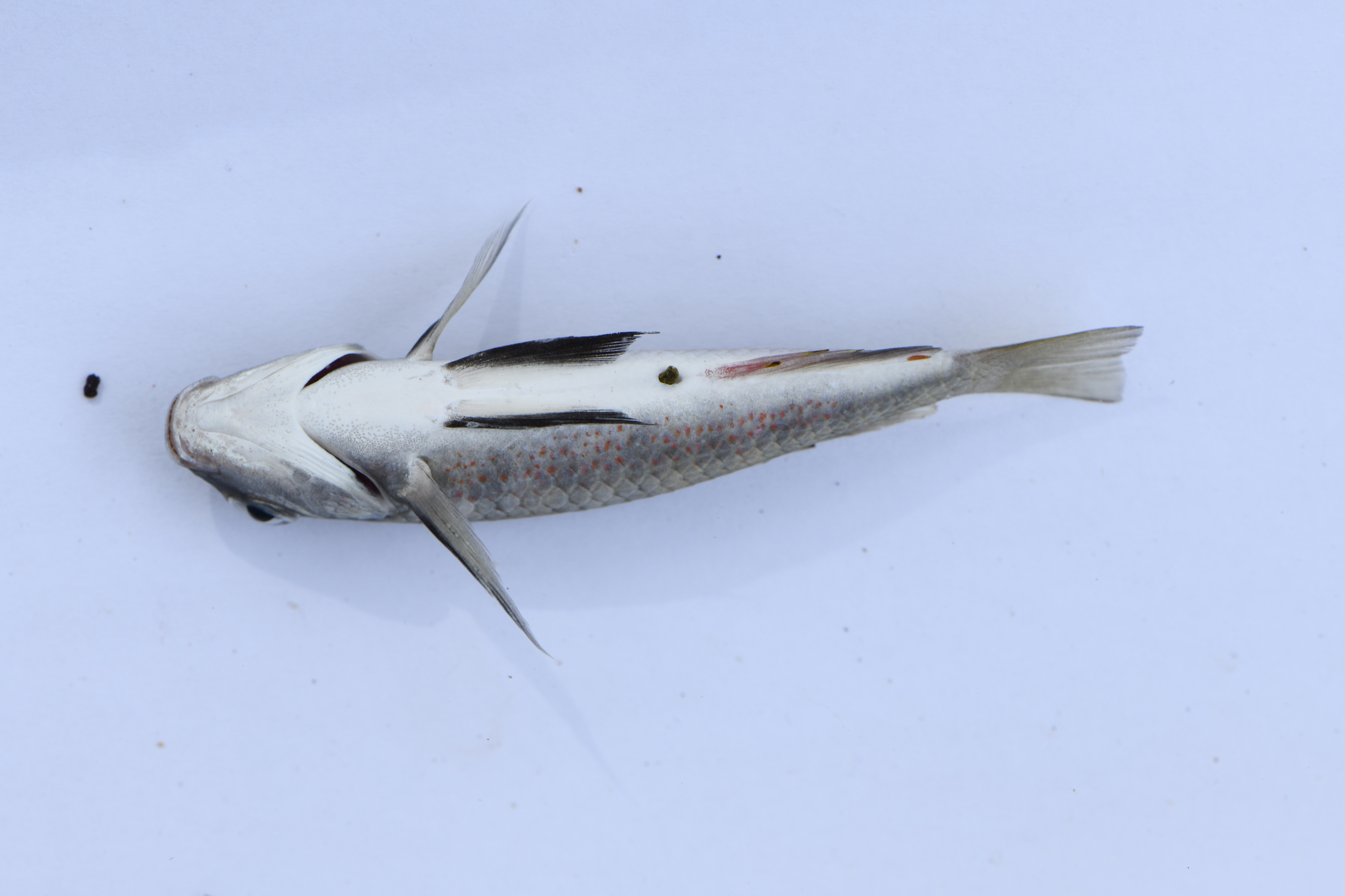
The modern placement is recent. For most of the 20th century babaulti sat in Simochromis, and that is the name a great deal of aquarium literature still uses. An integrative revision by Van Steenberge and colleagues (2015), combining morphology, DNA and even the host-specific gill parasites of the genus Cichlidogyrus, helped resolve the tangle: babaulti, marginatus and margaretae were transferred to Pseudosimochromis, and the southern form long catalogued as Simochromis pleurospilus (Nelissen, 1978) was sunk into babaulti as a junior synonym. Ad Konings had already suspected as much, noting that pleurospilus — distinguished mainly by rows of red dots along the flanks — was probably just a southern morph, with intermediate populations turning up along the western shore. Eschmeyer's Catalog of Fishes now lists the species as valid Pseudosimochromis babaulti (Pellegrin 1927), in the tribe Haplochromini of the Pseudocrenilabrinae.
Appearance
This is a small cichlid: FishBase gives a maximum of about 4.7 inches (12 cm) total length, and aquarium fish more often top out near 4 inches (10 cm). The body is moderately deep and laterally compressed, carried on a steeply sloping forehead that runs down to a distinctly underslung, downward-facing mouth — the working end of a dedicated algae scraper.
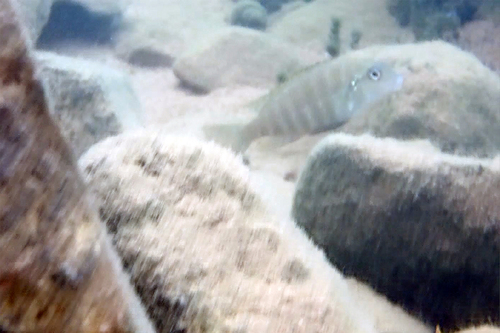
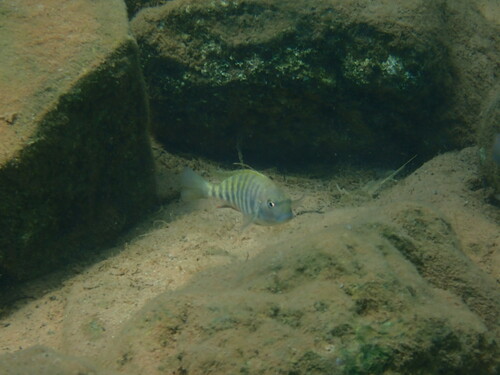
Ground color is an unglamorous greenish-yellow, paling toward the belly, crossed by eight or nine broad dark vertical bars running from behind the gill cover to the tail base; the back, snout and throat can look dusted with a sooty, blackish bloom. The fins are largely milky and translucent. Sexual dimorphism is real but subtle: mature males carry a dark longitudinal band in the dorsal fin and yellowish egg-spots on the anal fin, while females lack the anal spots and — the species' best party trick — can make their entire barred pattern vanish and reappear within seconds, a mood signal tied to courtship and stress. Separating babaulti from its congeners turns on fine points: P. marginatus has a deeper body, shorter mouth and larger eye, while the old "pleurospilus" southern populations show extra red flecking on the flanks that grades continuously into typical babaulti.
Range & habitat
Pseudosimochromis babaulti is a Lake Tanganyika endemic, found nowhere else on Earth except the lake's single outflow, the Lukuga River, where it has been recorded downstream as far as the Kisimba-Kilia rapids. Within the lake it is genuinely widespread, ringing the shoreline through all four riparian nations — Burundi, the Democratic Republic of the Congo, Tanzania and Zambia — rather than being pinned to one stretch of coast.
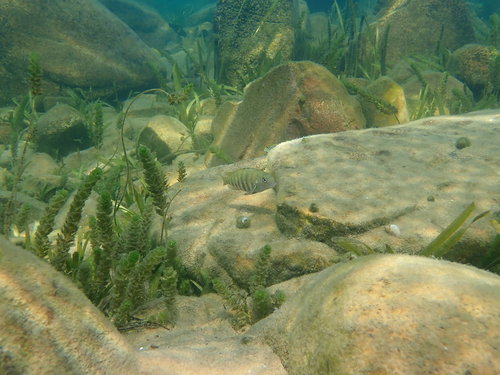
It is a fish of the shallow, sediment-rich rocky littoral. The IUCN assessment notes it on rocky substrate inshore and "not often encountered below 5 meters," and field observers describe it favoring the transition zones where rubble, sand and a scatter of plants meet, often in water cloudy with suspended silt. That tolerance for sediment is part of what makes it unusual: where the closely related Pseudosimochromis curvifrons is a fussy specialist of clean rocky shore, babaulti thrives in murkier, more disturbed shallows. In-situ conditions track the lake's stable chemistry — hard, alkaline water around pH 7.5–8.5, 10–20 dGH, and temperatures of roughly 75–79 °F (24–26 °C).
Ecology & diet
Functionally, babaulti is a browser of aufwuchs — the felt of filamentous algae, diatoms and small invertebrates that coats rocks in the sunlit shallows. Its trophic level is estimated at about 2.0, essentially a herbivore, and gut studies going back to Max Poll's foundational 1956 cichlid survey found filamentous algae mixed with fine organic sediment.
The feeding hardware tells the same story. Van Steenberge and colleagues point to a single row of closely set, bicuspid outer teeth in Pseudosimochromis — the dentition of a comber and scraper of algal turf — set in a jaw narrower than that of the broader-mouthed Tropheus, which works the same rocky shores. Simochromis proper, by contrast, has wider gaps between its teeth and a broader ecological niche. In the crowded guild of Tanganyika's rock-grazing cichlids, babaulti is thus a small, efficient turf-browser, and its sediment tolerance lets it exploit silty shallows that pickier grazers avoid — a foothold in a fiercely competitive trophic neighborhood.
Behavior & breeding
Like the Tropheus it superficially resembles in habit, babaulti is territorial and combative, especially toward its own kind and toward other rock-grazers competing for the same algal patch. A male treats a stretch of bottom as his domain and defends it hard; in confined quarters that aggression concentrates and a subordinate can be harried to death. Females, given room, will hold small territories of their own.
Reproduction is maternal mouthbrooding, the dominant strategy among Tanganyika's rock cichlids. The male prepares a spawning site — a cleaned patch of substrate or a small pit scraped between the rubble — and after the eggs are laid and fertilized the female takes them into her mouth, brooding eggs, then larvae, then free-swimming fry through development. Documented broods involve relatively modest clutches; FishBase records females of about 2.5–2.7 inches standard length (6.3–6.9 cm SL) carrying larvae up to roughly 0.6 inches (1.47 cm) total length, and hobbyist accounts put typical clutches in the range of 8 to 15 eggs depending on female size — a small brood that fits the species' small body. The female's rapid color-flashing figures prominently in courtship, and she will continue to take threatened fry back into her mouth for a time after release.
In the aquarium
Babaulti enters the hobby intermittently and is prized for being among the hardiest of Tanganyika's rock dwellers, but "hardy" should not be read as "easy." The defining problem is temperament: this is, behaviorally, a Tropheus-type fish, and it should be kept like one. Experienced keepers of the rock-grazing tribe consistently report that concentrated intraspecific aggression is the thing that kills these cichlids, and the remedies are the same here — either a single male with a small harem of females, or a deliberately large group that spreads the dominant male's bullying thin. A footprint of at least 4 feet (120 cm) is a sensible floor, and bigger is genuinely better for a group.
Replicate the shallow rocky littoral: a sand or fine-gravel base, stacked stable rockwork with crevices for subordinate fish to retreat into, and hard, alkaline water at pH 7.5–8.5, 10–20 dGH and 75–79 °F (24–26 °C). Diet is the second place keepers go wrong. This is a herbivore built to graze algal turf; its long gut is unforgiving of rich, protein-heavy feeding, which invites the bloat that plagues Tropheus-group cichlids. Feed a Spirulina-based staple and vegetable matter, and keep any animal protein to an occasional token. Plants are eaten as readily as offered — soft species like Vallisneria get mown down, while tougher Anubias and lotus are largely left alone. Tankmates are best limited to other robust Tanganyikan rock-grazers that can stand the heat; small or timid fish will simply be suppressed.
Conservation
On its own account the species is in reasonable shape. The IUCN Red List assesses Pseudosimochromis babaulti (under the name Simochromis babaulti) as Least Concern, an assessment dated 31 January 2006 and now flagged as needing updating. The justification is simple: a widespread lake-wide species with no known major, range-wide threats. The assessment does name two pressures — sedimentation following deforestation and shoreline erosion, and unspecified fishing or harvesting — and the first of these matters more than usual for this fish, because as a shallow rocky-shore grazer it lives precisely where eroded sediment settles out. There is no evidence of targeted collection pressure from the aquarium trade beyond modest, intermittent export.
The honest framing is that the fish is secure but the lake it depends on is not. Lake Tanganyika is warming, and the warming is doing real ecological work: O'Reilly and colleagues (2003, Nature; doi:10.1038/nature01833) tied rising surface temperatures to weaker vertical mixing and an estimated ~20% decline in primary productivity, with knock-on losses to fish yields on the order of 30%. Cohen and colleagues (2016, PNAS; doi:10.1073/pnas.1603237113) found that warming has already shrunk the oxygenated benthic habitat available to lake animals by roughly 38%. Those deep-water and pelagic-fishery stresses bear less directly on a shallow inshore grazer than on the lake's clupeid-and-Lates open-water fishery that feeds four nations — but the shoreline pressures do reach babaulti: catchment deforestation and the resulting sediment loading degrade the rocky littoral turf it scrapes for a living (a process documented in the lake by Cohen et al., 1993). Management is a four-country problem, coordinated through the Lake Tanganyika Authority. For now the verdict is the measured one: babaulti is Least Concern, its sediment tolerance even buys it some resilience, but it lives in a lake under mounting strain, and the most useful thing for it is a healthier, less eroded shoreline.
Sources
- Eschmeyer's Catalog of Fishes: babaulti, Simochromis (valid as Pseudosimochromis babaulti)
- FishBase: Pseudosimochromis babaulti (Pellegrin, 1927)
- FishBase: Tanganyika species ecology list (size, trophic level, endemism)
- Van Steenberge et al. 2015, Morphology, Molecules, and Monogenean Parasites: An Integrative Approach to Cichlid Biodiversity (PLoS ONE 10(4):e0124474)
- The taxonomic diversity of the cichlid fish fauna of ancient Lake Tanganyika (J. Great Lakes Research)
- Form, function and phylogeny: comparative morphometrics of Lake Tanganyika cichlids (PMC)
- Interspecific relationships of aufwuchs-eating fishes in Lake Tanganyika
- Cichlid Room Companion: Pseudosimochromis babaulti (profile, taxonomy & synonymy)
- AquaInfo: Pseudosimochromis babaulti (natural history, breeding, aquarium care)
- Cichlid Room Companion: The Tropheus Genus — A Beginner's Experience (algae diet & group keeping)
- IUCN Red List: Simochromis babaulti (Least Concern, 2006; threats & range)
- O'Reilly et al. 2003, Climate change decreases aquatic ecosystem productivity of Lake Tanganyika (Nature; doi:10.1038/nature01833)
- Cohen et al. 2016, Climate warming reduces fish production and benthic habitat in Lake Tanganyika (PNAS; doi:10.1073/pnas.1603237113)
- cichlid-forum.com: keeping Tropheus/Simochromis-group rock-grazers (aggression & group management) — community/anecdotal
- cichlid-forum.com: Tropheus are exclusively herbivorous — diet and bloat (raising-Tropheus thread) — community/anecdotal
- MonsterFishKeepers.com: starting a Tropheus colony — group size & temperament discussion — community/anecdotal