Taxonomy & naming

The species was described by Glen S. Axelrod and J. A. Harrison in 1978 as Simochromis margaretae, in a sixteen-page special publication of the J.L.B. Smith Institute of Ichthyology, from material collected in Kigoma harbour at 2–6 m depth (holotype SAIAB 965, three paratypes SAIAB 966). The specific epithet honours Margaret Mary Smith (1916–1987), the South African ichthyologist and illustrator.
Like several members of the old genus Simochromis, it was later reassigned. Maréchal and Poll hinted at the move in 1991, Konings flagged it again in 2015, and Van Steenberge and colleagues formally placed it in Pseudosimochromis that same year as part of a multidisciplinary revision of the Tropheus–Simochromis–Pseudosimochromis group; Eschmeyer's Catalog of Fishes now lists Pseudosimochromis margaretae (Axelrod & Harrison, 1978) as the valid name, with Simochromis margaretae as a synonym. The genus name translates roughly as "false Simochromis," reflecting its close resemblance to that lineage. All of these fishes belong to the tribe Tropheini, the haplochromine radiation that dominates Tanganyika's rocky shallows.
The species carries an unusual taxonomic footnote. The Lake Tanganyika reference site tanganyika.si reports that one of the paratypes, when re-examined, appears not to be a Tanganyikan cichlid at all but a misplaced Lake Malawi Tropheops — a labeling error attributed to personal communication with researcher Adrian Indermaur (2022). That muddle, combined with the tiny original type series, is part of why the species remains so thinly characterized.
Appearance
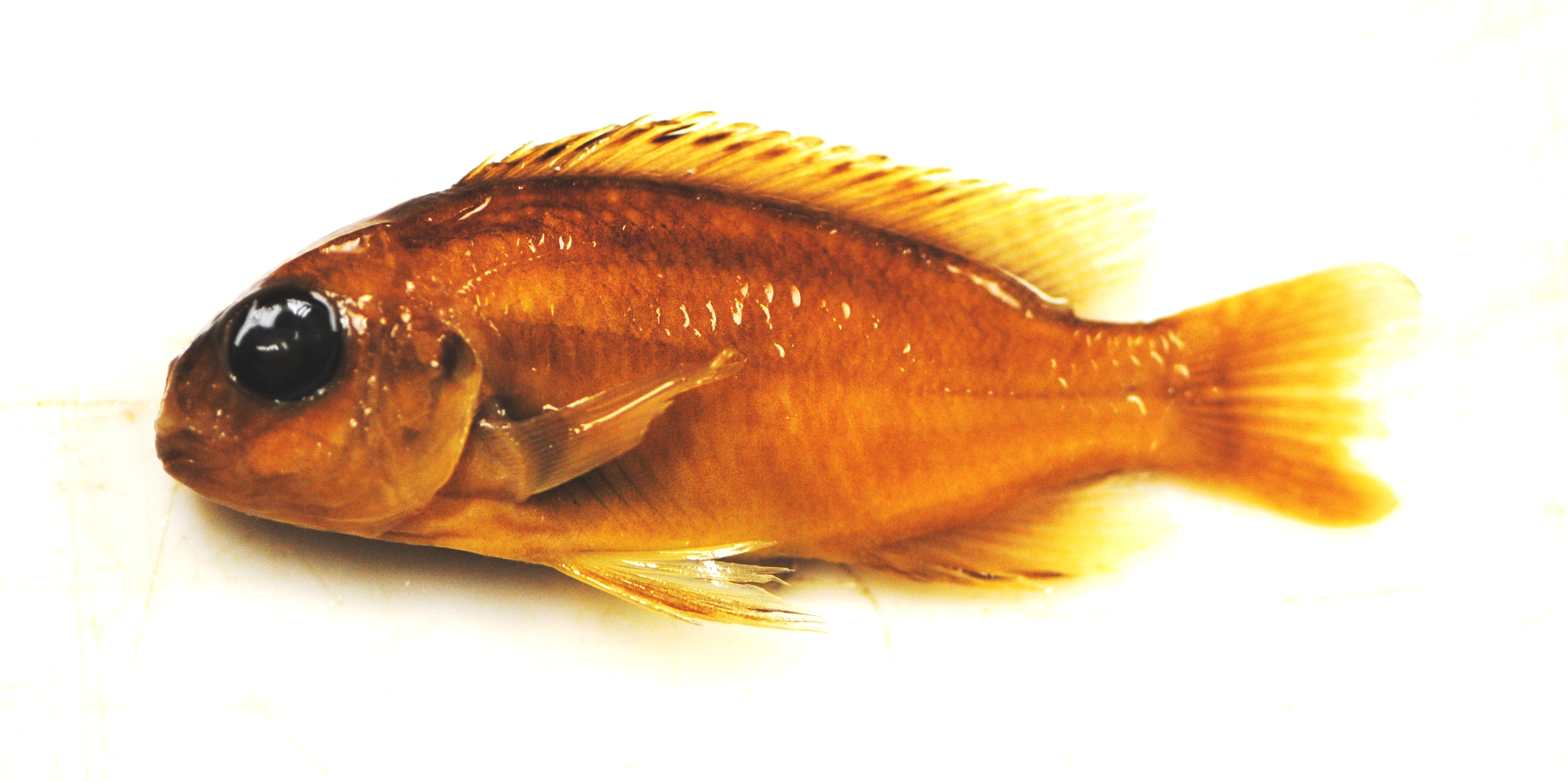
This is a small cichlid: FishBase gives a maximum of about 3.2 in (8.2 cm) standard length, so even a large adult is a palm-sized fish. In overall build it matches the Tropheini template — a compact, deep-bodied grazer with a blunt, steeply sloping forehead and a subterminal mouth set up for scraping rather than snapping.
Detailed, verifiable colour descriptions are scarce, a consequence of how rarely the fish has been collected or photographed alive. Images attributed to southern populations show a barred, brownish-to-olive body typical of rock-dwelling Tropheini, with males developing more contrast and intensity when dominant. Reliable accounts of sexual dimorphism, breeding dress, and the precise features that separate it from look-alike congeners such as Pseudosimochromis curvifrons are limited; given the genus's history of confusion and the questionable type material, fine identification is best left to specimens with documented Tanganyikan provenance rather than to colour alone.
Range & habitat
Pseudosimochromis margaretae is endemic to Lake Tanganyika and, on the published record, known only from the Kigoma area on the lake's eastern (Tanzanian) shore — effectively the type locality. That makes it a lacustrine micro-endemic: not merely restricted to one lake, but apparently to a single small patch of one lake's coastline.
The original collection came from the littoral zone at 2–6 m (roughly 7–20 ft), in shallow water that was heavily vegetated with aquatic macrophytes and strewn with algae-covered rocks — and, tellingly, littered with harbour debris. FishBase characterizes the species' habitat as shallow and sediment-rich, a rocky shore where fine sediment settles among the stones rather than the clean, wave-washed rock that many Tropheini prefer. Some aquarium-trade fish have been attributed to populations further south (for example near Mabilibili), but those assignments are tentative; the confirmed range is small. This is a fish of the warm, well-lit, near-shore band of one of the world's deepest and oldest lakes.
Ecology & diet
Functionally, P. margaretae is an algae grazer. FishBase records that it feeds on algae picked from rocks, and the Cichlid Room Companion describes it as an "algae puller" of the sediment-rich rocky littoral; its modelled trophic level of 2.0 places it firmly among primary consumers. This is the classic Tropheini job description — combing the epilithic "aufwuchs," the turf of filamentous algae, diatoms and associated micro-organisms that coats shallow rocks, using a jaw and dentition built for scraping and tugging at attached growth.
In the broader community, fishes like this are the grazing layer that converts sunlight-fuelled algal turf into fish biomass, and they partition the rocky shallows finely by depth, substrate and feeding style — work on coexisting herbivorous Tanganyikan cichlids shows neighbouring species dividing the same reef by exactly these axes. Because P. margaretae has been so little studied in situ, the specifics of its diet seasonality, competitors and predators are not well documented; what can be said with confidence is the guild it belongs to.
Behavior & breeding
Pseudosimochromis margaretae is a maternal mouthbrooder, the reproductive mode shared across the Tropheini and noted for this species by FishBase and the Cichlid Room Companion. In this strategy the female takes the fertilized eggs into her mouth and incubates them there, releasing fully formed, free-swimming fry after a period of brooding during which she does not feed normally. Mouthbrooding is widely regarded as one reason these rock-dwelling lineages have radiated so successfully in Tanganyika: it frees a breeding fish from needing a defensible nest site on contested rock and lets it carry its young anywhere.
Beyond the spawning mode, species-specific behavioral data are thin. Tropheini grazers are typically territorial over feeding patches and can be pugnacious toward conspecifics, and dominant males develop heightened colour, but the published record does not pin down P. margaretae's social structure, brood size, or breeding triggers with any precision. Anything more detailed would be inference from its relatives rather than direct observation of this fish.
In the aquarium
This is not an aquarium-store fish. FishBase notes a commercial aquarium interest and the Cichlid Room Companion flags it as a species for advanced aquarists, but in practice P. margaretae is rarely collected, rarely exported, and rarely kept; substantive first-hand keeping reports are essentially absent from the major hobby forums, where the genus barely registers compared with the popular Tropheus and Petrochromis grazers. That scarcity itself is the most honest thing to say about it.
Where care guidance exists, it is extrapolated from the Tropheini playbook, and an experienced keeper should treat it as such. These are hard, alkaline rift-lake conditions — high pH, hard water, warm and very clean, with the strong filtration and oxygenation Tanganyika fish expect. As small, algae-grazing mouthbrooders they want rockwork and an algae-based, vegetable-forward diet; like related grazers they can be sensitive to overly rich, protein-heavy feeding. Expect intraspecific aggression typical of territorial Tropheini, which usually argues for keeping a group rather than a pair and giving them broken sightlines among the rocks. Given the species' Critically Endangered status and pinpoint range, any specimens in the hobby deserve careful, deliberate husbandry rather than casual purchase.
Conservation
The IUCN Red List assessed Pseudosimochromis margaretae as Critically Endangered in its 2025-2 update (criteria B1ab(iii)+2ab(iii); assessed 28 February 2025, assessor Y. Fermon), an upgrade from the Vulnerable listing it held in 2006 under the old name Simochromis margaretae. The justification is geographic, not a measured crash: the species is endemic to Lake Tanganyika, known only from the Kigoma harbour area, and restricted to an estimated extent of occurrence and area of occupancy of about 8 km², with boats, pollution and sedimentation driving a continuing decline in habitat quality at what amounts to a single location. The population trend is listed as unknown. In plain terms, this is a fish at risk because it lives in one small, busy harbour-side patch — not because it is being fished out.
Those local pressures sit inside a lake that is itself under strain. Long-term limnological work shows climate warming has strengthened stratification and weakened the deep mixing that fertilizes Tanganyika's surface waters: O'Reilly and colleagues (2003, Nature, doi:10.1038/nature01833) estimated a roughly 20% decline in primary productivity over recent decades, with potential knock-on losses to fish yields that feed four countries. Cohen and colleagues (2016, PNAS, doi:10.1073/pnas.1603237113) documented warming-driven loss of oxygenated benthic habitat affecting a large share of the lake floor, and decades of catchment deforestation have increased sedimentation that degrades exactly the rocky littoral these grazers depend on (Cohen et al. 1993). Governance of the lake is shared across Tanzania, the DRC, Burundi and Zambia through the Lake Tanganyika Authority. For a shallow, sediment-tolerant rock-grazer with a footprint measured in single-digit square kilometres, sedimentation and shoreline disturbance are not abstract basin-scale concerns — they are the direct threats named in the species' own assessment.
Sources
- Eschmeyer's Catalog of Fishes — Simochromis/Pseudosimochromis margaretae
- FishBase — Pseudosimochromis margaretae
- FishBase — Synonyms of Pseudosimochromis margaretae
- Cichlid Room Companion — Pseudosimochromis margaretae (Patrick Tawil)
- tanganyika.si — Pseudosimochromis margaretae (paratype note)
- Ronco et al. 2020 — Taxonomic diversity of the cichlid fauna of Lake Tanganyika (J. Great Lakes Res.)
- Van Steenberge 2014/2015 — Species and speciation in Tropheus, Simochromis and Pseudosimochromis
- Depth and substratum differentiation among coexisting herbivorous cichlids (Royal Society Open Science)
- Comparative morphometrics of Lake Tanganyika's tribe Tropheini (PMC)
- IUCN Red List — Pseudosimochromis margaretae (CR, 2025)
- O'Reilly et al. 2003 — Climate change decreases productivity of Lake Tanganyika (Nature; AfricaMuseum PDF)
- O'Reilly et al. 2003 — abstract (PubMed 12917682)
- Lake Tanganyika: Status, challenges, and opportunities for research (J. Great Lakes Res.)
- FishBase country/occurrence summary — Pseudosimochromis margaretae
- Cichlid Fish Forum (cichlid-forum.com) — Tanganyikan keeping community — community/anecdotal