
Taxonomy & naming
The species was described in 1956 by the Belgian ichthyologist Max Poll, working from material gathered during the 1946–1947 Exploration Hydrobiologique du Lac Tanganika, and was originally placed in the genus Simochromis as Simochromis marginatus. The holotype (MRAC 106523) came from Manga, on the Tanganyika coast. The genus name strings together Greek and Latin roots — pseudes (false), simo (a snub or crushed nose), and chromis (an old name for a perch-like fish) — so the binomial reads roughly as 'false snub-nosed cichlid with a margin,' the marginatus epithet pointing to the dark edging on the male's dorsal fin.
The modern combination dates to a 2015 revision by Van Steenberge and colleagues, who reassessed the Tropheini — the tribe of rock-grazing Tanganyikan cichlids that also includes Tropheus and Petrochromis. They transferred four former Simochromis species — babaulti, marginatus, pleurospilus, and margaretae — into Pseudosimochromis, a move adopted by Ad Konings in the 2015 third edition of Tanganyika Cichlids in Their Natural Habitat and accepted by Eschmeyer's Catalog of Fishes. The reshuffle left Simochromis monotypic, holding only its type species S. diagramma. Older hobby literature, aquarium price lists, and a good deal of the web still call the fish Simochromis marginatus; that is the same animal under its previous, now-synonymized name.
Appearance
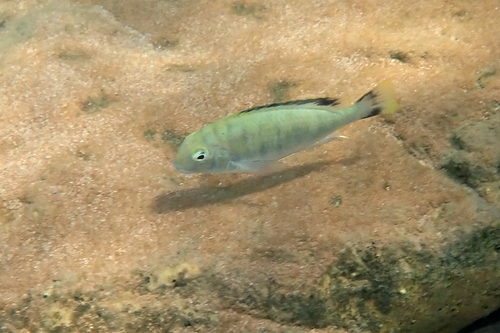
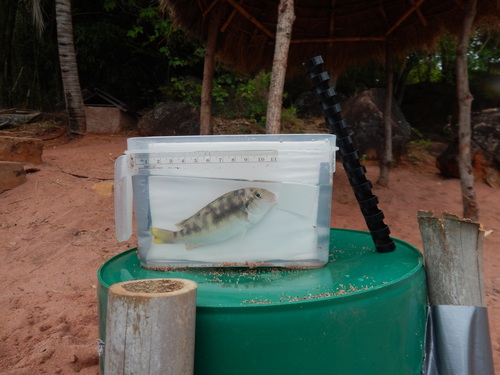
This is a medium-small cichlid with the blunt, rounded snout typical of the rock-grazing tropheines. FishBase records a maximum of about 4 in (10 cm) total length, drawing on Poll's original work, while Konings cites a maximum closer to 4.3 in (11 cm); both put it firmly in the palm-of-the-hand size class rather than among the lake's giants.
In coloration P. marginatus closely resembles its relative P. babaulti, and the two are easily confused. The most dependable separator is the male's spiny dorsal fin, which carries a short, dark band along or near its upper margin — the feature babaulti lacks and the one the species is named for. Females do not show that band but may flush cherry-red on the cheeks and anal fin. Sexual dimorphism is present but more muted than in babaulti. Across several localities, occasional individuals turn up blotched with irregular black markings on the body, an aberrant pattern also seen now and then in babaulti, so a blotched fish is not on its own diagnostic of either species.
Range & habitat
Pseudosimochromis marginatus is endemic to Lake Tanganyika and is recorded from all four riparian nations — the Democratic Republic of the Congo, Tanzania, Burundi, and Zambia. The 2025 IUCN assessment treats it as distributed throughout the lake, while Konings describes a more northern-weighted range, present along the Congo shore between Uvira and Kalemie and down the eastern coast from Nyanza-Lac in Burundi to Lyamembe in Tanzania. The discrepancy likely reflects how readily it is overlooked or confused with babaulti rather than a hard biogeographic boundary; either way it is a genuinely shallow-water fish.
It belongs to the lake's shallow 'intermediate' habitat — the patchy transition between clean rock and open sand, where stones and pebbles are kept relatively free of sediment by wave action and carry a film of algae. Territorial males sit very close to shore, frequently in less than 6.5 ft (2 m) of water; the IUCN gives a depth band of 0–16 ft (0–5 m), reaching about 33 ft (10 m). In-situ, this is warm, hard, alkaline water: FishBase lists a temperature range of roughly 75–82°F (24–28°C), consistent with Tanganyika's stable, mineral-rich surface layer.
Ecology & diet
Like the other tropheines, P. marginatus makes its living from 'biocover' or aufwuchs — the carpet of filamentous algae, diatoms, and the tiny invertebrates living within it that coats sunlit rocks. It picks this film directly off stone surfaces, and stomach studies report large quantities of filamentous algae alongside incidental items such as snail eggs, aquatic insects, and bits of fish. FishBase places it at a trophic level of about 2.0, the signature of a primary consumer that is essentially herbivorous with a small animal supplement.
In the wider community it is one of many aufwuchs-grazing cichlids partitioning the same rocky shallows — a classic Tanganyikan story in which closely related fishes coexist by carving up the algal resource and the space around it. Its low position in the food web and its high reproductive resilience (FishBase estimates a population-doubling time under 15 months) are typical of a small, fast-turnover grazer rather than a top predator.
Behavior & breeding
Pseudosimochromis marginatus is a maternal mouthbrooder, the dominant reproductive mode among Tanganyika's rock cichlids. After spawning, the female carries the developing eggs and fry in her mouth; field and aquarium observations describe brooding females in the 2.7–3.3 in (6.8–8.3 cm) standard-length range holding larvae up to about 2 in (5 cm) total length before release. Clutches are modest — Kuwamura's field survey and later work by Fermon and colleagues put fecundity at roughly 20 eggs. Detailed accounts of the brooding cycle remain thin compared with better-studied tropheines.
The defining behavioral trait is male territoriality. Territorial males hold small patches close to shore, on the order of 6.5 ft (2 m) across, built around a few stones forming a low platform, and defend them aggressively against conspecifics and other algae grazers. That intensity of intraspecific aggression — males harassing both rival males and females — shapes everything about how the fish lives in the wild and, as keepers quickly learn, how it must be housed.
In the aquarium
This is a fish for someone who already keeps Tropheus-type cichlids, not a beginner's mbuna substitute. The recurring theme across specialist sources is aggression: males are described as extremely territorial toward their own kind and toward other herbivores. Half-grown groups can be held temporarily in a tank of around 80 gal (300 L), but a larger, longer footprint is strongly preferred for the long term, with rockwork arranged into narrow holes and passages so that subordinate fish and harassed females have genuine escape routes. Surfaces that grow algae help, both as forage and to keep behavior natural.
Water should mirror the lake: hard, alkaline, and warm, in the mid-to-upper 70s °F (around 24–28°C), with the pristine quality and good oxygenation that wave-zone Tanganyikans expect. Diet is the other place people go wrong — as a dedicated grazer it needs a vegetable-based staple, with spirulina-based preparations standing in for the wild algal film; chronically overfeeding it on rich, protein-heavy foods invites the bloat that plagues herbivorous rift-lake cichlids. It is offered in the trade, though far less commonly than its showier relatives, and is usually sold by collection locality.
Conservation
On the IUCN Red List, Pseudosimochromis marginatus is assessed as Least Concern (assessed 28 February 2025, by Y. Fermon), an upgrade from the Vulnerable listing it carried in 2006 under the name Simochromis marginatus. The reasoning is straightforward: it is endemic to Lake Tanganyika but distributed throughout it, can be locally abundant, and faces no major lake-wide threat specific to the species. The population trend is recorded as unknown. It does enter the aquarium trade nationally and internationally, but collection is not flagged as a population-level pressure. The one threat the assessment names is local: agricultural and shoreline development driving siltation, turbidity, and pollution into the rocky shallows it depends on.
That caveat matters because this fish lives exactly where the lake is most exposed. Tanganyika as a whole is under strain. O'Reilly and colleagues (2003, Nature) linked regional warming and weakened mixing to a roughly 20% decline in primary productivity, with knock-on losses in fish yield; Cohen and colleagues (2016, PNAS) estimated the lake has lost on the order of 38% of its oxygenated benthic habitat as warming deepens stratification. Along the coast, catchment deforestation and erosion smother the rocky littoral in sediment (Cohen et al. 1993). For a snub-nosed grazer that holds territory in water often less than 2 m deep and feeds on the algal film coating clean, wave-washed stone, sedimentation is not an abstract worry — it directly degrades both its habitat and its food supply. The lake's enormous commercial fishery — the pelagic clupeids Stolothrissa and Limnothrissa and the Lates predators that feed four nations — does not target this shallow rock-dweller, and governance of those shared waters falls to the four-country Lake Tanganyika Authority. The honest summary is that the species itself is not currently threatened, but it sits in the strip of the lake where local degradation bites first, so its Least Concern status is best read as 'secure for now, and worth watching.'
Sources
- Eschmeyer's Catalog of Fishes — Pseudosimochromis marginatus (Poll 1956)
- FishBase — Pseudosimochromis marginatus
- IUCN Red List — Pseudosimochromis marginatus (Fermon 2025, e.T60674A47208286)
- IUCN Red List — Simochromis marginatus, 2006 assessment (Vulnerable)
- tanganyika.si — Pseudosimochromis marginatus 'Jakobsen's Beach' (Konings-based species account)
- Cichlid Room Companion — taxonomic changes in Tanganyika Cichlids in Their Natural Habitat (3rd ed., 2015)
- Van Steenberge, M. (2014). Species and speciation in Tropheus, Simochromis and Pseudosimochromis (PhD thesis, KU Leuven)
- Kuwamura, T. (1986). Parental care and mating systems of cichlid fishes in Lake Tanganyika. J. Ethol. 4:129–146 (cited in IUCN assessment)
- Interspecific relationships of aufwuchs-eating fishes in Lake Tanganyika (ResearchGate)
- Diet disparity among sympatric herbivorous cichlids in Lake Tanganyika (PMC4228161)
- The taxonomic diversity of the cichlid fish fauna of ancient Lake Tanganyika (ResearchGate)
- O'Reilly, C.M. et al. (2003). Climate change decreases aquatic ecosystem productivity of Lake Tanganyika. Nature 424:766–768
- Cohen, A.S. et al. (2016). Climate warming reduces fish production and benthic habitat in Lake Tanganyika. PNAS 113:9563–9568
- Fishi-pedia — Pseudosimochromis (Simochromis) marginatus
- GBIF — Pseudosimochromis marginatus occurrence records (genus page, EOL maps)