Taxonomy & naming
The species was described in 1997 by Nancy Bowers and Jay Stauffer as Melanochromis cyaneorhabdos, one of eight new rock-dwelling cichlids they named from Lake Malawi in a single paper in Ichthyological Exploration of Freshwaters. The holotype was collected at Mbako Point on Likoma Island at a depth of about 5 m. The epithet is descriptive: from Greek kyaneos, "dark blue," and rhabdos, "rod" or "stripe" — literally "blue-striped," for the pair of luminous blue lines that run the length of the body.
The fish has since been moved out of Melanochromis. Konings and Stauffer (2012) reassigned it to Pseudotropheus, and Eschmeyer's Catalog of Fishes now lists Pseudotropheus cyaneorhabdos (Bowers & Stauffer, 1997) as the valid name, with Melanochromis cyaneorhabdos as a synonym. The original placement reflected a superficial resemblance to the genuinely Melanochromis-like johannii group rather than close relationship. In the hobby the fish is almost universally called "Maingano," after the islet where it is most abundant, and is frequently sold under the misleading trade name "Electric Blue Johanni."
Appearance
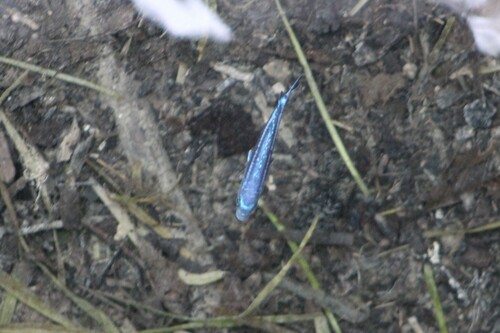
This is a small mbuna. FishBase gives a maximum of about 3 in (7.5 cm) standard length from the type series; field-based accounts put wild males at up to roughly 3.5 in (9 cm) and females nearer 2.75 in (7 cm), with both sexes often running a little larger in aquaria. The body is a deep, near-black blue crossed by two horizontal, pale electric-blue stripes — one along the upper flank and one lower — that glow most intensely on dominant fish.
Unusually for an mbuna, the sexes look almost alike: both males and females carry the same dark body and blue stripes, so the species cannot be sexed reliably on color the way most Malawi cichlids can. The clearest cue is on the anal fin, where adult males typically show one to five yellow or orange egg-spots and females one or none. The look-alike risk is real: P. cyaneorhabdos is easily confused with Pseudotropheus johannii (the "bluegrey mbuna"), and the two are difficult to separate as adult males. The tell is in the females — female and juvenile johannii are bright lemon-yellow or orange, whereas Maingano of both sexes stay dark blue and striped from juvenile to adult, a point hobbyists repeatedly use to flag mislabeled shop stock.
Range & habitat
Pseudotropheus cyaneorhabdos is a lacustrine endemic with one of the tightest ranges of any Malawi cichlid. It is confined to the northeastern corner of Likoma Island, from the eastern side of Yofu Bay to Membe Point, with the densest population at the small offshore islet of Maingano. The IUCN assessment estimates an area of occupancy of just 4 km² and treats the whole population as a single location.
It is a rock-dweller, occupying the sediment-free rocky habitat and the transitional zones where clean rock grades into sand. Reports place it at depths of roughly 10–60 ft (3–18 m), most commonly between about 16 and 40 ft (5–12 m); the type material came from around 5 m. Like all of Lake Malawi's mbuna it lives in hard, alkaline, oxygen-rich water — the lake sits near pH 7.7–8.6 with high carbonate hardness and warm surface temperatures around 75–82 °F (24–28 °C). One footnote worth flagging: FishBase records the species as introduced to Indonesia, almost certainly an artifact of the ornamental-fish trade rather than a self-sustaining wild population.
Ecology & diet
Functionally, this is an aufwuchs grazer with an omnivorous streak. "Aufwuchs" is the carpet of algae and associated micro-life that coats Malawi's rocks; P. cyaneorhabdos works that film, taking diatoms and filamentous and blue-green algae along with the small invertebrates and microorganisms living in it. Field and database accounts add zooplankton and epibenthic invertebrates to the menu, and FishBase places it at a trophic level of about 3.5 — squarely an omnivore rather than a strict herbivore, despite the "algae-eater" shorthand.
That mixed diet matters for its conservation: an aufwuchs feeder depends on clean, well-lit rock surfaces, which makes it directly vulnerable to anything that smothers the substrate in sediment. Within the Likoma community it is one of many rock-dwelling specialists partitioning the same reefs, a pattern of fine-grained niche division that is the engine of Lake Malawi's extraordinary cichlid diversity.
Behavior & breeding
There is a striking gap between how this fish behaves in the lake and how it behaves in a tank. In the wild, the IUCN assessment notes that most males are solitary and show little or no territoriality, and that brooding females are rarely seen on the reef. In aquaria, by contrast, keepers consistently describe it as a pugnacious, territorial mbuna in which a dominant male will claim a patch of rockwork and harry rivals — a difference best explained by the cramped, escape-proof confines of a glass box concentrating aggression that open reef space normally diffuses.
Like essentially all Malawi rock cichlids, it is a maternal (ovophilous) mouthbrooder. Spawning probably takes place in caves and crevices between rocks; the female takes the eggs into her mouth, the male's anal-fin egg-spots playing their classic role in fertilization, and she then broods the clutch — roughly 10 to 30 eggs — for around three weeks, not feeding the whole time. Once she releases the free-swimming fry they are on their own and are not taken back into the mouth. The young are dark and striped like the adults from the start. One breeding hazard is genetic rather than behavioral: because Maingano and P. johannii are so similar and are often housed together, hobbyists widely report that the two hybridize readily, so anyone hoping for pure fry is advised to keep them apart.
In the aquarium
Maingano is an easy fish to keep alive and a harder one to keep peacefully. It is hardy, eats prepared foods readily, and tolerates the wide range of conditions typical of a Rift Lake tank — roughly 76–84 °F (24–29 °C), pH around 7.8–8.6, and hard, alkaline water. The catch is temperament: this is an aggressive mbuna, and the usual care-sheet line of a 55-gallon (about 200 L) minimum is realistic only with proper stocking. Experienced keepers favor a footprint of at least 4 ft (about 120 cm), heavy rockwork with abundant caves, and either a well-managed mbuna community or a single male with several females (three or four females per male is the common recommendation) to spread out his attention. Lone males will bully tankmates, and crowding aggression onto one female can stress her badly while brooding.
Diet should lean vegetable — spirulina-based foods, with meatier items as a supplement; like many mbuna it is prone to digestive problems on too rich a diet. The most common mistakes are predictable: buying it as "Electric Blue Johanni" without realizing what it is, housing it with true johannii and ending up with hybrid fry, and underestimating how much aggression a small fish can generate. It is not a community-tank fish in the general sense and not the best choice for an absolute beginner, but for someone set up for African Rift Lake cichlids it is a durable, vividly colored, and genuinely rewarding mbuna.
Conservation
Pseudotropheus cyaneorhabdos is assessed by the IUCN as Critically Endangered (2018, assessor Ad Konings), under criteria A2a; B2ab(v). The driver is unusually clear-cut. The fish has an area of occupancy of only about 4 km² at a single location, and the assessment infers a roughly 90% population decline over ten years — almost entirely because of extraction for the ornamental fish trade. It is too small to interest local food fisheries, so the pressure on it is specifically the aquarium hobby that prizes it; Konings notes that very few individuals now remain around Maingano Island and that the species is in urgent need of protection. Earlier assessments (2006 and 2017) listed it as Vulnerable, so its status has worsened, and no conservation actions are currently in place. This is one of those cases where the species is genuinely imperiled in the wild even as it remains abundant and cheap in tanks worldwide — the trade has effectively created a captive safety net while drawing down the source population.
That species-level threat sits inside a lake under broad strain. Basin reviews of Lake Malawi/Niassa/Nyasa (Chavula et al., 2023, Journal of Great Lakes Research) document over-fishing and the collapse of the commercial chambo (Oreochromis) fishery, rising sediment and nutrient loading from deforested and farmed catchments, and warming of roughly 0.7 °C in the surface layer that strengthens thermal stratification, weakens mixing, and reduces the nutrient upwelling that feeds the lake's productivity. For a sediment-sensitive aufwuchs grazer pinned to one small stretch of shallow reef, the most immediate of these is sedimentation: the IUCN assessment explicitly flags increased future sedimentation as a secondary threat, because silt smothering the rock surfaces would degrade the very algal film the fish feeds on. The honest summary is that Maingano's peril is driven overwhelmingly by targeted collection of a microendemic population, with shoreline sedimentation as a real and growing second pressure — and that conserving it ultimately depends on managing the trade and protecting that single corner of Likoma.
Sources
- Eschmeyer's Catalog of Fishes — Pseudotropheus cyaneorhabdos
- FishBase — Pseudotropheus cyaneorhabdos (Bowers & Stauffer, 1997)
- IUCN Red List — Pseudotropheus cyaneorhabdos (Konings 2018, CR, errata 2019)
- Bowers & Stauffer (1997), Eight new rock-dwelling Melanochromis from Lake Malawi, Ichthyol. Explor. Freshwat. 8(1):49–70 (via Cichlid Room Companion)
- Cichlid Room Companion — Pseudotropheus cyaneorhabdos species profile (Ad Konings)
- malawi.si — Pseudotropheus cyaneorhabdos 'Maingano Island'
- AquariumDomain — Maingano Cichlid species profile
- Chavula et al. (2023), Lake Malawi/Niassa/Nyasa basin: Status, challenges, and research needs, J. Great Lakes Res. 49(6):102241
- Cichlid Forum — Breeding Melanochromis cyaneorhabdos 'maingano' — community/anecdotal
- Cichlid Forum — Can Johanni and Maingano Crossbreed? — community/anecdotal
- Cichlid Forum — Breeding maingano (johanni / cyaneorhabdos / interruptus) — community/anecdotal
- Cichlid Forum — Melanochromis johanni (Maingano hybridization discussion) — community/anecdotal
- Aquarium Advice — Pregnant / aggressive Maingano cichlid thread — community/anecdotal
- Cichlid Room Companion — New Pseudotropheus species described from Likoma Island (announcement)
- Malawi Cichlids — Bibliography of Lake Malawi biology (Bowers & Stauffer 1997 entry)