
Taxonomy & naming
The species was described by the British biologist Geoffrey Fryer in 1956 as Pseudotropheus elongatus, from specimens collected at Mbamba Bay on the Tanzanian (northeastern) coast of Lake Malawi. The trivial name simply refers to its elongate, sub-cylindrical body, slimmer than the deeper-bodied zebra mbuna it shares the rocks with.
For decades "elongatus" sat in the catch-all genus Pseudotropheus. That changed in 2016, when Shan Li, Ad Konings and Jay Stauffer revised the Pseudotropheus elongatus species group and erected the genus Chindongo to receive it (Zootaxa 4168(2):353–381). Eschmeyer's Catalog of Fishes and FishBase now list the valid name as Chindongo elongatus (Fryer, 1956), with Pseudotropheus elongatus as the senior synonym most aquarists still use. The genus name is taken from a Chichewa vernacular word for the small, rock-frequenting fishes of the lake; its members are diagnosed by bicuspid outer teeth, a small mouth with large outer-row teeth, and a flank pattern of vertical bars with no horizontal stripes at any age. Alongside elongatus, Li and colleagues transferred a familiar roster of aquarium fish into Chindongo, including C. demasoni, C. saulosi and C. socolofi.
The naming muddle runs deeper than the genus change. As experienced keepers on Cichlid-Forum point out, the attractive blue-and-black fish sold for years as "Pseudotropheus elongatus" are typically regional forms such as the Likoma "ornatus" or the Mphanga and Ruarwe populations, several of which are undescribed or only informally named. The actual Fryer species is, in their words, "a much less common, less attractive mbuna" — so a fish bought under this label may be almost anything in the complex.
Appearance
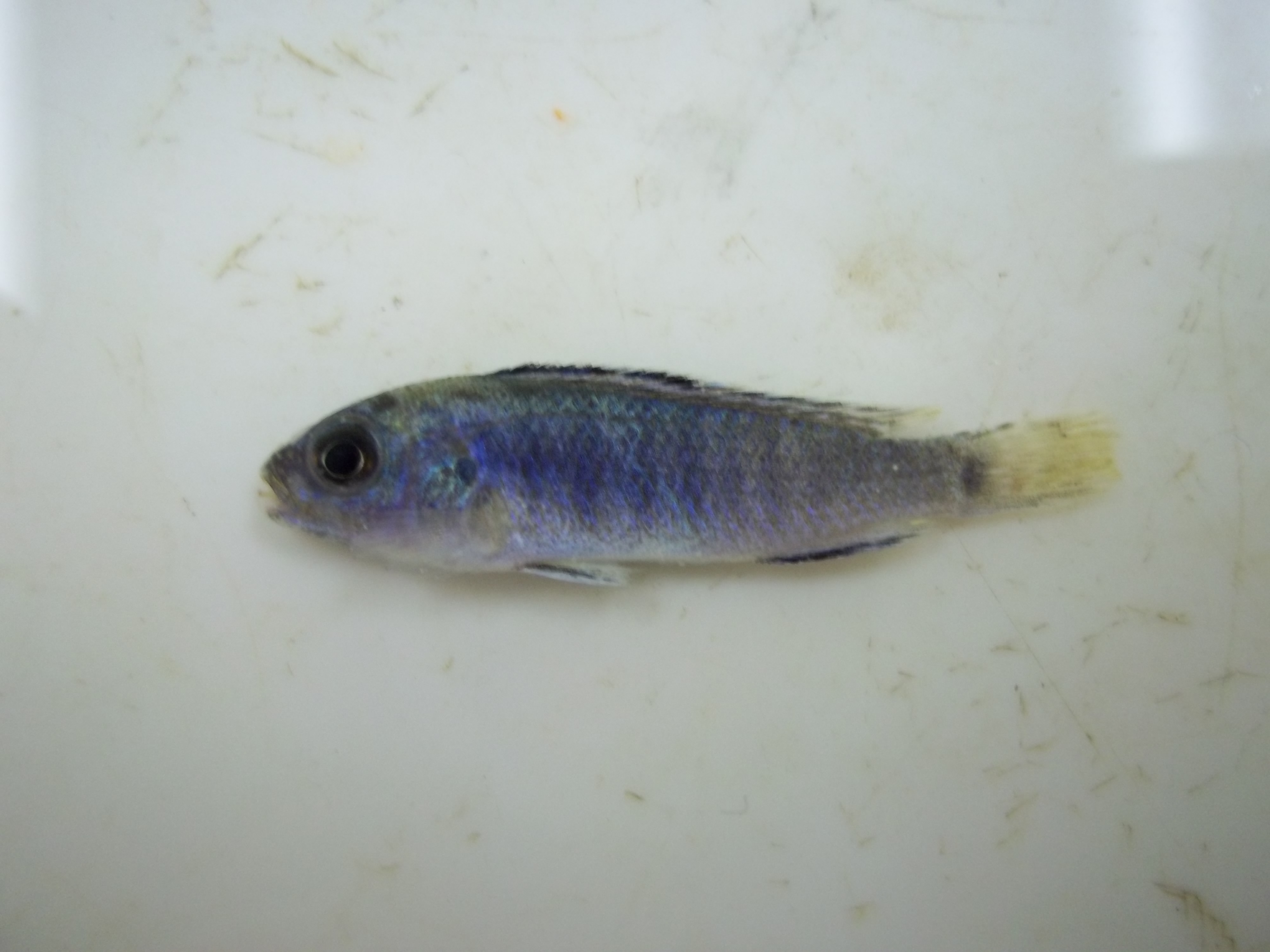
This is a small cichlid. FishBase gives a maximum of about 3.7 in (9.5 cm) standard length, and most members of the elongatus complex stay under 4 in (10 cm); reports of 4–5.5 in (10–14 cm) in some care sheets are at the high end and probably reflect the larger geographic variants rather than the nominal form. The body is noticeably long and torpedo-shaped for an mbuna, with a small, slightly subterminal mouth built for scraping.
Colour is where the trade and the textbook diverge. Dominant males of the popular forms are a vivid pale-to-electric blue crossed by six to a dozen dark vertical bars, often with a black band in the dorsal fin; females and subordinate males are drabber and greyer. The diagnostic melanin pattern in Chindongo is always vertical barring, never the horizontal stripes seen in Melanochromis — a useful field mark. Sexual dimorphism is modest: males show egg-spots ("ocelli") on the anal fin and intensify in colour when breeding, while females stay paler. Because the colour forms grade into one another, keepers widely agree that a photograph alone rarely settles an identification; as one long-time forum member put it, unambiguous ID in this group is nearly impossible without a known collection locality.
Range & habitat
Chindongo elongatus is endemic to Lake Malawi (also called Lake Nyasa or Niassa), the third-largest of the African Great Lakes and home to more freshwater fish species than any other lake on Earth — on the order of 800 to 1,000, most of them endemic cichlids. Within the lake the species is a creature of the shallow, sediment-free rocky biotope, the wave-washed zone of tumbled boulders and cobble where light and oxygen are high and the rocks carry a thick algal turf. FishBase records it around small rocks at the upper end of the rocky habitat.
Water over these reefs is hard and alkaline. In-situ and reference values cluster around pH 7.5–8.0, moderate to high hardness (roughly 9–19 dH), and warm temperatures near 72–77 °F (22–25 °C). Like other mbuna, elongatus is tightly bound to its rocky home: the intervening stretches of open sand act as barriers it will not readily cross, which is exactly why isolated reefs and islands have each evolved their own colour form. That patchiness is the engine of mbuna diversity — and the reason "locality" matters so much for this fish.
Ecology & diet
Ecologically, elongatus is an aufwuchs grazer — a specialist on the felt of algae, diatoms, cyanobacteria and associated micro-invertebrates that coats the rocks (the German loanword "aufwuchs" is standard for this biofilm). FishBase summarises its method neatly: it combs loose material from the biocover. The revision by Li and colleagues is more specific, noting that Chindongo species bite loose diatoms and cyanobacteria from the algal matrix, feeding at a steep 30–60° angle to the rock and favouring lush patches that repay each bite. FishBase places it at a low trophic level of about 2.5, consistent with a largely vegetable-and-microbe diet.
That feeding style has a behavioural consequence that defines the fish: to guarantee a return on its bites, it defends a patch of rich algal turf — an "algal garden" — against other grazers. In a community where dozens of mbuna species compete for the same green film, this aggressive territoriality is less personality than economics.
Behavior & breeding
Like all Lake Malawi mbuna, Chindongo elongatus is a maternal mouthbrooder. After a male courts a female over his territory and she lays and collects her eggs, fertilisation happens in her mouth (drawn to the egg-spots on his anal fin), and she then carries the developing brood for roughly three weeks before releasing free-swimming fry. Broods are small: FishBase cites up to about 37 eggs, and hobbyist accounts of wild-derived stock describe clutches in the low tens, sometimes only a handful. There is no biparental care — once the fry are released they are on their own.
Socially, the species is pugnacious out of proportion to its size. Males hold and patrol territories and harass rivals relentlessly; a recurring forum theme is keepers rehoming "elongatus" because the aggression overwhelmed a tank. One detailed Cichlid Room Companion account of a related form even reports a recovering, recently released female temporarily taking on a bluish, quasi-male coloration with mock egg-spots while out of a male's sight — a reminder of how plastic dominance and colour can be in this group. Treat single-post anecdotes as leads rather than gospel, but the consensus across independent keepers is consistent: the mbuna traded under the 'elongatus' name are feisty, territorial fish — though that reputation belongs to the colour forms more than to the plain nominal species.
In the aquarium
Elongatus is kept by intermediate-to-experienced African-cichlid hobbyists, and the honest framing is that its aggression, not its needs, is the challenge. Provide hard, alkaline water (pH around 7.8–8.4, moderate-to-high hardness) and warm temperatures near 75–79 °F (24–26 °C), with a rockwork-heavy aquascape of caves and crevices over sand. Despite the "slender mbuna's" small size, a genuine footprint matters far more than nominal gallons: a 4-foot, roughly 55-gallon (about 200-liter) tank is a sensible minimum, and bigger is better for spreading aggression. Smaller tanks that pet shops and breeders use successfully demand constant management.
The standard advice — keep one male to several females to dilute his attention, and stock enough fish to break up line-of-sight bullying — applies here in spades. Tankmates should be similarly robust mbuna (yellow labs, zebras, and the like), never timid or slow fish. Two practical pitfalls dominate keeper reports. First, hybridisation and misidentification: because "elongatus" forms look alike and freely cross with relatives such as demasoni, responsible keepers buy locality-known stock and avoid mixing similar species. Second, diet: as a grazer, elongatus does best on a spirulina- or algae-based staple, with protein-rich foods limited to prevent digestive problems. It is not a beginner's community fish, but for a dedicated mbuna keeper it is a hardy, long-lived (commonly cited at several years), genuinely interesting subject.
Conservation
The IUCN Red List assesses Chindongo (as Pseudotropheus) elongatus as Near Threatened (NT), in an evaluation dated 22 June 2018 and authored by Ad Konings — a status driven mainly by its restricted distribution within a single lake rather than by documented collapse. It is harmless, of no food-fishery interest, and traded commercially for aquaria; that trade is a relatively minor pressure for the nominal species, though targeted collection of narrowly distributed colour forms is the kind of pressure that can matter for a rock-bound, locality-specific mbuna.
The larger story is the lake itself. A basin-wide review by Chavula and colleagues (Journal of Great Lakes Research, 2023, 49(6):102241) catalogues severe and compounding stressors on Lake Malawi/Niassa/Nyasa: heavy and in places over-exploited fisheries — emblematically the decline of the chambo (Oreochromis) tilapias — together with rising sediment and nutrient loading washing off deforested catchments, the looming risk of invasive species, and climate warming. Shallow-water temperatures have risen on the order of 0.7 °C, strengthening the lake's thermal stratification, reducing the mixing that lifts nutrients to the surface, and so cutting primary productivity. For a shallow rocky-shore grazer like elongatus, the most direct threats are local: sedimentation and shoreline development smother the rock turf it feeds on and erase the clear, sediment-free reefs it needs, while a less productive lake means a thinner algal film to graze. The species itself is not in free fall, but it lives in a strained system — and its tight dependence on clean, well-lit rock makes it a sensitive bellwether for the health of the lake's littoral zone.
Sources
- Chindongo elongatus (Elongate mbuna) — FishBase summary
- Eschmeyer's Catalog of Fishes — Chindongo elongatus (species record)
- GBIF — Chindongo Li, Konings & Stauffer, 2016 (taxon)
- Li, Konings & Stauffer 2016 — A Revision of the Pseudotropheus elongatus species group, with description of a new genus and seven new species (Zootaxa 4168(2):353–381)
- Chindongo Li, Konings & Stauffer, 2016, gen. nov. — Plazi taxonomic treatment (Zenodo)
- Li, Konings & Stauffer 2016 — revision abstract (PubMed)
- Chavula et al. 2023 — Lake Malawi/Niassa/Nyasa basin: Status, challenges, and research needs (J. Great Lakes Res. 49(6):102241)
- Chavula et al. 2023 — basin status review (ScienceDirect)
- IUCN Red List — Chindongo elongatus (Near Threatened, assessed 2018)
- Red List assessment of Lake Malawi finds fish species threatened (JRS Biodiversity Foundation)
- Cichlid Room Companion — Pseudotropheus genus overview
- Cichlid Room Companion — keeper account of an 'elongatus'-group mbuna (breeding & female colour change)
- Slender mbuna (Pseudotropheus elongatus) care — Aqua-Fish.net
- The mbuna keeper's survival guide — Practical Fishkeeping
- Chindongo elongatus Mpanga — Fishipedia species sheet
- Cichlid-Forum — 'Maybe Chindongo Elongatus Likoma?' (ID confusion among elongatus forms) — community/anecdotal
- FishProfiles.com — Mbuna helpful hints (elongatus aggression class) — community/anecdotal
- Reddit r/Cichlid — experiences with closely related Chindongo (demasoni) aggression — community/anecdotal