
Taxonomy & naming
Donald S. Johnson described this fish in 1974 in the hobbyist magazine Today's Aquarist, naming the genus and species together as Labidochromis joanjohnsonae. The species honors Joan Johnson, then editor of that magazine; the genus name combines the Greek labidos (a pair of forceps, for the slender, tweezer-like teeth of typical Labidochromis) with chromis, an old name for a perch-like fish.
What followed is one of the messiest taxonomic histories among Malawi cichlids. Early material was mixed, and over the next several years the fish was shuffled through a string of names: it was synonymized under Labidochromis fryeri (Oliver 1975), part of the type series was later referred to Labidochromis textilis, and in 1976 Walter Burgess described what proved to be the same animal as Melanochromis exasperatus — the source of the trade name "exasperatus" still printed on shop tanks today. It has also been combined as Pseudotropheus joanjohnsonae, the heading under which many databases and the upgraded GBIF backbone still list it. Eschmeyer's Catalog of Fishes, FishBase and GBIF now all treat Labidochromis joanjohnsonae Johnson, 1974 as the valid name, with Melanochromis exasperatus Burgess, 1976 as a junior synonym.
The genus assignment is not fully settled. The fish's rounded, blunt snout is unlike the slender-jawed feeding apparatus of true Labidochromis, and specialists including Ad Konings have noted it may eventually warrant its own, as-yet-undescribed genus. Until a formal revision arrives it is retained in Labidochromis alongside its presumed closest relatives. We keep the file under the Pseudotropheus heading the site inherited, but treat Labidochromis joanjohnsonae as the working valid name.
Appearance
This is a compact mbuna with a slightly elongate, laterally compressed body that reaches about 10 cm (4 in) total length. Reports converge on roughly 9–10 cm in the wild, with keepers commonly citing males to around 5 in (13 cm) and females nearer 4 in (10 cm); aquarium fish often run a touch larger than wild ones.
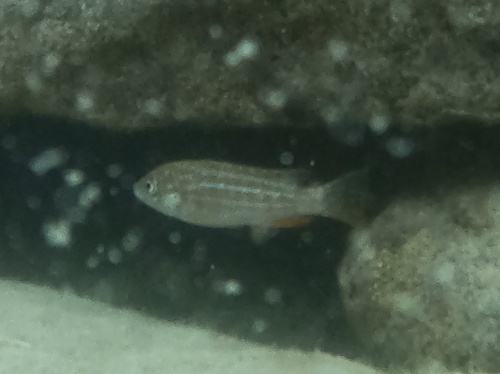
Sexual dimorphism is strong and is the easiest field mark. Dominant males are an intense, iridescent sky-blue, the dorsal fin pale-edged over a dark longitudinal band and the anal fin black with a scatter of yellow-to-orange egg-spots; when courting, frightened, or at night they can throw up seven to nine dark vertical bars. Females and juveniles look like a different fish entirely — pearly grey-green to blue-green with several wavy orange-brown longitudinal stripes along the flanks and bright blue gill covers, the trait that earned the "Pearl of Likoma" name. Meristic counts cited for the species run to roughly XVI–XVIII dorsal spines with 8–9 soft rays and III anal spines with 7–8 soft rays.
The blue male is easy to confuse with other solid-blue mbuna such as Pseudotropheus socolofi, and the striped females resemble several Labidochromis and Melanochromis — a similarity that matters in the tank, because lookalikes hybridize.
Range & habitat
Labidochromis joanjohnsonae is a lacustrine endemic with one of the smallest natural ranges of any Malawi cichlid: it is native only to Likoma Island, the larger of the two Mozambican-administered islands in the lake's northern half. A second population is established at Thumbi West Island, where the fish was introduced (along with several other Likoma mbuna) and is now common — a human-made range extension, not a natural one.
It is a shallow-water, rock-shore specialist. The species is most abundant around small rocks in very shallow water, typically less than 2.5 m (8 ft) deep; it ranges out to larger rocks down to about 7 m (23 ft) but becomes rare below roughly 4.5 m (15 ft). FishBase gives a working depth band of 1–5 m. The surrounding water is the warm, hard, alkaline epilimnion typical of Lake Malawi's rocky littoral — pH on the order of 7.0–8.5, moderate hardness, and temperatures around 24–26 °C (75–79 °F). Because it lives in the sunlit upper few meters, its entire world is the rock-and-Aufwuchs zone where light, algae and invertebrate life are richest.
Ecology & diet
Like most mbuna of the rocky shore, this is an omnivore that leans on the Aufwuchs — the carpet of algae, diatoms and associated micro-invertebrates that coats the rocks. In the wild it takes insect larvae and nymphs, small crustaceans, and other invertebrates picked from the biofilm, supplemented by the algal matrix itself. FishBase places it at a low trophic level of about 2.6, consistent with a diet weighted toward small animal prey and plant material rather than active predation.
That invertebrate-leaning, generalist feeding style is ecologically unremarkable for a Labidochromis but it is the key to its captive care: a fish evolved to graze and pick at a thin, constant film does not handle a rich, meat-heavy diet well. Within the densely packed mbuna community of the Likoma rocks it occupies the small-bodied invertebrate-picker niche, sharing the shallows with Labeotropheus, Pseudotropheus and other Labidochromis.
Behavior & breeding
Labidochromis joanjohnsonae is a maternal mouthbrooder, the standard haplochromine strategy: the female lays a small clutch, takes the eggs into her mouth, and is fertilized when she mouths the egg-spots on the male's anal fin. She then incubates eggs and fry orally — reports describe roughly 20–30 young carried for about three weeks at around 25 °C, and keepers note she often holds the brood longer than many of the vertically barred mbuna. Males establish and defend a small territory among the rocks and court by quivering and chasing off rivals.
The temperament is classic mbuna with a particular intraspecific edge. Across independent keeper reports the consensus is that males are "cranky" toward their own kind — two males in one tank is the usual flashpoint — while the fish is generally indifferent to dissimilar species. It is frequently sold as one of the more aggressive mbuna under the "exasperatus" name, but experienced keepers who have run it repeatedly describe ordinary mbuna attitude rather than the relentless hostility of, say, Melanochromis auratus. The other behavioral constant in the forums is how readily it hybridizes with similar Labidochromis and Melanochromis — a real concern, not a theoretical one, for anyone keeping lookalikes.
In the aquarium
This is a rewarding but firmly intermediate-level mbuna, not a beginner's community fish. Plan on a tank around 100 cm (4 ft) and 250 liters (about 65 US gal) at minimum, with larger footprints preferable for a mixed setup; the priority is a rock-dominated layout with abundant caves and broken lines of sight to diffuse aggression. Water should match the lake: hard, alkaline (pH roughly 7.5–8.5) and warm (around 24–26 °C / 75–79 °F).
Stock it the mbuna way — one male to three or four females. A lone pair tends to end as a single fish once the male's attention has nowhere to spread, and keeping multiple males in a small tank invites trouble. Feed mainly a vegetable- or Spirulina-based diet; despite its taste for invertebrates in the wild, this fish bloats and over-grows on rich, protein-heavy fare, so treat live and frozen foods as occasional rather than staple.
The two mistakes keepers make most often are both about identity. First, pairing it with similarly colored fish: blue males clash with other solid-blue species like socolofi, and the striped females read as rivals to other Labidochromis. Second, hybridization — because it crossbreeds so easily with related mbuna, anyone intending to raise true fry should run a species-only tank and avoid passing along mixed offspring. Confusingly, it still appears in the trade under several names ("exasperatus," "Labidochromis textilis," "Pearl of Likoma"), so buyers should verify what they are actually getting.
Conservation
The IUCN Red List assessed Labidochromis joanjohnsonae as Near Threatened in 2018 (criterion B1a). The reasoning is geographic: its natural range is so small — essentially the rocky shallows of Likoma Island, a single location — that it meets the area thresholds (extent of occurrence) that would qualify a declining species as Critically Endangered. It is listed only at Near Threatened rather than something higher because continuing population decline is plausible but unproven, and because the impact of the aquarium trade on wild stocks is genuinely unknown. (An older 2006 assessment of Vulnerable, still cited on some hobby pages, has been superseded by the 2018 evaluation.) The introduced Thumbi West population, while not natural, does mean the species exists in more than one place in the lake.
The honest summary is that the fish itself is not currently judged to be in steep decline, but its narrow-endemic biology leaves it with almost no margin for error. That risk sits inside a lake under real and documented strain. The basin-scale review by Chavula and colleagues (2023, Journal of Great Lakes Research 49(6):102241) catalogs the pressures on Lake Malawi/Niassa/Nyasa — a system holding an estimated 800–1,000 fish species, most of them endemic: over-fishing and the long decline of commercial stocks such as the chambo, rising sediment and nutrient loading washing off deforested catchments, climate-driven warming of the shallow water that strengthens stratification and trims productivity, and the threat of invasive species. For a fish that lives in the top few meters of one island's rocky shore, the most direct of these is shoreline and catchment change: sedimentation and nutrient runoff smother the rock surfaces and the Aufwuchs film a shallow grazer depends on, and a single-island endemic has nowhere to retreat to. So the framing is deliberately precise — the species is Near Threatened, not endangered, but it is a tiny-range fish in a large lake whose littoral habitat is being measurably degraded.
Sources
- Eschmeyer's Catalog of Fishes — Labidochromis joanjohnsonae (Johnson 1974)
- FishBase — Labidochromis joanjohnsonae (Pearl of Likoma)
- GBIF — Labidochromis joanjohnsonae / Pseudotropheus joanjohnsonae taxonomy
- IUCN Red List — Labidochromis joanjohnsonae (Near Threatened, 2018)
- Chavula et al. 2023 — Lake Malawi/Niassa/Nyasa basin: status, challenges, and research needs (J. Great Lakes Res. 49(6):102241)
- Cichlid Room Companion — Labidochromis joanjohnsonae (Patrick Tawil; synonymy & conservation note)
- malawi.si — Labidochromis joanjohnsonae 'Likoma Island' (habitat, dimorphism, breeding, taxonomic note; photos by Ad Konings)
- Cichlid-forum.com — Melanochromis joanjohnsonae (Pearl of Likoma): temperament, name history, hybridization (community) — community/anecdotal
- AquariaCentral.com — exasperatus / Pearl of Likoma: size and aggression (community) — community/anecdotal
- FishBase — Territory / distribution list for Labidochromis joanjohnsonae
- GBIF (German-language profile) — meristics and male/female coloration of Pseudotropheus joanjohnsonae
- Chavula et al. 2023 (ADS abstract) — Lake Malawi/Niassa/Nyasa basin status & stressors