Taxonomy & naming
Pseudotropheus purpuratus was described by Donald S. Johnson in 1976, in the hobbyist magazine Today's Aquarist (2(3):17-24), in a short paper introducing two new mbuna from Malawi alongside notes on several bicuspid-toothed Labidochromis. The species epithet purpuratus is Latin for "clad in purple," a nod to the dark blue-violet cast of breeding males. The genus name Pseudotropheus combines Greek roots loosely rendered as "false trophy," coined for the conspicuous, specialized teeth of these algae-rasping cichlids.
Before Johnson's description, and for years afterward in field literature, the fish circulated under the cheironym (an informal working name) Pseudotropheus sp. "Aggressive Blue" — the same label Ribbink and colleagues used in their landmark 1983 survey of Lake Malawi's rocky-shore cichlids, and the IUCN still notes as the name it was "previously known by." Pseudotropheus is a famously unsettled genus: it has been repeatedly split, and many former members have moved to Maylandia/Metriaclima, Tropheops, Chindongo and other genera as the mbuna flock has been revised. P. purpuratus has so far remained in Pseudotropheus proper. Specialists place it in an informal cluster of slender, elongate-snouted mbuna — Ad Konings' "dolphin" group — alongside close relatives such as Pseudotropheus fuscus and the still-undescribed P. sp. "aggressive grey." It sits within the rock-dwelling (mbuna) radiation of the lake's roughly 800-1,000 cichlid species, nearly all of them endemic.
Appearance
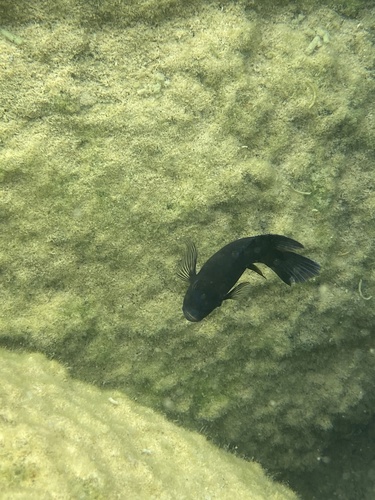
This is a modest-sized mbuna with a notably pointed, slightly elongated snout that marks it as one of the "dolphin" cichlids. Reported maximum size varies with how it is measured: FishBase lists about 4 in (10 cm) standard length, while field references following Konings give roughly 4.7 in (12 cm) total length in the wild — figures that largely reconcile once the tail is accounted for.
The sexes are strongly dichromatic. Dominant males are the namesake "aggressive blue": a body washed in blue to blue-violet, typically set off by a yellow or orange throat and chin, with longer, more produced fins. Females and subordinate, non-territorial males are a plainer brown overlaid with darker vertical bars — cryptic coloration that helps them slip through territories. As with most mbuna, color intensity is mood- and status-dependent; a male loses much of his blue when subdued, and stress or shipping can leave any individual washed-out. The combination of small size, a pointed snout, blue male/barred-brown female dimorphism and a yellow chin distinguishes it from blunter-faced congeners, though across its range it varies enough between sites that hobbyists track geographic forms (e.g. "Mumbo Island," "Maleri Island," "Thumbi West") rather than treating the species as uniform.
Range & habitat
Pseudotropheus purpuratus is endemic to Lake Malawi, with its type locality at Chizumulu (Chisumulu) Island. Despite that island origin it is fairly widespread along the southern lake: the IUCN range description has it along the western shore from the Maleri Islands south to Monkey Bay (including intervening islands but, tellingly, not the isolated Chinyankwazi/Chinyamwezi rocks), and along the eastern shore from Thumbi Point in Tanzania south through the Mozambican coast to the Nsinje River in Malawi. Familiar collection sites include Thumbi West Island, Nankoma, Tsano Rocks and Gome.
It is a shallow-water, rock-associated fish that favors the "intermediate" habitat — the zone where rock gives way to sand, strewn with small to pebble-sized stones rather than massive boulders. It occurs from the surface down to roughly 30 ft (9 m), most commonly in just 10-20 ft (3-6 m). That shallow, well-lit, surge-washed band is precisely where the algal films it grazes grow thickest. Lake Malawi's water suits the mbuna template it shares with its neighbors: warm (surface temperatures generally in the high 70s °F / mid-20s °C), hard and alkaline, with a high, stable pH around 7.7-8.6 — chemistry worth matching closely in captivity.
Ecology & diet
Like most mbuna, P. purpuratus is built around grazing the "Aufwuchs" — the carpet of attached algae, diatoms and the small invertebrates living within it that coats sunlit rock. Its specialized teeth pull and comb loose algal filaments; FishBase places it at a trophic level near 3.3, reflecting a diet that is mostly vegetable but not strictly herbivorous. Stomach-content work and field observation indicate it takes invertebrates from the algal turf as well, so it is best described as an algae-puller with an insectivorous streak rather than a pure herbivore.
What sets this species apart ecologically is gardening. It is among the mbuna that cultivate and defend algal "gardens" — patches of turf kept cropped and tended within a held territory, a small-scale farming behavior also seen in damselfishes on coral reefs. That investment in a fixed food patch helps explain the year-round territoriality: a tended garden is worth fighting for. In a rocky community already crowded with competing grazers, P. purpuratus carves out its niche by holding ground and managing its own forage rather than ranging widely.
Behavior & breeding
The defining trait is aggression, and it is not just male posturing. Ribbink et al. summed the wild fish up as "a small, highly aggressive species," and unusually for an mbuna both males AND females hold and defend feeding territories and algal gardens throughout the year, not only when breeding. Field observers rank it among the more pugnacious mbuna, with both sexes driving off intruders far larger than themselves.
Reproduction follows the classic Malawi-cichlid pattern: it is a polygynandrous maternal mouthbrooder. A territorial male spawns with visiting females, often within a cave or crevice among the rocks; descriptions note that spawning occurs inside the male's cave and that brooding females are seldom seen afterward, presumably retreating to shelter. The female alone incubates the eggs and then the wrigglers in her buccal cavity for several weeks before releasing free-swimming fry, with no further parental investment from the male. Some gravid females leave their own territories to spawn and have even been observed continuing to defend territory while carrying — a reminder of how central holding ground is to this fish's biology.
In the aquarium
P. purpuratus is a fish for experienced rift-lake keepers, not a community starter. The blue males and the species' broader reputation make it desirable, and it shows up in the trade under names like "Aggressive Blue" and (for certain geographic forms) "orange chin," but its temperament drives every stocking decision. Specialist references recommend a tank of at least roughly 130 gallons (500 L), and if you want more than one displaying male they advise a footprint on the order of 6.5 ft (2 m) long — extreme rockwork with abundant caves and crevices to break sightlines and let subordinate fish and females escape. Match the lake's chemistry: hard, alkaline water and a pH in the high 7s to mid 8s, kept warm and clean against the heavy feeding load of an mbuna tank.
The diet should be predominantly vegetable — a quality spirulina/algae-based prepared food — to mirror its natural grazing and avoid the bloat that plagues herbivorous mbuna fed too much protein. On compatibility, treat it as you would any hot-tempered mbuna: the broad hobbyist consensus is to keep mbuna with mbuna of similar vigor, avoid slow or timid tankmates, and stock the tank fairly heavily so aggression is diffused across many targets rather than focused on one. Because both sexes are territorial, even female-heavy groups can bicker. The common mistakes are predictable — undersized tanks, too little rock, mixing it with peaceful fish, and over-feeding protein — and each of them tends to end badly with this species.
Conservation
The IUCN Red List assesses Pseudotropheus purpuratus as Least Concern (assessed 20 June 2018; assessor Ad Konings), an upgrade from its earlier 2006 listing as Vulnerable. The reasoning is straightforward: it is endemic to Lake Malawi but widespread and common within its southern-lake range, the population is judged stable, and some subpopulations fall inside Lake Malawi National Park. It is not targeted by the ornamental trade, so collection pressure is not a meaningful threat. The one species-specific concern the assessment flags is sedimentation of its shallow rocky habitat.
That caveat matters because this is a shallow, rock-and-sand grazer whose food supply — the algal turf on sunlit stone — is exactly what silt smothers. The wider basin is under real strain. Chavula et al.'s 2023 status review of the Lake Malawi/Niassa/Nyasa basin (Journal of Great Lakes Research 49(6):102241) catalogs the pressures: over-fishing and the collapse of the commercial chambo (Oreochromis) fishery; heavy sediment and nutrient loading washing off deforested, eroding catchments; roughly 0.7 °C of warming in shallow waters that strengthens stratification and reduces the mixing that sustains productivity; and growing invasive-species risk. Fluvial sediment delivered to rocky shores has been shown to degrade exactly the intermediate-zone Aufwuchs communities that fish like the "aggressive blue" depend on. So the honest reading is this: the species itself is, for now, Least Concern and locally abundant, but it sits in the precise habitat guild — shallow rocky-shore algae grazer — most exposed to the shoreline development, deforestation and sedimentation eroding Lake Malawi's near-shore. Its security rests on the health of that near-shore, not on any inherent safety.
Sources
- Pseudotropheus purpuratus — FishBase summary
- Pseudotropheus purpuratus — FishBase (Malawi country record)
- Eschmeyer's Catalog of Fishes (California Academy of Sciences)
- Pseudotropheus purpuratus — Cichlid Room Companion species profile (taxonomy & references)
- Pseudotropheus purpuratus 'Chiloelo' — malawi.si (Konings data)
- Pseudotropheus purpuratus 'Mumbo Island' — malawi.si
- Johnson, D.S. 1976. Two new cichlids of the Mbuna group from Malawi. Today's Aquarist 2(3):17-24 (original description; cited via CRC bibliography)
- Leibel, W. 'Cichlidophiles — Pseudotropheus purpuratus, the Aggressive Blue Mbuna from Lake Malawi.' Tropical Fish Hobbyist 53(5):44-47 (indexed via CRC)
- Ribbink, A.J. et al. 1983. A preliminary survey of the cichlid fishes of rocky habitats in Lake Malawi. S. Afr. J. Zool. 18:149-310 (PDF)
- Duponchelle, F. The potential influence of fluvial sediments on rock-dwelling cichlids, Lake Malawi (PDF)
- Pseudotropheus purpuratus — IUCN Red List (Konings 2018, Least Concern)
- Chavula, G. et al. 2023. Lake Malawi/Niassa/Nyasa basin: Status, challenges, and research needs. J. Great Lakes Res. 49(6):102241
- r/Cichlid — mbuna tankmates and stocking-to-spread-aggression discussions — community/anecdotal
- r/Cichlid — keeping mbuna and overstocking to diffuse aggression — community/anecdotal
- Cichlid Fish Forum (cichlid-forum.com) — Pseudotropheus aggression threads — community/anecdotal
- African Cichlids Breeding community — Pseudotropheus purpuratus 'orange chin' in the trade — community/anecdotal