

Taxonomy & naming
George Albert Boulenger described this fish in 1908 as Paratilapia esox, from specimens collected in Lake Nyasa (now Lake Malawi) by Captain E. L. Rhoades; the syntypes remain in the Natural History Museum, London. The species was later moved into Rhamphochromis, a genus whose name fuses the Greek rhamphos (beak or bill) with chromis, an old name for a perch-like fish — an apt label for these long-snouted hunters. The species epithet esox borrows the scientific name of the northern pike, signaling the same elongate, ambush-predator body plan.
Rhamphochromis has long frustrated taxonomists because its species are slender, variable, and easy to confuse, and they often swim in mixed schools. Eschmeyer's Catalog of Fishes treats R. esox as valid, with Rhamphochromis leptosoma (Regan, 1922) and Rhamphochromis melanotus (Ahl, 1927) as junior synonyms — a conclusion Turner and colleagues reached in their 2004 review of the genus, where they noted that folding those names in makes R. esox "the most distinctive and readily identified species of the genus." (Some databases, including the IUCN assessment, instead list R. lucius among its synonyms, a reminder that the genus-level bookkeeping is still imperfect.) In the trade it is sold simply as Rhamphochromis esox or as the "Malawi barracuda"; Malawians group the elongate Rhamphochromis predators under the local name mcheni.
Appearance
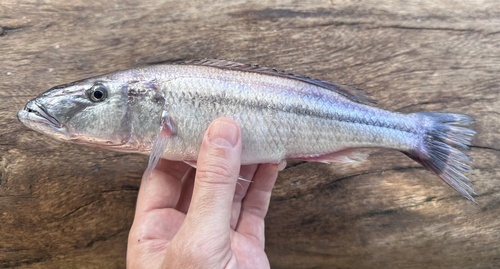
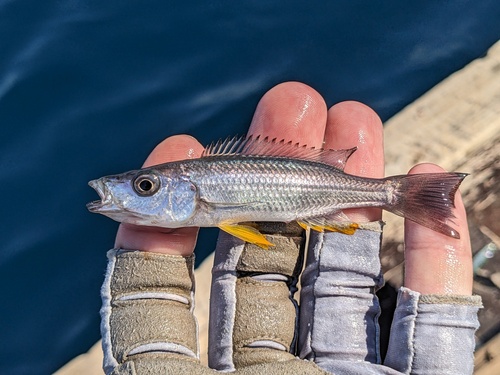
Everything about R. esox is built for speed. The body is extremely elongate and streamlined, rounder in cross-section than most congeners, tapering to a long, slender caudal peduncle and a powerful tail. The mouth is large and the jaws are lined with conspicuous teeth — even juveniles a few inches long show them plainly. A broad dark horizontal stripe frequently runs along the flank, a feature shared with the similar R. lucius and one of the reasons identification within the genus is so fraught.
This is among the larger Rhamphochromis: FishBase and the IUCN both give a maximum of 42 cm (about 17 in) standard length, and field workers report most adults a little under that, around 39 cm SL. Mature males develop the showiest coloration — orange pelvic fins, a dorsal and anal fin that can flush blue, and an anal fin bearing up to about eight eggspots that may turn intensely orange — while the overall ground color stays silvery and pike-like. Sexual dimorphism is otherwise modest, and because several Rhamphochromis look alike and hybridize the eye in mixed schools, even specialists treat single-fish identifications with caution.
Range & habitat
Rhamphochromis esox is endemic to the Lake Malawi system, shared by Malawi, Mozambique, and Tanzania, where it is abundant and distributed lake-wide. FishBase records it across a depth band of roughly 2 to 65 m (6.5 to 213 ft), in water that runs warm and hard: about 23-27 °C (73-81 °F), pH 7.4-8.5, and moderate-to-high hardness typical of the lake.
What sets it apart from its relatives is where it spends its time. Most Rhamphochromis are creatures of the offshore deep water, but R. esox favors the shelf and rocky-reef zones where the bottom is fairly shallow, and it is frequently encountered near the surface and close to shore — it is rarely found far offshore. Small juveniles are scattered through the littoral zone in swampy, sandy, and rocky habitats, and adults turn up regularly in the shallows off sandy beaches. That shoreward, surface-oriented life is the single most important fact about the species, because it overlaps directly with where people fish.
Ecology & diet
Rhamphochromis are the principal piscivores of Lake Malawi's open water, and R. esox sits near the top of that guild — FishBase places it at a trophic level around 4.2, the signature of a dedicated fish-eater. Its staple prey are the lake's small, shoaling fishes: young utaka (open-water Copadichromis and kin) and especially the lake sardine usipa, Engraulicypris sardella, the silvery clupeid-like cyprinid that dominates the pelagic forage base.
Feeding tracks the prey's daily rhythm. Studies of the genus describe most feeding by day, with peaks at dawn and dusk that follow the vertical migrations of zooplankton-feeding prey through the water column. The streamlined body and toothy jaws are the tools of pursuit predation rather than ambush: R. esox runs down its quarry in open water, and is routinely netted alongside the very usipa shoals it hunts. As a mid-to-upper-level predator it helps regulate the abundance of these small pelagic fishes, knitting the lake's plankton-fueled forage base to its larger carnivores.
Behavior & breeding
Like the rest of the genus, R. esox is a maternal mouthbrooder. Females spawn with territorial males, take the fertilized eggs into the buccal cavity, and brood the clutch for roughly three to four weeks before releasing free-swimming young; there is no sharply defined breeding season. Recorded fecundity is comparatively high for the genus, on the order of 117 to 680 eggs, and the fish mature early — around 18.7 cm SL in females and 20.4 cm SL in males — with a short generation length of about two to three years. That fast turnover gives the species real resilience on paper, even as fishing pressure works against it.
In the wild it is a schooling, open-water animal rather than a rock-bound territory holder. Aquarist accounts of temperament diverge in a way that is itself informative: some keepers describe a confident "bully" that strikes anything hitting the surface like a torpedo, while others call their fish calm, even skittish, hovering motionless near a vertical rock for minutes before a sudden dash. The common thread is that aggression toward tankmates is modest for a predator its size — the danger is to anything small enough to swallow, which it hunts relentlessly, not to comparable cichlids.
In the aquarium
This is a fish for experienced keepers with space, not a community centerpiece. It is genuinely uncommon in the hobby — keepers describe it as rare and hard to source, occasionally turning up cheaply and unlabeled as a juvenile at a local shop — and it does not come from the ornamental trade so much as the occasional wild import. A fast, open-water swimmer that can approach a foot and a half in total length wants a long tank with lots of unobstructed swimming room; a six-foot footprint is a sensible floor, not a luxury. Match the lake: warm water around the mid-70s °F (mid-20s °C), hard and alkaline, pH comfortably above 7.5, with strong filtration to support a meat-eater's bioload.
The non-negotiable rule is prey size. R. esox will hunt and eat any tankmate small enough to fit in its mouth, including fry and small mbuna, so companions must be too large to swallow — robust haps and similarly sized predators are the realistic pool. Keepers report it gets along with comparable fish without the relentless flank-nipping of true mbuna, but it can be flighty in a sparse tank and may dash into the glass when startled, so give it cover and avoid skittish, crowded setups. Breeding has been done — owners have maintained spawning groups — but the limiting step is simply finding a female of a correctly identified fish, since mixed and misidentified Rhamphochromis are common in the trade.
Conservation
The IUCN Red List assesses Rhamphochromis esox as Vulnerable (VU A2d), in an assessment dated 23 May 2018 by Konings and Kanyerere (amended 2019). Despite being endemic to Lake Malawi with a lake-wide, abundant distribution, the species has declined sharply: catch records from the southern arm, where data exist, show an estimated 80% drop over a decade, and the lake-wide decline is put at roughly 30% over the same period, with the population still trending downward. The driver is fishing. Because R. esox uniquely comes into shallow, near-surface inshore water, it is caught on hand lines and in gill nets, longlines, chirimila and beach seines, and its juveniles are taken in small-meshed seines working the very inshore vegetation they use as nursery grounds. It is not targeted by the aquarium trade. Part of the juvenile population falls within Lake Malawi National Park, offering some refuge.
That species-level picture sits inside a strained basin. The Chavula et al. (2023) review of the Lake Malawi/Niassa/Nyasa basin (Journal of Great Lakes Research 49(6):102241) documents a lake under mounting anthropogenic and climatic stress — over-fishing that has hammered stocks such as the iconic chambo, rising sediment and nutrient loading washing off deforested catchments, the looming risk of invasive species, and climate warming and variability. Warming of the shallow water (on the order of +0.7 °C in recent decades) strengthens the lake's stratification and tends to suppress the nutrient mixing that fuels productivity at the base of the food web. For a near-surface predator that depends on shoals of usipa and young utaka, that combination is doubly concerning: the inshore fishery removes the adults directly, while any climate-driven erosion of the pelagic forage base would squeeze the prey it relies on. The honest summary is that R. esox is not yet rare, but it is a fish whose shallow-water habits expose it to the lake's two heaviest pressures at once — and its status has already moved off "Least Concern" because of it.
Sources
- Eschmeyer's Catalog of Fishes: Rhamphochromis esox (species record)
- FishBase: Rhamphochromis esox (Boulenger, 1908)
- IUCN Red List: Rhamphochromis esox (Vulnerable, assessed 2018; Konings & Kanyerere)
- iNaturalist taxon: Rhamphochromis esox
- Cichlid Room Companion: Rhamphochromis esox species profile (public page)
- malawi.si: Rhamphochromis esox 'Narungu' (Ad Konings / Gregor Bauer)
- Ngwira (2021), GRÓ Fisheries Training Programme: aquaculture potential of Rhamphochromis (ecology, maturity, fecundity, breeding)
- Turner, Robinson, Shaw & Carvalho (2004): Identification and biology of Diplotaxodon, Rhamphochromis and Pallidochromis (genus revision, via Catalog of Fishes references)
- Chavula et al. (2023): Lake Malawi/Niassa/Nyasa basin: Status, challenges, and research needs, J. Great Lakes Res. 49(6):102241
- Chavula et al. (2023), publisher record (ScienceDirect / Elsevier)
- MonsterFishKeepers forum: 'Rhamphochromis esox' (keeper accounts — size, temperament, 'barracuda of Lake Malawi') — community/anecdotal
- MonsterFishKeepers forum: 'Rhamphochromis cf. esox info' (keeper accounts — behavior, tank, rarity) — community/anecdotal
- Cichlid Fish Forum (cichlid-forum.com) — Lake Malawi keeping practice (community reference) — community/anecdotal
- Reddit r/Cichlid — Lake Malawi keeping discussion (community reference) — community/anecdotal
- FishBase Catalog of Fishes reference: Boulenger 1908 original description of Paratilapia esox