
Taxonomy & naming
Albert Günther described this fish in 1864 as Hemichromis longiceps, working from dried half-skins collected during David Livingstone's Zambezi expedition to "Lake Nyassa" — the syntypes (BMNH 1863.12.21.5) are still curated at the Natural History Museum in London. It was later moved into the genus Rhamphochromis, where it stands today as Rhamphochromis longiceps (Günther, 1864), accepted by Eschmeyer's Catalog of Fishes, FishBase, and the IUCN alike. The genus name pairs the Greek rhamphos, a beak or bill, with chromis, an old name for a perch-like fish — an apt nod to the elongate, predatory head — while the species epithet longiceps simply means "long-headed."
Rhamphochromis belongs to the cichlid subfamily Pseudocrenilabrinae and the haplochromine radiation, and sits within the endemic Lake Malawi pelagic clade sometimes called Rhamphochromina. This is a genus that has long frustrated taxonomists: the species are slender and superficially similar, and R. longiceps in particular was for decades confused with R. macrophthalmus (Regan, 1922), which the IUCN treats as a synonym and which reaches a similar size and shares similar male breeding colours. Much older ecological literature lumps the two, so some historical "R. longiceps" records likely mix species. Modern molecular work (Genner et al.; and a 2025 phylogenomic study of the clade in Genome Research) confirms that the sampled Malawi Rhamphochromis form distinct, reciprocally monophyletic lineages and that the group has undergone dramatic, repeated shifts in body size during its radiation.
Appearance
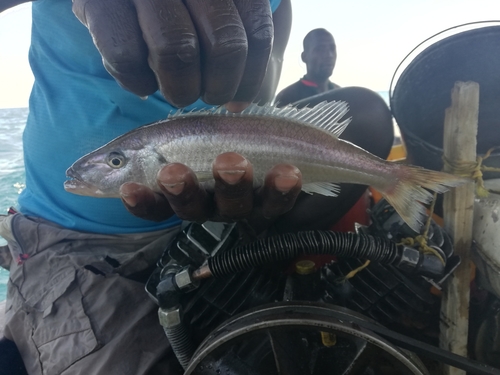
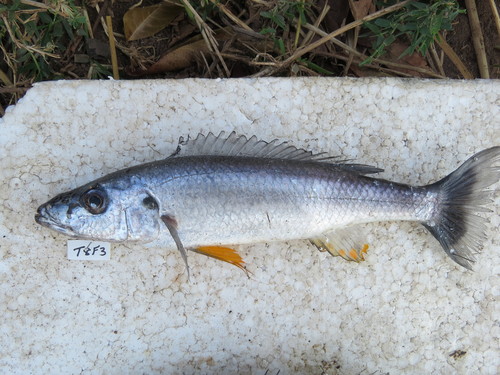
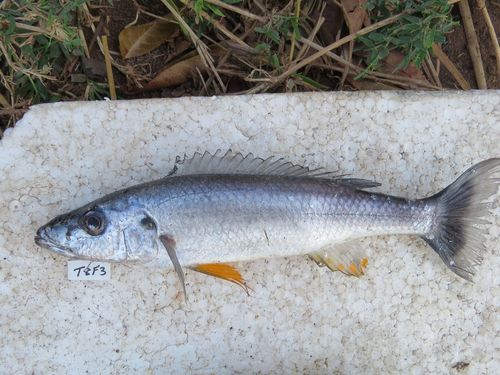
This is an unmistakably predatory shape: long, laterally compressed, and streamlined, with a pointed, elongated head and a large terminal mouth set with small, closely packed teeth rather than the heavy fangs the "tigerfish" and "barracuda" trade names might suggest. Reported maximum size varies a little between sources — FishBase lists 28 cm (11 in) total length while the IUCN assessment gives 25 cm (10 in) TL, and field references put typical adults around 20 cm (8 in) standard length — so a fair summary is a fish that matures small but can reach roughly 10–11 in (25–28 cm).
Colour is subtle and silvery, suited to open water rather than the gaudy reef. Larger fish often carry a bright greenish metallic iridescence over the upper body; mature, breeding males turn a darker bluish-grey on the back and, in lake populations, can show bright orange pelvic fins, while females and immatures keep a more greenish dorsal cast. Because R. longiceps overlaps so closely with its congeners in size and male colour, in-hand identification leans on details — the relatively small, tightly packed teeth, a comparatively deep cheek, and the modest maximum size — more than on any single field mark.
Range & habitat
Rhamphochromis longiceps is endemic to the Lake Malawi system, distributed lake-wide across the Malawian, Mozambican, and Tanzanian waters and extending into the upper Shire River, the lake's only outflow. The IUCN puts its estimated area of occupancy near 2,700 km2 within an extent of occurrence of about 29,600 km2 — a wide but lake-bounded range typical of a Malawi endemic.
Unlike the rock-bound mbuna, this is a fish of open and intermediate water. It has been recorded from reedy bays and lagoons, over open sandy beaches, throughout the shelf and reef zones, and out into the offshore pelagic. Depth records span from a few metres to around 74 m in the IUCN assessment, with FishBase noting occurrences down to roughly 148 m, though the species concentrates in the productive upper water column where its prey shoals. The relevant chemistry is the lake's own: Malawi is warm, clear (Secchi readings up to about 17 m), alkaline, and strongly and permanently stratified, with anoxic water below roughly 250 m that the whole pelagic community is confined above. Mouthbrooding females and juveniles move shallow, gathering in surface water of the shelf and littoral and especially in sheltered, vegetated inshore bays.
Ecology & diet
R. longiceps is a piscivore and one of the principal predators of Lake Malawi's open water. Its diet shifts with age in a textbook way: small juveniles feed mainly on crustacean zooplankton, then graduate to fish as they grow, with adults preying predominantly on the larvae and juveniles of Engraulicypris sardella — the small, silvery, schooling cyprinid known locally as usipa and one of the most abundant pelagic fishes in the lake. FishBase places the species at a trophic level of about 3.8, squarely mid-to-upper in the food web.
That role matters at the scale of the whole lake. Fisheries reviews identify Rhamphochromis and Diplotaxodon as the main cichlid predators of the pelagic zone, the open-water counterparts to the catfishes Bagrus and Bathyclarias that dominate the demersal stocks. By cropping young usipa, R. longiceps sits at a junction between the lake's enormous zooplankton production and its commercially important sardine fishery — a reminder that even a modest-sized cichlid can be an ecologically significant predator when its prey numbers in the billions.
Behavior & breeding
Like the great majority of Lake Malawi cichlids, R. longiceps is a maternal mouthbrooder: the female incubates the fertilised eggs and then the free-swimming fry in her mouth, releasing them in protected water. Broods are small for a cichlid — the IUCN cites a fecundity of about 27–68 eggs, and field references a comparable 52–76 — fitting a fish that invests in relatively few, well-guarded young rather than a flood of eggs. Reported minimum size at maturity is roughly 13.8 cm for males and 14.3 cm for females (about 109 mm and 130 mm standard length in field data), and ripe fish have been recorded across multiple months, suggesting a protracted rather than sharply seasonal breeding period.
The striking part of its life history is a migration. Brooding females leave the open lake and move into shallow, sheltered, weedy inshore areas — vegetated lagoons and swampy bays, including those within Lake Malawi National Park — to release their fry, after which the juveniles stay inshore near the surface before recruiting back to open water. It is precisely this predictable shoreward movement that exposes an otherwise offshore fish to inshore fishing pressure. Generation length is short, around one to two years, and the species is a fast, restless swimmer in keeping with a life spent chasing prey across open water.
In the aquarium
In the hobby R. longiceps and its relatives trade as the "Malawi barracuda" or "tigerfish," and they are an uncommon, specialist's fish rather than a beginner's Malawi cichlid. Keepers who have kept them describe exactly what the body shape promises: a fast, almost constantly cruising predator that takes meaty foods readily — silversides and similar fish foods — and can be weaned onto quality pellets over time. Encouragingly, the same first-hand reports note that despite the "barracuda" billing they can be surprisingly peaceful toward tankmates outside of breeding, behaving more as a busy open-water swimmer than a bruising territorial cichlid.
The practical demands follow from the natural history. This is an active, open-water hunter, so the real requirement is swimming length and pristine, well-oxygenated water rather than a maze of rockwork; a long tank with clear horizontal space suits it far better than a typical mbuna rock setup. Anything small enough to fit the mouth will be treated as food, so tankmates should be robust, similarly sized open-water or hap-type cichlids, not small or slender fish. Honesty also means flagging availability: experienced keepers note these fish surface in the trade only sporadically, and much of what circulates online conflates the several Rhamphochromis "barracuda" forms, so buyers should treat any single care sheet with caution.
Conservation
The IUCN Red List assesses Rhamphochromis longiceps as Vulnerable (criterion A2d), based on an assessment dated 23 May 2018 (published 2019, assessor A. Konings, amended only to add point data). Although it is common and genuinely lake-wide, its population trend is decreasing: fishery catch records from the southern arm — where data exist — indicate a roughly 80% decline over a recent ten-year window, and the lake-wide decline is estimated near 30% over the same period. The threats are overwhelmingly fishing: it is taken in large numbers by mid-water and demersal trawlers in the south, plus gillnets, seines, chirimila nets, and hand lines, and is collected irregularly by the ornamental trade. Its shoreward breeding migration compounds the risk, concentrating an offshore fish in shallow, easily netted water at exactly the wrong moment. So the headline is specific and not overstated: a widespread fish that is nonetheless declining, primarily through over-harvest.
That species-level picture sits inside a strained basin. The Chavula et al. (2023) review of the Lake Malawi/Niassa/Nyasa basin (Journal of Great Lakes Research 49(6):102241) catalogues severe and compounding stressors across the lake: heavy and rising fishing pressure and the well-documented collapse of the chambo (Oreochromis) fishery, sediment and nutrient loading washing off deforested catchments, climate warming and variability, and the risk posed by invasive species. Shallow-water warming on the order of +0.7 C strengthens the lake's already permanent stratification, limiting the mixing that returns nutrients to the lit surface layer and thereby trimming the pelagic productivity that ultimately feeds usipa — and so feeds R. longiceps. For a predator tied to the open-water sardine and to inshore nursery bays, the relevant pressures are thus twofold: the same trawl and net fishery that targets it directly, and the slower erosion of the productive, well-mixed pelagic and unsilted shoreline its life cycle depends on. The fish itself is not endangered, but the system it hunts in is under real and accelerating strain.
Sources
- Eschmeyer's Catalog of Fishes: Rhamphochromis longiceps (Günther 1864)
- FishBase: Rhamphochromis longiceps (Tigerfish) summary
- IUCN Red List: Rhamphochromis longiceps (Vulnerable, 2018 assessment)
- Chavula et al. 2023, Lake Malawi/Niassa/Nyasa basin: Status, challenges, and research needs (J. Great Lakes Res. 49:102241)
- Chavula et al. 2023, full text (ScienceDirect)
- Magasa, FAO: A brief review of the fish stocks and dependent fisheries of Lake Malawi
- Genner et al. 2007, Evolution of a cichlid fish in a Lake Malawi satellite lake (Proc. R. Soc. B 274:2249)
- Dynamic body size evolution during speciation of predatory cichlid fishes (Genome Research 36:949)
- Identification and Biology of Diplotaxodon, Rhamphochromis and Pallidochromis (Turner et al.)
- Identification of the Cichlid Fishes of Lake Malawi/Nyasa, Part 3: Rhamphochromina and others
- malawi.si: Rhamphochromis longiceps biotope and species profile
- Cichlid Room Companion: Rhamphochromis sp. 'chilingali' (genus context, public page)
- Francis, UNU-GRO: light-attraction (chilimira) fishery effects on Engraulicypris and Rhamphochromis
- MonsterFishKeepers forum: Malawi barracuda (keeping experience) — community/anecdotal
- Reddit r/Cichlid: Malawi barracuda discussion — community/anecdotal
- Cichlid-Forum: Lake Malawi Species board — community/anecdotal
- American Cichlid Association group: Lake Malawi pelagic predators discussion — community/anecdotal