
Taxonomy & naming
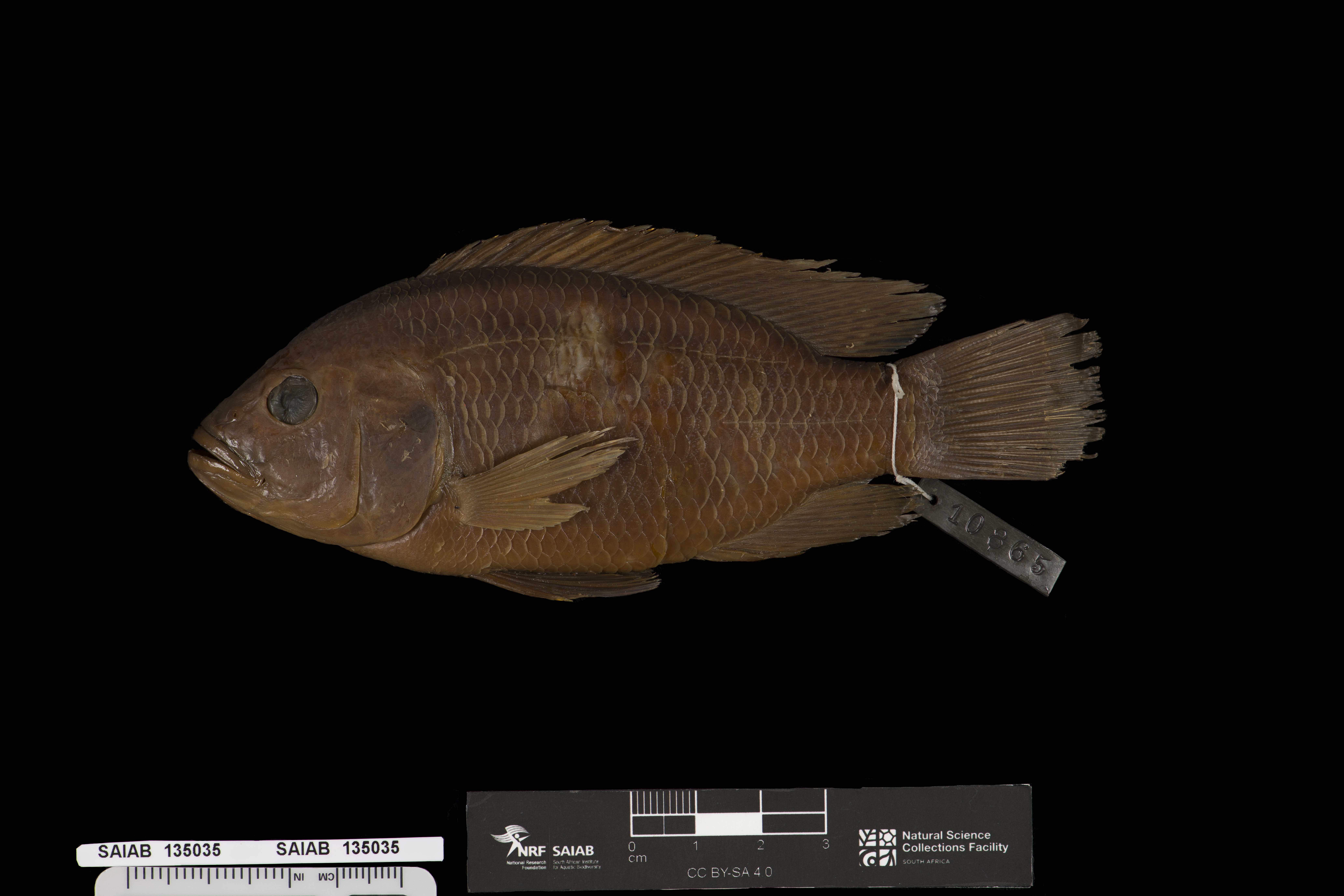
George Albert Boulenger described this fish in 1908 as Paratilapia codringtonii, from material taken in the Zambezi River above Victoria Falls. Eschmeyer's Catalog of Fishes records the lectotype (BMNH 1908.11.6.32) and tracks the name through two later genus moves: Skelton and Teugels placed it in Serranochromis in 1991, and Skelton transferred it to Sargochromis in 1993, where it has remained valid as Sargochromis codringtonii (Boulenger, 1908). Tilapia woosnami Boulenger, 1911 and Paratilapia marginata Gilchrist & Thompson, 1917 are junior synonyms. The species epithet honors Thomas Codrington (1829-1918), a British engineer and antiquarian; the genus name pairs Greek sargos (a sea bream) with chromis.
Sargochromis was long treated as a subgenus of Serranochromis, separating the smallmouth, invertebrate-feeding "happies" from the largemouth, piscivorous "breams." Both belong to the serranochromine flock that radiated across the Zambezi, Okavango, Kafue and Congo-fringe drainages — a continental radiation distinct from the great endemic species flocks of the Rift lakes. A point worth stating plainly: S. codringtonii is not a Lake Malawi cichlid. Authoritative sources (Catalog of Fishes, FishBase, and the IUCN assessment) place it firmly in the Okavango and upper-to-middle Zambezi, and any record attaching it to Lake Malawi conflates it with that lake's unrelated haplochromine fauna.
Appearance
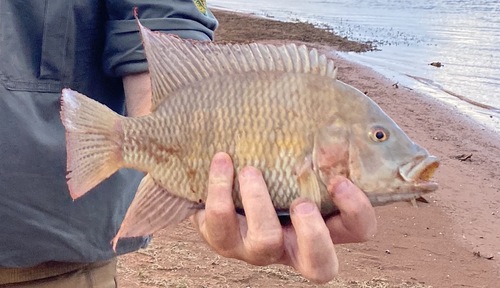
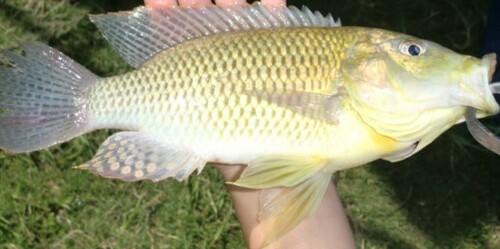
The green happy is a deep-bodied, laterally compressed cichlid with a gently convex forehead and a slightly subterminal mouth — the profile of a fish built to work the bottom rather than chase prey in open water. FishBase gives the fin formula as nine dorsal spines and ten soft rays, three anal spines and eight soft rays. Maximum size is about 39 cm (15 in) total length and around 2.2 kg (4.9 lb), though most fish encountered are well under that; it is a medium-large cichlid by any standard.
Coloration is the muted greenish-bronze that earns the common name, often with darker flank markings and a sheen that brightens in breeding condition. Like its congeners it shows the size-related sexual dimorphism typical of the group — Winemiller's Barotse floodplain study found males maturing near 150 mm standard length and females a little smaller (125-150 mm), with males reaching larger maximum sizes. The convex snout and digging-oriented jaws are the most useful field cues separating it from the largemouth Serranochromis "breams," which have bigger, more terminal mouths; telling the several smallmouth Sargochromis species apart, however, often comes down to careful counts and proportions rather than color.
Range & habitat
Sargochromis codringtonii is native to the Okavango (Okovango) system, the upper and middle Zambezi, and the Kafue River, spanning Angola, Namibia, Botswana, Zambia and Zimbabwe, with a report from the Kunene as well. The IUCN assessment notes it is generally sparse in the Zambezi proper and uncommon in the Upper Zambezi and Okavango Delta, but that it adapted strikingly well to Lake Kariba — the giant reservoir on the middle Zambezi — where it became one of the more numerous large cichlids after impoundment in the 1960s.
Its preferred biotope is quiet water: deep, slow-flowing channels, floodplain lagoons and backwaters, and shallow vegetated fringes, rather than fast main-channel current. Winemiller classed it among the lagoon- and backwater-dwelling serranochromines of the Barotse floodplain, where a sand substrate appeared to be a critical habitat component for its digging style of foraging. In-situ conditions on that floodplain are soft and acidic: water over Kalahari sands ran roughly pH 6.3-7.0 and 18-28 °C (64-82 °F) through the seasons, clear but often tea-stained with organics and nutrient-poor — a very different chemistry from the hard, alkaline Rift lakes.
Ecology & diet
This is where the green happy gets genuinely interesting, because two careful studies disagree, and the disagreement is real rather than an error. Winemiller's 1991 survey of the Upper Zambezi floodplain found that small seeds were the single most important food of large S. codringtonii (about 63% by volume), with snails a minor 6%; smaller fish took more chironomid larvae, substrate particles and aquatic insects, the mix of a bottom-digging generalist. FishBase, drawing on regional fisheries work, similarly lists Nymphaea (water-lily) seeds, aquatic insects, mollusks and even fish scales among its foods.
Moyo's 2002 study in Lake Kariba told a different story: there, the diet of adults was dominated by prosobranch snails, and the fish's jaw and pharyngeal morphology was well suited to a molluscivorous habit. The reconciliation is ecological — a flexible bottom-forager eats what a given habitat offers, lily seeds and insects on a clear sand-bottomed floodplain, snails in a snail-rich reservoir. That same study punctured a long-standing hope: because the fish largely ignores the pulmonate snails that carry schistosomiasis (taking prosobranchs instead), it is a poor biological control agent against the disease, despite frequently being proposed for that role. FishBase places it at a trophic level near 3.1, the omnivore-leaning-carnivore band the diet data support.
Behavior & breeding
Like all members of the Serranochromis-Sargochromis group, S. codringtonii is a maternal mouthbrooder: the female incubates fertilized eggs and early fry in her buccal cavity. FishBase describes it as an ovophilic, female mouthbrooder, and Winemiller documented a 209 mm female carrying developing zygotes in her mouth in November on the Barotse floodplain — direct field evidence of the strategy and its timing.
Breeding is keyed to the annual flood cycle. Across the Upper Zambezi serranochromines, spawning is initiated just before the rains and rising water, so that mouthbrooding females can carry their broods out onto the freshly inundated plain and release fry into expansive, low-predator nursery habitat. Fish in this species mature at roughly two years; fecundity is modest for the genus — a single ripe Barotse female held about 580 mature oocytes, far below the >1,000 of the larger piscivorous "breams." Sources note it probably spawns twice in a season. Compared with the territorial, reef-bound mouthbrooders of the Rift lakes, the green happy's social and breeding behavior is comparatively poorly documented; what is established is the mouthbrooding mode and its tight coupling to the flood pulse.
In the aquarium
Honest answer: this is not a common aquarium fish, and the hobby literature on it is thin. It is primarily an angling and food fish in its native range — a "gamefish" in FishBase's terms — rather than an export ornamental, and it does not appear in the curated hobby care archives the way Rift-lake cichlids do. The Cichlid Room Companion maintains a species profile, but most of its keeping notes sit behind a subscriber paywall, so corroborated, hands-on care data is genuinely scarce; treat any single care-sheet claim about it with caution.
What can be said responsibly comes from its biology. At up to 15 in (39 cm) it is a large cichlid that would need a long, wide tank measured in hundreds of gallons, with a sand bottom it can sift and dig. Its natural water is soft and near-neutral to mildly acidic and warm (roughly 64-82 °F / 18-28 °C), which is the opposite of the hard, alkaline conditions Malawi and Tanganyika cichlids want — so it should never be mixed into a generic "African cichlid" hard-water community on the assumption that all African cichlids are interchangeable. As a substantial molluscivore/omnivore it would view small tankmates as food and needs robust, similarly sized companions if kept communally. In short: a specialist's fish, sized for serious aquarists, not a beginner purchase.
Conservation
The IUCN Red List assesses Sargochromis codringtonii as Least Concern (Marshall & Tweddle, assessed 1 March 2007), with an unknown population trend and no known major threats; the assessment flags itself as needing updating. Its justification is straightforward — the species is widespread across the Zambezi system and numerous in Lake Kariba, and it enjoys some incidental protection within game reserves. There is no targeted-collection pressure on it for the aquarium trade, and CITES has not evaluated it. In plain terms, the species itself is not currently of conservation concern.
Because this is a Zambezi-Okavango fish, the relevant basin pressures are those of the Zambezi system and reservoirs like Kariba — fishing pressure on floodplain stocks, habitat alteration from impoundment and flow regulation, and the sediment and nutrient changes that follow catchment land use. Its flood-pulse breeding and floodplain-lagoon habitat make it sensitive to anything that dampens the annual inundation that its reproduction depends on. The Lake Malawi/Niassa/Nyasa basin review by Chavula et al. (2023, Journal of Great Lakes Research 49(6):102241) documents the parallel strains on that Rift lake — over-fishing and the chambo (Oreochromis) decline, sediment and nutrient loading off deforested catchments, roughly +0.7 °C of shallow-water warming that strengthens stratification and cuts productivity, and invasive-species risk — but that source is included here only as context for the lake this fish is sometimes mistakenly linked to. S. codringtonii does not live in Lake Malawi, so those basin pressures do not bear on it directly; the honest framing is that a Least-Concern Zambezi cichlid has been misattributed to a lake under genuine strain, and the two should not be conflated.
Sources
- Eschmeyer's Catalog of Fishes — Sargochromis codringtonii (species record)
- FishBase — Sargochromis codringtonii (Green happy) summary
- GBIF — Sargochromis codringtonii (Boulenger, 1908)
- IUCN Red List — Sargochromis codringtonii (Marshall & Tweddle 2007, Least Concern)
- Winemiller, K.O. 1991. Comparative ecology of Serranochromis species in the Upper Zambezi River floodplain. Journal of Fish Biology 39(5):617-639
- Moyo, N.A.G. 2002. Aspects of the feeding ecology of Sargochromis codringtonii in Lake Kariba, Zimbabwe. African Journal of Ecology 40(3):241-247
- Cichlid Room Companion — Sargochromis codringtonii species profile (public page)
- Cichlid Room Companion — Sargochromis genus page (public)
- Chavula, G.M.S. et al. 2023. Lake Malawi/Niassa/Nyasa basin: Status, challenges, and research needs. Journal of Great Lakes Research 49(6):102241
- CLOFFA / FaunAfri — Sargochromis codringtonii distribution record
- Musilová et al. 2013 (PLOS ONE) — Cichlid fishes in the Angolan Okavango-Zambezi headwaters
- Winemiller & Kelso-Winemiller 1991 — Serranochromis altus, a new piscivorous cichlid (Upper Zambezi context)
- NSW DPI — Management of ornamental fish in Australia (lists 'green happy' Sargochromis common names)
- PestSmart — Management of freshwater fish incursions: a review (Sargochromis 'green happy')