Taxonomy & naming
Ad Konings described Sciaenochromis psammophilus in 1993, in volume 3 of The Cichlids Yearbook, as part of his revision of the genus Sciaenochromis — a genus that Eccles and Trewavas had erected in 1989. The generic name couples the Greek skiaina (a fish, the meagre or croaker) with chromis (an old name for a perch-like fish); the species epithet psammophilus, from psammos (sand) and philos (loving), simply records where the fish lives and hunts. It sits among the haplochromine cichlids (subfamily Pseudocrenilabrinae, tribe Haplochromini) in the "non-mbuna" or "hap" assemblage of open-water and sand-associated predators rather than the rock-grazing mbuna.
The genus is small — alongside S. psammophilus it holds S. fryeri, S. ahli and S. benthicola — and its members have caused the hobby endless grief. S. fryeri (the true "electric blue") and the rarely-imported S. ahli are routinely sold interchangeably as "electric blue," and S. psammophilus is itself sometimes mistaken for, or sold as, an electric blue. Konings' revision is the reference that disentangled these forms, and his fieldwork supplied both the description and most of what is reliably known about the species' natural history. There are no widely used synonyms; the only common name in circulation is "electric blue kande," after its type locality.
Appearance
This is a slim, predatory cichlid of moderate size. Konings' description gives a maximum of about 11.6 cm (4.6 in) standard length, and that figure is what FishBase and most catalogues carry; once the tail is included, and allowing for the larger growth fish often reach in captivity, field and aquarium sources put total length nearer 14–15 cm (5.5–6 in) for males, with females smaller at roughly 11–12 cm (4–5 in). In the tank, well-fed individuals are sometimes reported up to about 18 cm (7 in). The body is the elongate, slightly compressed shape typical of a roving Malawi piscivore, with a convex upper head profile and an almost straight, horizontal lower profile.
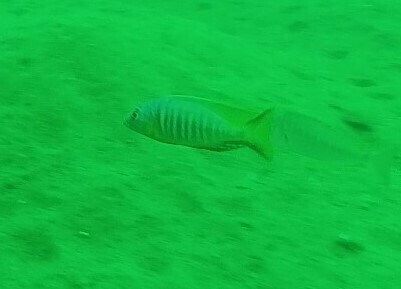
Color is where this fish earns both its trade name and its identification headaches. Breeding males are silvery-blue and — crucially — carry 9 to 11 dark vertical bars over the flank, a feature S. fryeri and S. ahli lack. The males also show conspicuous yellow in the dorsal and caudal fins and yellow markings on the anal and dorsal fins, where the electric blue hap stays largely blue-finned; egg-spots are present on the anal fin. Females are a plainer silver. Color is also regional: keepers and Konings' photographs note that southeastern-arm populations can show a more metallic green cast in breeding dress than the bluer northern fish. Hobbyists who have kept the genus side by side use the same shorthand — dark bars plus yellow fins means psammophilus, not fryeri — which is the most practical field mark for a fish this easy to mislabel.
Range & habitat
Sciaenochromis psammophilus is endemic to Lake Malawi; FishBase records it from no other water. Its type locality is Kande Island on the western shore, roughly halfway down the lake, and it has since been recorded from a scatter of locations including Likoma Island, Mazinzi Reef, Masasa Reef, Masinje, Senga Bay and Mdoka, extending into the southeastern arm of the lake. That is a respectably wide distribution for a Malawi cichlid, though the species is described as nowhere especially common.
The habitat is precisely what the name advertises. It lives over sandy substrates in the transition zones where sand meets rock, at depths of about 5 to 30 m (16–100 ft). Rather than rooting in the sediment, it cruises roughly 30 cm (about a foot) above the bottom, quartering the open sand for prey. This puts it in the lake's intermediate, sand-and-rubble guild rather than on the algae-covered rocks of the mbuna or out in the true pelagic zone. The surrounding water is the warm, hard, alkaline water of Lake Malawi — broadly pH 7.7–8.6 and around 24–28 °C in the upper layers it occupies — a chemistry that any aquarist keeping the fish has to reproduce.
Ecology & diet
S. psammophilus is a carnivore and primarily a piscivore — a fish-eater. Konings' original account describes it feeding on small cichlids, with small invertebrates probably taken as well, and FishBase places it at a trophic level near 3.9, squarely among the lake's predators. Its hunting style fits the open-sand niche: it patrols a short distance above the substrate and ambushes or chases down small fishes and the juveniles of other cichlids that shelter on or near the sand, picking off invertebrates along the way.
In the broader community it functions as a mid-sized, mobile predator of the sand-and-transition zone, a guild that includes other roving haps. Because it hunts juvenile cichlids, it is one of the predators that shapes where and how smaller sand-dwellers can safely forage and breed. FishBase rates it of high resilience and low fishing vulnerability — the profile of a small, fast-maturing predator rather than a slow-growing commercial target.
Behavior & breeding
Like virtually all Malawi haplochromines, S. psammophilus is a maternal mouthbrooder with no pair bond. Outside breeding it is largely a solitary hunter; the social structure tightens only when males come into condition. Konings recorded that a breeding male defends a territory roughly 2 m (6.5 ft) in diameter centered on a nest he excavates in the sand — often a spawning pit dug partly under a rock to form a cave-like crater, or, where suitable rocks are lacking, a shallow bower scraped on open sand. Males may gather to display where conditions allow, the open-sand equivalent of a lek.
Spawning follows the standard haplochromine script: the female lays eggs in the male's pit, takes them into her mouth almost at once, and is induced to fertilization by the egg-spots on the male's anal fin. She then broods the clutch alone, releasing free-swimming fry after the usual two-to-three-week incubation and continuing to shelter them in her mouth when threatened. As with related haps, males are intolerant of rival males in breeding condition but the species is not described as relentlessly aggressive by Malawi standards — assertive rather than savage.
In the aquarium
S. psammophilus is an uncommon import — hobbyists routinely list it among the harder-to-source Sciaenochromis — so the first practical reality is simply finding genuine stock rather than a mislabeled electric blue. Given the confusion in the trade, buyers should look for the diagnostic dark vertical bars and yellow finnage, and be wary of "electric blue" fish of unknown parentage, since cross-breeding within the genus and with peacocks (Aulonocara) and other blue haps is a long-running problem the community openly acknowledges.
Husbandry follows from the natural history. This is a sand-and-open-water predator that wants room: a tank on the order of 800 L (about 200 US gallons), 180 cm (6 ft) or more in length, is the sensible target for a male with females, given the roughly 2 m breeding territory a conditioned male tries to claim. Use a fine sand substrate with rock structure providing crevices and a spawning cave, leave generous open swimming room, and keep the lighting moderate. Water should be hard and alkaline in the Malawi range (pH ~7.8–8.5, ~76–80 °F / 24–27 °C). As a piscivore it needs a protein-rich diet — quality pellets supplemented with frozen or live mysis, krill, amphipods, mosquito larvae and Artemia — and it should not be housed with fish small enough to read as prey, nor with very timid species it will bully. Treated as the open-water predator it is, rather than as a generic "electric blue" for a 55-gallon community, it is a manageable fish for an intermediate keeper with the footprint to spare.
Conservation
The IUCN Red List assesses Sciaenochromis psammophilus as Least Concern, in an assessment dated 13 June 2018, and it carries no CITES listing. That status reflects a genuinely lake-wide distribution across multiple reefs and shores and the absence of any targeted commercial fishery; FishBase's low fishing-vulnerability score reinforces the point. The aquarium trade takes the species in small numbers but its rarity in shops reflects limited collection and export, not scarcity in the lake, and there is no evidence the hobby threatens it. So the honest headline is that this particular fish is, at present, secure.
The lake it depends on is not so comfortable. The Chavula et al. (2023) review of the Lake Malawi/Niassa/Nyasa basin (Journal of Great Lakes Research 49(6):102241) documents over-fishing and the collapse of the chambo tilapia fishery, heavy sediment and nutrient loading washing off deforested catchments, roughly 0.7 °C of shallow-water warming that strengthens stratification and reduces the lake's productivity, and a rising risk from invasive species. Those pressures bear directly on this fish's world. As a shallow-to-moderate-depth predator of the sand-and-transition zone — the 5–30 m band closest to shore — S. psammophilus lives exactly where shoreline development, catchment erosion and sediment plumes are heaviest, and its prey base of small inshore cichlids is itself exposed to the same degradation. The species is Least Concern today; the qualifier is that it is a Least Concern fish in a strained lake, and its nearshore, sand-bound habitat is among the parts of Lake Malawi most exposed to that strain.
Sources
- FishBase — Sciaenochromis psammophilus (Electric blue kande)
- Eschmeyer's Catalog of Fishes — Sciaenochromis psammophilus (species record)
- GBIF — Sciaenochromis psammophilus occurrence search
- Cichlid Room Companion — Sciaenochromis psammophilus (public species profile)
- malawi.si (Ad Konings imagery) — Sciaenochromis psammophilus 'Kande Island'
- AquaticRepublic.com — Sciaenochromis psammophilus data sheet
- Konings, A. 1993 — A revision of the genus Sciaenochromis Eccles & Trewavas, 1989 (The Cichlids Yearbook vol. 3, original description; CRC reference)
- IUCN Red List — Sciaenochromis psammophilus (Least Concern, 2018)
- Chavula et al. 2023 — Lake Malawi/Niassa/Nyasa basin: Status, challenges, and research needs (J. Great Lakes Research 49(6):102241)
- Australian Cichlid Enthusiasts Forums — 'Sciaenochromis fryeri' thread (psammophilus vs. fryeri/ahli ID discussion) — community/anecdotal
- MonsterFishKeepers.com — Sciaenochromis ahli vs fryeri (genus ID discussion) — community/anecdotal
- Cichlid-Forum — availability of Sciaenochromis psammophilus (community thread) — community/anecdotal
- FishBase — references used for Sciaenochromis psammophilus