
Taxonomy & naming
Albert Günther described this fish in 1864 from a half-skin collected on Lake Malawi during one of Livingstone's Zambezi expeditions (the holotype, BMNH 1864.1.9.56, was gathered by John Kirk). He placed it in Hemichromis; it later passed through Paratilapia and was repeatedly confused with the Tanganyika-described Serranochromis thumbergi before Regan erected the genus Serranochromis in 1920 and Trewavas revised it in 1964. The genus name blends Latin serra ('saw') with the Greek chromis, an old name for a perch-like fish.
For decades the taxonomy was tangled with a near-identical southern-African fish, Serranochromis jallae (Boulenger, 1896) from the upper Zambezi and Okavango. Trewavas treated the two as subspecies of S. robustus, and that lumping persisted in much hobby literature. Stauffer, Bills, Skelton and Weyl (Zootaxa, 2020) re-elevated jallae to full species using morphometrics, color and a principal-component analysis, formalizing what Joyce et al. (2005) had already shown genetically — that the Lake Malawi fish is distinct from the Okavango and Congo populations. The upshot for readers and keepers: 'S. robustus' in the strict modern sense means only the Lake Malawi animal; the trade name nembwe and the bright yellow-belly belong to jallae. Confusingly, the FishBase common name 'yellow-belly bream' is a holdover from the old combined concept. Common names in use around the lake include Sungwa, Tsungwa and tilapia-style local terms; among the genus's so-called largemouth breams, robustus is the Malawi member.
Appearance
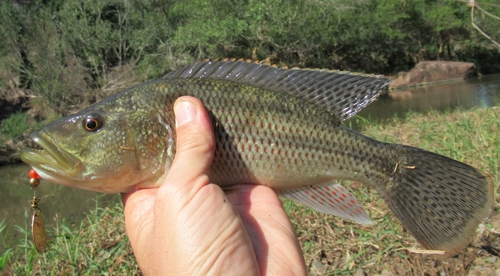
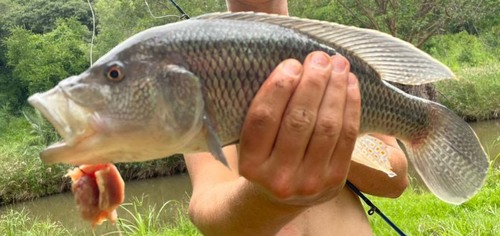
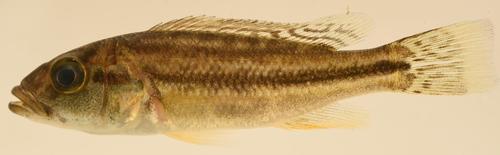
This is a large, powerfully built cichlid with an elongate head, a deep robust body and a notably long lower jaw set with two rows of widely spaced, conical (unicuspid) teeth — the classic gape of a fish that swallows other fish whole. Breeding males are blue-green along the flanks, carrying a narrow yellow marginal band on the dorsal fin and often a small yellow tip on the upper lobe of the tail. Diagnostically, breeding males show egg-spot ocelli restricted to just the rearmost four or five membranes of the anal fin, a feature shared only with its sister species jallae; every other Serranochromis spreads ocelli across the whole anal fin.
Reported maximum size varies with the source and with how 'maximum' is measured. FishBase lists a maximum of about 22 in (56 cm) total length and a published weight near 13.5 lb (6.1 kg); the IUCN assessment gives a more typical maximum of roughly 18 in (45 cm), and the specialist site malawi.si cites males of about 18–20 in (45–50 cm) with females somewhat smaller. Fish over about 4.4 lb (2 kg) are described as rare. Against the look-alike jallae, robustus runs a longer lower jaw, a slimmer body and a narrower caudal peduncle, more teeth in the outer lower-jaw row, and the blue-green rather than yellow-green breeding dress — distinctions worked out specimen by specimen rather than visible across a tank.
Range & habitat
The native range is the Lake Malawi system: the lake itself, the lower reaches of inflowing rivers, the outflowing Upper and Middle Shire River, and shallow, weedy Lake Malombe downstream. The IUCN lists it as native to Malawi, Mozambique and Tanzania, with the species' presence in Zambia's Luangwa River still unconfirmed (angler photographs suggest robustus rather than jallae there, but specimens are needed). It has been moved around by people: introduced to the upper Ruo River in Malawi and to the Sand River Dam in Eswatini, from where it spread into the Komati system in South Africa and, by recent report, onto the Mozambique coastal plain.
Within the lake this is a shallow-water fish, almost always in less than 30 ft (10 m) and most often in the 6–16 ft (2–5 m) band. It favors structurally complex margins — the rock-to-sand interface, submerged vegetation, reed beds and the quiet water of bays and river mouths, concentrated in the lake's southern arms. Juveniles hide in plant beds in shallow bays; large adults patrol among big rocks at the sand-rock transition. That habitat choice matters for two reasons: it puts robustus in exactly the zones most exposed to inshore netting, and it means standard deep-water trawl surveys miss it (a 2016 survey of the southern lake that hauled no shallower than about 26 ft / 8 m simply didn't catch any). It is genuinely uncommon in the open lake but can be locally common in larger rivers and lagoons.
Ecology & diet
Serranochromis robustus is a piscivore — a sit-and-ambush predator of the shallows with a trophic level around 4.1, near the top of the inshore food web. In Lake Malawi it hunts mbuna and sand-dwelling haplochromines, and large individuals appear to specialize on the lake's endemic squeaker catfish, Synodontis njassae. The long jaw, wide gape and gripping conical teeth are the tools of a fish that takes sizeable prey rather than grazing or sifting. Across the genus, the largemouth breams partition prey finely; in the upper Zambezi, Winemiller (1991) found low dietary overlap among co-occurring Serranochromis, with the largest size classes turning increasingly piscivorous and leaning on small catfishes — a pattern that fits what is seen in robustus in Malawi.
The Cichlid Room Companion has noted that despite its size, robustus leads a cautious, concealed life, often slipping along head-down or even upside-down near cover — the behavior of an ambusher that earns its meals by stealth rather than open pursuit. As a sister lineage to the river serranochromines, it also offers a window into the lake's deeper history: several authors have suggested that a Serranochromis-like, generalized predator of this kind may resemble the ancestral stock from which parts of the Malawi haplochromine flock radiated.
Behavior & breeding
Like the great majority of Malawi cichlids, S. robustus is a maternal mouthbrooder, but it spawns in the shallow vegetated fringes rather than on open sand arenas. Breeding males are territorial and defend a large cave among the rocks; females incubate the comparatively large eggs — about 3.5 mm across — in the mouth. Fecundity is high for a mouthbrooder: a single brood may hold up to roughly 1,000 eggs, and fry-guarding females have been seen shepherding broods of more than 500 free-swimming young in the shallow intermediate zone. Brooding and fry-guarding females are otherwise secretive, tucking into rock caves in the lake or into weed beds in Lake Malombe and the Shire. Spawning occurs in summer, and sexual maturity comes at about three years, by which point males have reached roughly 12 in (30 cm).
The river relatives fill in the behavioral picture. In the closely related jallae, bowers are simple saucer-shaped sand depressions about 12 in (30 cm) across built among vegetation, and a telemetry study on the upper Zambezi found adults holding small home ranges — a mean river stretch of about 1,330 m — and moving onto temporarily flooded margins as water rose rather than undertaking long migrations. The genus, in short, is sedentary, structure-bound and strongly tied to vegetated shallows for reproduction.
In the aquarium
Be honest with yourself before you consider this fish: it is a rarely kept, demanding predator, not a community Malawi cichlid. It almost never appears in the trade — the strict-sense Lake Malawi robustus has only sporadically shown up on export lists, and even then it has never caught on, for two reasons the specialists keep repeating: the size and the attitude. Cichlid Room Companion's Pam Chin frames it bluntly — a 16-plus-inch predator that loves the same shallows where it can eat plenty of mbuna, with broods of 500, and very few keepers are prepared to give it the tank it needs.
That tank is enormous. The realistic recommendation from Malawi specialists is on the order of 500-plus gallons (2,000+ liters) — at least a 13 ft (4 m) length and a meter of depth — with broad open sand, large rock structures, wide swim-throughs and shaded retreats mimicking the sand-rock interface. Water should track standard Malawi conditions: hard, alkaline, pH on the high side of neutral into the 8s, and warm (the lake sits around 75–79°F / 24–26°C). Diet is a protein-forward menu of meaty frozen and prepared foods; do not feed live 'feeder' fish, which risk disease and teach nothing the fish doesn't already do. On tankmates the rule is simple and unforgiving — anything small enough to fit the mouth is food, so only similarly large, robust species belong with it. This is a fish for a public aquarium or a dedicated specialist with the space and the protein budget, not for a mixed rift-lake display.
Conservation
Serranochromis robustus is assessed by the IUCN as Critically Endangered (criteria A2c+3cde; Konings & Tweddle, assessed 20 June 2018), with a decreasing population trend — a striking change from the 2010 Least Concern listing, which applied to the older, broader 'subspecies' concept before the Malawi fish was separated out. The drivers are direct and well documented: heavy, unsustainable net fishing, and the destruction of its preferred weed beds by beach-seine and nkacha nets, with gillnets targeting it along rocky shores. In Lake Malombe and the Upper Shire it was common until the late 1970s, then nearly extirpated within a few years as netting wrecked its habitat — a fall of well over 90%, traceable in the Angling Society of Malawi's competition records, with a further recorded decline of more than 90% between 1995 and 2006. As a once-prized angling and food fish ('Sungwa') that lives precisely in the heavily netted shallows, it has been hit harder than the open-water community. A looming additional threat is epizootic ulcerative syndrome (EUS), the fungal disease that savaged its sister species jallae in the Zambezi and Okavango; an outbreak in the Malawi catchment could do the same here. Protection exists only in fragments — Liwonde National Park on the Middle Shire and Lake Malawi National Park's rocky shores — and recent surveys in those waters failed to find the fish, with poaching described as rampant.
Those pressures sit inside a basin that is itself under strain. Chavula et al. (2023), in their Lake Malawi/Niassa/Nyasa basin review (Journal of Great Lakes Research 49(6):102241), document over-fishing and the collapse of the chambo (Oreochromis) fishery, heavy sediment and nutrient loading washing off deforested catchments, and roughly +0.7°C of warming in the shallow water that strengthens stratification and trims primary productivity, alongside invasive-species risk. For a shallow, weed-and-rock predator like robustus, the catchment story bites hardest where it lives: sedimentation and shoreline disturbance degrade the very nearshore vegetation and rock-sand margins it spawns and hunts in, compounding the direct toll of the nets. The honest summary is that this is not a Least Concern fish in a healthy lake — it is a Critically Endangered top predator whose inshore habitat is squeezed from two directions at once.
Sources
- FishBase — Serranochromis robustus (Yellow-belly bream)
- GBIF — Serranochromis robustus (Günther, 1864)
- Catalog of Fishes (CAS) — Serranochromis robustus species record
- Stauffer, Bills, Skelton & Weyl (2020) — Re-elevation and redescription of Serranochromis jallae and S. robustus, Zootaxa 4858(1):126–134
- Winemiller (1991) — Comparative ecology of Serranochromis in the Upper Zambezi floodplain, Journal of Fish Biology 39:617–639
- Thorstad et al. (2005) — Movements and habitat utilization of nembwe (Serranochromis robustus) in the Upper Zambezi River, African Zoology 40:253–259
- Joyce et al. (2005) — An extant cichlid fish radiation emerged in an extinct Pleistocene lake, Nature 435:90–93
- Plazi TreatmentBank — Serranochromis robustus treatment (Stauffer et al. 2020)
- malawi.si — Serranochromis robustus (Konings/Bauer biotope profile)
- Cichlid Room Companion — Serranochromis robustus species profile
- Snoeks & Hanssens (2004) — Identification guidelines to other non-mbuna, in Snoeks (ed.) The cichlid diversity of Lake Malawi/Nyasa/Niassa, Cichlid Press
- IUCN Red List — Serranochromis robustus (Critically Endangered, 2018; Konings & Tweddle)
- Chavula et al. (2023) — Lake Malawi/Niassa/Nyasa basin: Status, challenges, and research needs, J. Great Lakes Research 49(6):102241
- Cichlid Room Companion 'Ask Pam' — Serranochromis robustus in aquaria (Pam Chin) — community/anecdotal
- MonsterFishKeepers — Serranochromis (trade availability of the Malawi robustus) — community/anecdotal
- Gratwicke & Marshall (2001) — Exotic predators Micropterus salmoides and Serranochromis robustus vs native stream fishes in Zimbabwe, Journal of Fish Biology 58:68–75