Taxonomy & naming
The species was described by the German-born British ichthyologist Albert Günther in 1894 as Chromis diagramma, from material collected on Lake Tanganyika by the missionary-explorer Edward Coode-Hore and published in the Proceedings of the Zoological Society of London. It was later transferred to the genus Simochromis, the combination — Simochromis diagramma (Günther, 1894) — recognized today by Eschmeyer's Catalog of Fishes and FishBase. One junior synonym exists: Tilapia adolfi Steindachner, 1909, also described from the lake and synonymized by Trewavas in 1966. The genus name marries the Greek simos, "snub-nosed" or "flattened," to chromis, an old name for a perch-like fish, a nod to the steep, blunt facial profile shared across the group; the epithet diagramma refers to the dark vertical bars that cross the flank.
Simochromis belongs to the Tropheini, the rock-grazing radiation within the larger Haplochromini that also contains Tropheus, Petrochromis, Pseudosimochromis and their relatives — a flock of substrate-scraping herbivores that has repeatedly evolved similar mouths and gut lengths to exploit the lake's algal turf. The genus and its sister Pseudosimochromis have been the subject of detailed multidisciplinary revision (work centred at KU Leuven), reflecting how much taxonomic flux still surrounds these closely similar grazers; within that shuffling, S. diagramma has stayed put as the type-grade, large-bodied member of Simochromis. In the hobby it is usually sold simply as "Simochromis diagramma," sometimes with a collection locality such as 'Isanga Bay', 'Kala' or 'Kalambo Lodge' appended.
Appearance
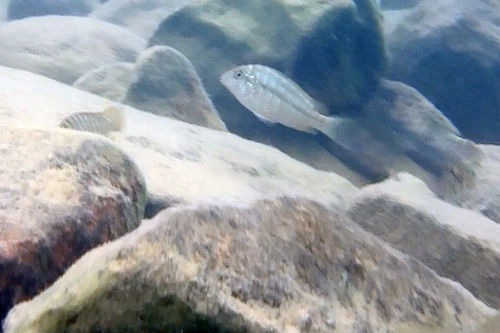
This is the giant of its genus. FishBase lists a maximum of about 19.5 in total length — closer to 7.7 in (19.5 cm) — and hobby and field references round the typical adult to roughly 8 in (20 cm), well above the 4-to-5-in size of most other Simochromis. The body is deep, robust and laterally compressed, with the blunt, slightly upturned snout characteristic of the group: a face built for working algae off a flat rock face rather than chasing prey.
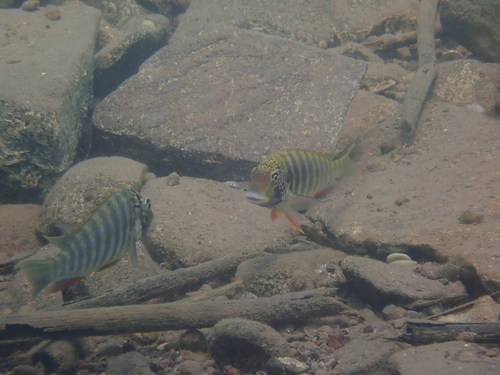
The pattern is a series of darker vertical bars running down a body that ranges from olive and grey-green to brassy gold, broken by rows of iridescent spangling on the flanks and fins. The species is sexually dimorphic. Territorial males carry the stronger color — a bright, often yellow throat and chest, deeper greens and reds, and bolder markings — while females and non-territorial fish are plainer and more uniformly drab. One quirk noted in field references is that, despite a range spanning almost the whole lake, S. diagramma looks remarkably consistent from shore to shore; the most saturated red, black, green and yellow individuals come from the southernmost Zambian populations, but there is nothing like the explosive geographic color variation seen in Tropheus.
Range & habitat
Simochromis diagramma is a lacustrine endemic — found naturally nowhere but Lake Tanganyika — with one of the broadest distributions of any rock-dweller in the lake, recorded all the way from Burundi in the north through the Democratic Republic of the Congo and Tanzania to Zambia at the southern foot. It even pushes a short way down the Lukuga, the lake's only outflow, where it has been recorded at the Kisimba-Kilia rapids. Across this enormous range it occupies all four of the lake's bordering nations, a footprint that underlies its relatively secure conservation status.
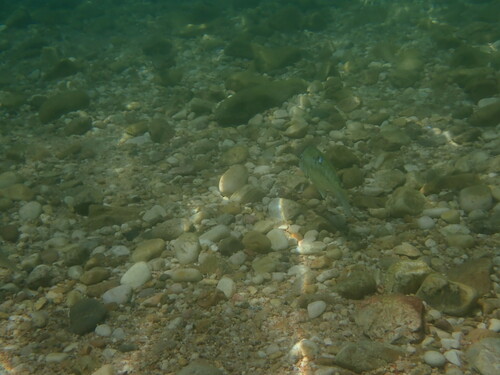
It is, above all, a fish of the shallows. FishBase and field observers place it in rubble and rock areas "most often not exceeding 5 m" and rarely below about 33 ft (10 m) — the brightly lit, wave-washed top of the littoral, where strong water movement keeps the stones swept clean of sediment and lets the algal turf grow thickest. The biotope is best described as a shallow intermediate zone, rock and pebble interspersed with sand and mud. Notably for a lake famous for its gin-clear water, S. diagramma is described as adapted to murky, turbid water, tolerating conditions cleaner-water specialists avoid. The water itself is the open lake's: hard, strongly alkaline (around pH 8 to 9) and warm, with surface temperatures generally in the upper 70s Fahrenheit (about 25 to 27 °C).
Ecology & diet
Simochromis diagramma is a committed herbivore — a grazer of the "aufwuchs," the carpet of filamentous algae, diatoms and associated micro-life that coats Tanganyika's sunlit rocks. It feeds by nipping and combing this turf from stone surfaces, and its anatomy advertises the diet: a much-elongated intestine, several times the body length, the standard plumbing of a fish that has to ferment a low-value plant diet. In the ecomorphological scheme used by researchers studying these cichlids, it sits among the "browsers" — fish that pluck filamentous algae rather than the "grazers" that scrape tightly attached epilithic crusts — though browser gut lengths vary enough that the group spans a range of herbivorous specializations.
That trophic role places it in one of the most studied examples of niche partitioning in fresh water. A rocky Tanganyikan slope can support a dozen or more algae-eating cichlids side by side, and stable-isotope and stomach-content studies (e.g. Hata and colleagues) show they avoid direct competition largely by stacking out along depth: closely related species hold feeding territories separated by only a few meters of water, partitioning the same algal resource by where they graze it. S. diagramma takes the shallowest tier, the top few meters. FishBase places it at a low trophic level of about 2.0, consistent with a near-pure plant diet, and rates its intrinsic resilience as high — a fast-maturing, productive fish typical of the lake's hardy littoral grazers.
Behavior & breeding
Out on the reef this is a territorial, pugnacious fish. Males establish and defend feeding-and-breeding territories on the rock, displaying in full color and driving off rivals, while females and juveniles range more widely and hold no fixed ground. The aggression is directed hardest at its own kind and at other herbivores competing for the same algal turf — the predictable friction of a grazer that must defend a patch of productive rock to make a living.
Reproduction is maternal mouthbrooding, the East African cichlid norm. Spawning happens within a male's territory, typically in or near a cave or rocky shelter, sometimes on open sand just in front of cover. The female takes the fertilized eggs into her mouth and incubates them there, releasing the young only once they are free-swimming. Reported clutches are modest — on the order of 35 to 90 eggs — and field-based accounts put the brooding period at roughly four weeks. FishBase records that eggs from the cleavage stage and larvae of up to about 0.6 in (1.56 cm) are carried by brooding females measuring 6 to 9 cm standard length, confirming that fish mature and breed well below maximum size. As in other mouthbrooders, the female invests heavily and feeds little while holding, and the male's contribution ends at the spawning site.
In the aquarium
S. diagramma is a fish for the experienced Tanganyika keeper, not a community starter. The honest comparison is Tropheus: a large, food-obsessed, hot-tempered herbivore that needs space, numbers and discipline. Field and hobby references converge on a big tank — at least around 125 gallons (roughly 500 L) for a group — strongly aquascaped with rock to break sightlines and define territories. The counterintuitive trick that keepers borrow from Tropheus husbandry is to stock in numbers and at density: a crowd disperses aggression so no single fish is hounded, whereas a lonely pair or trio usually ends with the dominant fish killing the rest. Suitable tankmates are other large, robust, similarly herbivorous Tanganyikans on the same diet — Tropheus and Petrochromis are the usual company — and decidedly not small, slow or carnivore-fed fish.
Water must mirror the lake: hard, alkaline (pH around 8 to 9), warm, and very clean, which in practice means heavy filtration and generous water changes to cope with the bioload of a crowd of hungry grazers. The single most important — and most commonly botched — point is diet. Like Tropheus, this is a low-protein algae-eater with a long gut, and overfeeding rich, protein-heavy foods (beefheart, excess bloodworm) causes the bloat that kills rift-lake herbivores; a spirulina- and vegetable-based diet is essential, not optional. Keepers should also expect intraspecific brawling, sexually charged males, and a fish that looks its best only when it has room and rivals to display against. Treated like the demanding herbivore it is, it is a striking, characterful tank subject; treated like a generic African cichlid, it disappoints or dies.
Conservation
On its own account, Simochromis diagramma is in good standing. The IUCN Red List assesses it as Least Concern (assessed 31 January 2006, an assessment now flagged as needing updating), describing it as a widespread species across Lake Tanganyika with no known major widespread threats, present in all four riparian nations — Burundi, the Democratic Republic of the Congo, Tanzania and Zambia — with an unknown population trend. The threats the assessment does note are local and habitat-specific: inshore fisheries pressure, and water turbidity and siltation in the nearshore zone, driven by agricultural and forestry runoff. The species is harvested both as a local food fish and for the aquarium trade, and a regional climate-vulnerability review (TRAFFIC/IUCN, Africa's freshwater fisheries) flags it as an Albertine Rift endemic important to people as food and in the pet trade — but neither pressure is at a level that currently endangers so wide-ranging a fish.
The more honest worry is not the species but its home. Lake Tanganyika is under sustained, basin-scale strain, and the pressures bear directly on a shallow-water algal grazer like this one. Long-term limnology shows the lake's surface warming and its water column stabilizing, which weakens the wind-driven mixing that lifts deep nutrients into the lit zone: O'Reilly and colleagues (Nature, 2003) inferred from sediment cores that primary productivity may have fallen by roughly 20%, implying a decline in fish yields of around 30% over the twentieth century, and Cohen and colleagues (PNAS, 2016), using a ~1,500-year paleoecological record, tied ~150 years of warming and intensifying stratification to measurable declines in both fishery species and endemic benthic life — including a 38% shrinkage of oxygenated benthic habitat in their study areas. For a fish whose entire economy is algae growing on shallow, well-lit, sediment-swept rock, two of these forces hit home most directly: warming-driven loss of the productivity that feeds the algal turf, and sedimentation from catchment deforestation and farming, which smothers the very rock surfaces it grazes and clouds the littoral. Layered on top is the commercial fishery that feeds millions across the four bordering countries — concentrated on the open-water clupeids and the Lates predators, but indicative of how heavily the lake is leaned on — and the standing difficulty of coordinating management across four sovereign nations. The fair summary: S. diagramma itself is presently secure and resilient, one of the lake's more abundant rock-grazers, but it lives in exactly the shallow benthic band that the lake's warming and shoreline degradation are quietly eroding, and its 2006 Least Concern listing is overdue for a fresh look.
Sources
- Eschmeyer's Catalog of Fishes — Simochromis diagramma (Günther, 1894)
- FishBase — Simochromis diagramma (Günther, 1894)
- GBIF — Simochromis diagramma (Günther, 1894)
- Cichlid Room Companion — Simochromis diagramma species profile (A. Indermaur, 2011)
- tanganyika.si — Simochromis diagramma (species, habitat, husbandry notes)
- Fishipedia — Simochromis diagramma fish sheet
- Hata et al. (2015), Sci. Rep./BMC — Depth segregation and diet disparity revealed by stable isotope analyses in sympatric herbivorous cichlids in Lake Tanganyika
- Hata et al. (2014), BMC Biology — Diet disparity among sympatric herbivorous cichlids in the same ecomorphs in Lake Tanganyika
- Yamaoka (1984), Environ. Biol. Fishes — Interspecific relationships of aufwuchs-eating fishes in Lake Tanganyika
- The taxonomic diversity of the cichlid fish fauna of ancient Lake Tanganyika (inventory of 208 species)
- IUCN Red List — Simochromis diagramma (Least Concern, 2006)
- O'Reilly et al. (2003), Nature — Climate change decreases aquatic ecosystem productivity of Lake Tanganyika
- Cohen et al. (2016), PNAS — Climate warming reduces fish production and benthic habitat in Lake Tanganyika
- TRAFFIC/IUCN — Vital but vulnerable: climate change vulnerability and human use of wildlife in Africa's freshwater ecosystems
- Cichlid-forum.com — Tanganyikan herbivore (Tropheini) keeping and bloat-prevention community guidance — community/anecdotal