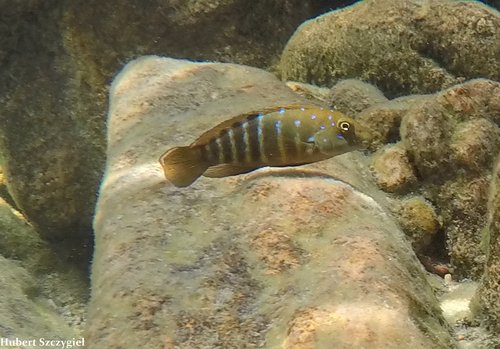

Taxonomy & naming
George Albert Boulenger described Spathodus erythrodon in 1900 from specimens collected at Albertville (modern Kalemie, in the Democratic Republic of the Congo), on the western shore of Lake Tanganyika; the syntypes are held at the Natural History Museum in London and the Royal Museum for Central Africa at Tervuren. Eschmeyer's Catalog of Fishes still lists the name as valid in its original combination, placing it in the family Cichlidae, subfamily Pseudocrenilabrinae.
The genus name comes from the Greek spathe, a blade or sword, and odous, tooth — a reference to the distinctive teeth Boulenger used to separate Spathodus from its near-twin Eretmodus, which he had named only a year earlier. In practice the two are almost impossible to tell apart on body shape and color alone; the long, cylindrical teeth of Spathodus versus the broad, spatulate teeth of Eretmodus are the reliable diagnostic. Together with the monotypic Tanganicodus irsacae, these fish make up the tribe Eretmodini, the so-called Tanganyika clowns or goby cichlids. Modern workers have flagged that the tooth-based generic split may not survive a proper molecular revision — several authors note it would be unsurprising to see the whole group folded into a single genus, which by priority would be Eretmodus — but as of writing Spathodus erythrodon stands. A second nominal species, S. marlieri, differs enough in breeding mode and dimorphism that some question whether it belongs in the genus at all.
Appearance
This is a small, stout, blunt-headed fish. FishBase gives a maximum of about 3.3 in (8.5 cm) total length; in practice males reach roughly 3 in (8 cm) and females stay smaller, near 2.4 in (6 cm), so the larger animal in a pair is usually the male. The body is built for life among rounded cobbles — heavy-bodied forward, with large pectoral fins for bracing and a reduced swimbladder that keeps it from floating off its perch.
Coloration is muted and cryptic: a brownish-to-grey ground that matches algae-covered stone, often broken by faint barring and frequently set off by a band of iridescent blue on the lips and lower face, the touch of color that earns the group its "clown" nickname. Pattern and the intensity of that blue vary geographically from one stretch of shoreline to the next. Sexual dimorphism is slight and frustrating for breeders — size is the most dependable cue, with subtle, population-specific color differences sometimes layered on top. Against its congeners, S. erythrodon lacks the discrete blue spotting typical of southern Eretmodus cyanostictus and the bold mid-dorsal blotch that marks Tanganicodus, but tooth structure remains the only truly diagnostic character.
Range & habitat
Spathodus erythrodon is endemic to Lake Tanganyika, the ancient rift lake shared by Tanzania, the Democratic Republic of the Congo, Burundi and Zambia. FishBase records it from around the lake except the extreme southern end. Within that range it is a creature of the very edge: it is most often seen in less than a foot (under ~1 m) of water, right at the margin of the pebble or rubble shoreline where waves break over the rocks.
This is a demanding biotope. Even in calm weather the lake carries a swell, and storms can drive substantial waves into the shallows, so the water there is turbulent, sun-warmed and exceptionally well oxygenated. In-situ conditions are hard and alkaline — FishBase cites a pH range of about 7.2–8.5, hardness of roughly 10–20 dH, and temperatures around 25–27 °C (77–81 °F). The reduced swimbladder and bracing fins are direct adaptations to holding station in that surge while grazing, rather than swimming in open water. As a strict shallow rocky-shore specialist, the species' fortunes are tied closely to the condition of Tanganyika's littoral fringe.
Ecology & diet
Like the other eretmodines, S. erythrodon is an aufwuchs grazer — it makes its living off the "biocover" that sheaths the rocks of the surf zone. That film is a community: a turf of attached algae together with the diatoms, microcrustaceans, insect larvae and other small invertebrates living within it. The fish works the stone with its specialized teeth, picking and scraping this material rather than chasing prey, and FishBase places it at a trophic level of about 3.4, reflecting that it ingests both plant and animal matter.
The genus-level division of labor among the three goby genera is subtle but real: differing tooth shapes let Spathodus, Eretmodus and Tanganicodus exploit the same rock surfaces in slightly different ways, which is part of why up to three of these near-identical fish can share a stretch of shoreline without competing head-on. In its narrow, energetic band of habitat, S. erythrodon is a minor but characteristic player in the littoral food web — a primary consumer harvesting the algal-detrital film that the lake's wave energy and sunlight keep productive.
Behavior & breeding
Goby cichlids are pugnacious for their size. They are strongly territorial and notably aggressive toward their own kind and other eretmodines, defending a patch of rock that supplies both food and shelter. The trade-off for that aggression is an unusually faithful private life: pairs are socially monogamous and hold a territory together year-round.
Reproduction follows the eretmodine pattern of sequential, biparental mouthbrooding — a strategy documented in detail for the closely related Eretmodus cyanostictus by Morley and Balshine (2003) and shared across the tribe. The female cleans a horizontal patch of rock; the male passes over it and deposits sperm; the female lays a small clutch — on the order of 30 comparatively large eggs — and takes them straight into her mouth, drawing in milt to fertilize them. She then incubates for roughly 10–12 days before transferring the developing young, mouth to mouth, to the male, who carries them a further week or so. There is no guarding of fry once they are released. This female-to-male handoff is one of only about fifteen mouthbrooding species in Tanganyika known to do it, and it is thought to reflect the costs of care: a brooding fish cannot feed effectively, so splitting the burden lets each parent recover. The downside for the fish is that males which brood lose feeding and mating opportunities — and the upside for aquarists is one of the most charming spectacles in the hobby.
In the aquarium
These are rewarding fish with a reputation for being more demanding than their cute, glass-surfing personalities suggest. The non-negotiables follow directly from the wild biotope: hard, alkaline water, pristine quality, and vigorous oxygenation and current — keepers and shops alike recommend strong aeration, even a wave-maker, to mimic the surf they evolved in. Décor should be rounded stones with abundant caves and broken sight lines, because the limiting factor in captivity is aggression, not size.
The consistent message from experienced keepers is that intraspecific aggression makes group-keeping hard: a bonded pair will hold a territory and a single tank usually ends up with just one surviving pair, with the female needing genuine escape routes from an attentive mate. A footprint of at least roughly 35 in (90 cm) is the common floor for a pair, and hobbyists who keep several specimens repeatedly report needing a 4-to-6-foot tank with heavy rockwork to let weaker individuals find their own space. They are not good mixers with rock-dwelling Lamprologines, which occupy a different niche, and pair poorly with other goby cichlids. On diet, older care sheets warned heavily of bloat and pushed an algae-only regimen; current keeper experience is more relaxed — these fish are greedy and will eat almost anything — but the practical advice still holds: favor a spirulina-rich prepared food, feed small amounts, and go easy on rich, non-aquatic meaty foods like beef heart or excessive brine shrimp. Because the sexes are so hard to tell apart and the fish are aggressive in groups, the usual route to a pair is to buy several juveniles or to spot an already-bonded pair in a dealer's tank.
Conservation
The IUCN Red List assessed Spathodus erythrodon as Least Concern (assessment dated 31 January 2006). It remains common along Tanganyika's shores and is regularly collected for the aquarium trade, where it is valued but not heavily targeted; FishBase rates its fishing vulnerability as low and its population resilience as high. There is no evidence that collection pressure threatens the species at present. In short: the fish itself is not in trouble.
The lake it depends on is another matter, and a shallow rocky-shore specialist is exposed to several of Tanganyika's basin-scale stresses. O'Reilly and colleagues (2003, Nature, doi:10.1038/nature01833) showed that sustained warming has strengthened the lake's stratification and weakened the seasonal mixing that lifts nutrients into the sunlit layer, with an estimated ~20% decline in primary productivity and a knock-on drop of roughly 30% in potential fish yields. Cohen and colleagues (2016, PNAS, doi:10.1073/pnas.1603237113) documented warming-driven loss of oxygenated benthic habitat — on the order of 38% of the lake's habitable lakebed in their reconstruction — as the oxygenated layer shoals. Most directly relevant to this fish, shoreline development, deforestation and erosion are loading sediment onto the rocky littoral (Cohen et al. 1993), and sediment is corrosive to the clean, algae-bearing rock surfaces a surf-zone aufwuchs grazer needs. Meanwhile the lake's economic backbone — the pelagic clupeid fishery for Stolothrissa and Limnothrissa together with their Lates predators, feeding four nations — sits separate from this near-shore guild but underlines how strained the system is, and management is coordinated across borders through the Lake Tanganyika Authority. The honest summary: S. erythrodon is a Least Concern species living in a lake under real and worsening pressure, and its narrow, near-shore habitat is precisely the band most sensitive to sedimentation and warming.
Sources
- Eschmeyer's Catalog of Fishes — Spathodus erythrodon (CAS)
- FishBase — Spathodus erythrodon summary
- FishBase — Eretmodus cyanostictus (congener reference)
- Cichlid Room Companion — Spathodus erythrodon (P. Tawil)
- Cichlid Room Companion — genus Spathodus
- Aqualog — Tanganyika Clowns (Boulenger/Poll/Tawil)
- Practical Fishkeeping — How should I keep goby cichlids?
- Morley & Balshine (2003), Reproductive biology of Eretmodus cyanostictus, Env. Biol. Fishes
- Sefc (2011), Mating and Parental Care in Lake Tanganyika's Cichlids (review), PMC
- Kuwamura — female-to-male shift of mouthbrooding in Tanganicodus irsacae (Springer)
- O'Reilly et al. (2003), Climate change decreases aquatic ecosystem productivity of Lake Tanganyika, Nature
- Cohen et al. (2016), Climate warming reduces fish production in Lake Tanganyika, PNAS
- IUCN Red List — Spathodus erythrodon (Least Concern, 2006)
- AquariaCentral forum — "I have goby cichlid fry! (Spathodus erythrodon)" — community/anecdotal
- Cichlid-Forum — Feeding goby cichlids (Lake Tanganyika species) — community/anecdotal
- African Diving (Facebook) — The complexity of the goby cichlids (eretmodines) — community/anecdotal