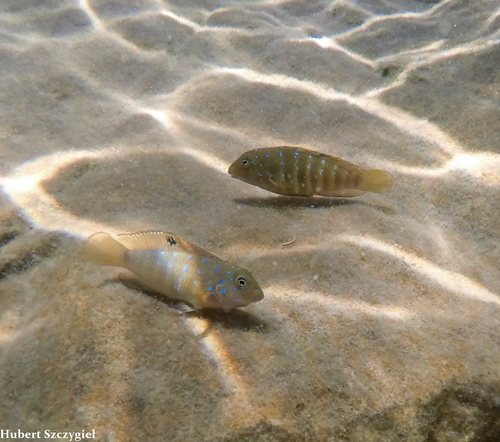

Taxonomy & naming
Tanganicodus irsacae was described by the Belgian ichthyologist Max Poll in 1950, in a paper on two rock-dwelling cichlids of Lake Tanganyika, with the type specimens taken near Uvira at the lake's northern tip. It remains the sole species in the genus Tanganicodus, which Eschmeyer's Catalog of Fishes lists as valid (Poll, 1950) within the cichlid subfamily Pseudocrenilabrinae.
The species name is not Latin in the usual sense but an acronym: I.R.S.A.C. stood for the Institut pour la Recherche Scientifique en Afrique Centrale, the colonial-era research body whose expeditions yielded much of the early Tanganyika fish material. Tanganicodus, Eretmodus and Spathodus together make up the tribe Eretmodini, the so-called goby cichlids — a tight, ancient lineage of surge-zone specialists endemic to the lake. Among them, Tanganicodus is distinguished mainly by its mouth and dentition, which are narrower and more pointed than the broad, scraping jaws of Eretmodus; tooth morphology is in fact the primary diagnostic character separating the three genera. In the hobby it is sold as the spotfin or jeweled goby cichlid. Field workers have flagged several geographically isolated populations — for instance around Moba and Kavalla in the Democratic Republic of Congo, and the southernmost Tanzanian fish near Udachi — that differ in colour and may not be conspecific with typical T. irsacae, so the genus is probably more diverse than the single name suggests.
Appearance
This is a small cichlid, reaching about 2.8 in (7 cm) in total length. The body is short and strongly laterally compressed, carried by a long, low, spiny dorsal fin — a profile that lets the fish slip edge-on through breaking water and resist being tumbled. Ground colour is a mottled grey-brown that disappears against wet, algae-filmed stone, broken by rows of pale, often pale-blue iridescent spots and frequently blue-tinged lips. A single dark spot in the dorsal fin is diagnostic of the genus, though specimens from some Congolese localities can show up to four.
The most useful field mark separating Tanganicodus from its goby-cichlid relatives is the mouth: narrow and somewhat pointed, set low (subterminal) so the fish can lie flat against a rock while it feeds, rather than the wide, blunt mouth of Eretmodus. Sexual dimorphism is slight — the sexes share essentially the same pattern — but males grow larger than females and may carry slightly longer pelvic fins, which makes reliable sexing difficult outside of breeding condition.
Range & habitat
Tanganicodus irsacae is a lacustrine endemic, found only in Lake Tanganyika and concentrated in the lake's northern basin. The IUCN range description, drawing on Konings' fieldwork, has it common north of Kalemie in the DR Congo, all along the Burundi shoreline, and down the Tanzanian coast to about Kansombo, with an isolated outlying population around Kapampa in the DRC; it has also been recorded from the Lukuga River, the lake's only outflow. This is a site about the water body first, and few Tanganyika fish are tied as tightly to one micro-habitat as this one.
That habitat is the surge zone — the uppermost band of rocky and sand-rock-interface shoreline, often in less than 1 m (3 ft) of water, where waves break against cobbles and currents are constant. The fish is so specialized to this turbulence that it is essentially found nowhere else, although divers report it slightly deeper than about 3 m (10 ft) where headlands calm the water. To keep from being swept away, its swim bladder is reduced and cannot make it buoyant; at rest it wedges itself between stones using its pectoral and pelvic fins. The surge water it favours is hard, alkaline and, because the churning constantly re-oxygenates it, often higher in pH and dissolved oxygen than the wider lake.
Ecology & diet
Tanganicodus is a benthic grazer-picker of the rocky littoral, feeding low on the food web — FishBase places it at a trophic level of about 2.0. Where the broader-mouthed Eretmodus rasps the algal turf (aufwuchs) that coats the rocks, the narrower, pointed jaws of Tanganicodus are built for a more selective approach: it picks small invertebrates — tiny crustaceans and other micro-fauna living within and on that algal film — from the stone surface. Hobbyists who keep all three goby genera consistently note that Tanganicodus is regarded as the most invertebrate-leaning, finely targeted feeder of the group.
Ecologically it is one of countless small endemics partitioning the lake's rocky shoreline by depth, exposure and feeding style. Its niche is the high-energy splash zone that few other fishes can exploit, which both shelters it from competition and exposes it to whatever degrades that narrow band of shore.
Behavior & breeding
The breeding biology of T. irsacae is, by cichlid standards, genuinely unusual, and it is unusually well documented thanks to a field study by Kuwamura, Nagoshi and Sato (1989) on tagged fish in the lake. Tanganicodus is a biparental mouthbrooder that performs a female-to-male shift of brooding: the female takes the roughly 20 eggs of a clutch into her mouth and incubates the eggs and early larvae for about ten to fourteen days, until the young reach roughly 8–10 mm, then transfers them to the male, who broods them for a further week or so before they are released. Neither parent feeds while carrying, and a brooding fish is easily spotted by its distended throat.
What sets the species apart is the social system behind that hand-off. The same field work found that pairs are monogamous: a male's home range overlapped almost entirely with his mate's but was segregated from those of other adults, and pairs commonly stay together for life — a strategy rare among mouthbrooders, most of which are polygamous and maternal-only. Both partners defend a shared territory and drive off intruders, but the sharpest aggression is reserved for their own kind. The closely related Eretmodus cyanostictus shows the same monogamous female-to-male pattern, while Spathodus marlieri reverts to maternal-only mouthbrooding — a contrast researchers have linked to differences in feeding ecology among the goby cichlids.
In the aquarium
Goby cichlids have a reputation as rewarding but demanding, and Tanganicodus is the most delicate of the three. It is not a beginner fish. The single biggest requirement is water quality and oxygen: this is a surge-zone animal, so the tank needs vigorous aeration, spotless biological filtration and a high, stable pH — roughly 8.0–9.0, hardness around 8–25 °H, and 75–82 °F (24–28 °C). Aquascape with rounded stones and rubble to mimic the cobble shore; strong current is appreciated but good oxygenation matters more than visible flow.
The practical rule among keepers is one pair per tank. The species is intensely aggressive toward conspecifics and other goby cichlids, so a 35 in (90 cm) tank with abundant rockwork and sightline breaks is a sensible floor — the female in particular needs escape routes from an over-keen mate. Pairs are best obtained by growing out a small group and letting a bond form naturally; buying a random adult male and female often ends with the female harassed to death. Suitable tankmates occupy other parts of the tank — open-water Cyprichromis and Paracyprichromis, or shell-dwellers — rather than rock-bound lamprologines or boisterous mbuna. On diet, care-sheet folklore long warned of "bloat" from rich foods, but experienced Tanganyikan keepers report these fish are opportunistic, almost greedy eaters that do well on a quality flake or pellet (such as spirulina-based or New Life Spectrum) with sparing frozen supplements; the lasting advice is to skip fatty, mammalian or shellfish-heavy foods and feed modestly rather than to fear protein outright. Growth is slow, as with most Tanganyikans.
Conservation
The IUCN Red List assesses Tanganicodus irsacae as Least Concern, reassessed on 3 March 2025 (assessor C. Sibomana, reviewed by A. Konings) and unchanged from its 2006 listing. The rationale is straightforward: it is widespread and common across the northern lake with no known major lake-wide threat. It is collected for the aquarium trade nationally and internationally, but that pressure is not flagged as a population-level risk. The same assessment does, however, name localized habitat threats that bear directly on a shallow rocky-shore specialist: sedimentation and siltation from deforestation and agriculture along the shore, and construction such as the Bujumbura–Rumonge road in Burundi, all of which smother and degrade the exact surge-zone cobble this fish cannot live without.
Those local pressures sit inside a basin under broader strain. Long-term work on Lake Tanganyika has shown that climate warming is reducing the seasonal mixing that fertilizes the lake: O'Reilly and colleagues (2003, Nature) inferred a roughly 20% drop in primary productivity and an implied ~30% fall in fish yields, and Cohen and colleagues (2016, PNAS) found that warming-driven loss of mixing had shrunk the oxygenated benthic habitat by about 38% in their study areas, accompanying declines in fish and endemic molluscs. The lake also supports a pelagic clupeid (Stolothrissa and Limnothrissa) and Lates fishery feeding four nations, governed jointly through the Lake Tanganyika Authority. T. irsacae is not a pelagic or deep-water fish, so it is less exposed to the offshore productivity decline than to the shoreline problems — sedimentation, shoreline development and deforestation — that are the local face of the same regional stress. The honest summary is the one the Red List gives: the species itself is doing fine for now, even as the rocky littoral it depends on is being chipped away.
Sources
- Eschmeyer's Catalog of Fishes: Tanganicodus irsacae (species record)
- FishBase: Tanganicodus irsacae (Spotfin goby cichlid)
- FishBase point/occurrence data: Tanganicodus irsacae
- iNaturalist taxon: Tanganicodus irsacae
- Cichlid Room Companion: Tanganicodus irsacae (profile, P. Tawil)
- Kuwamura, Nagoshi & Sato (1989), Female-to-male shift of mouthbrooding in Tanganicodus irsacae, Environmental Biology of Fishes 24(3):187-198 (abstract via CRC)
- Mating and Parental Care in Lake Tanganyika's Cichlids (review, PMC)
- Seriously Fish: Tanganicodus irsacae
- Tawil, P. (2007), New goby cichlids from Lake Tanganyika, Cichlid News
- Practical Fishkeeping: How should I keep goby cichlids?
- IUCN Red List: Tanganicodus irsacae (Least Concern, 2025)
- O'Reilly et al. (2003), Climate change decreases aquatic ecosystem productivity of Lake Tanganyika, Nature (PubMed)
- Cohen et al. (2016), Climate warming reduces fish production and benthic habitat in Lake Tanganyika, PNAS
- Lake Tanganyika: Status, challenges, and opportunities for research (ScienceDirect)
- Cichlid Fish Forum: Feeding goby cichlids (keeper discussion) — community/anecdotal
- r/Cichlid: Jeweled Goby Cichlid (Tanganicodus irsacae) — community/anecdotal
- Aquarium Advice Forum: Keeping goby cichlids — community/anecdotal
- tanganyika.si: Goby cichlids distribution maps