
Taxonomy & naming
George Albert Boulenger described this fish in 1919 as Lamprologus dhonti, from material collected at Albertville (now Kalemie) on the Congolese shore of Lake Tanganyika. The species epithet honors G. Dhont-De Bie, a member of the Belgian expeditionary corps in East Africa; the genus name pairs the Greek telma ("swamp" or "marsh") with chromis, an old name for a perch-like fish. It was later moved to Telmatochromis, a small genus of bottom-oriented lamprologines that Regan anchored on T. temporalis as the type species.
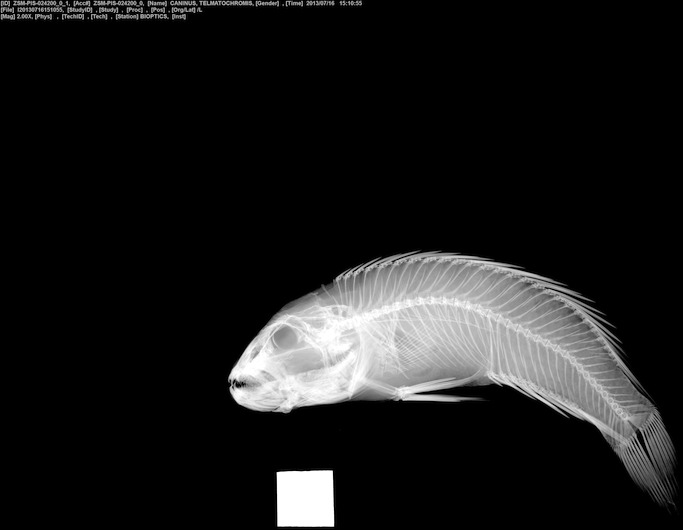
Telmatochromis splits into two informal groups. The "vittatus complex" is slim and torpedo-shaped with one or two dark lengthwise stripes; the "temporalis complex" — which includes dhonti — is deeper-bodied and more uniformly colored. The species has accreted a thicket of synonyms: Julidochromis macrolepis Borodin 1931 and Telmatochromis caninus Poll 1942 are both treated as the same fish. The status of macrolepis is the live dispute. Hanssens and Snoeks (2001) folded it into dhonti, FishBase and a 2020 genomic study (Ronco et al.) follow that, but Eschmeyer's Catalog of Fishes currently lists T. macrolepis as valid again, leaning on Ad Konings' argument that the markedly larger northern populations may be a separate taxon. A 2025 morphological revision of the genus (Indermaur et al., Journal of Fish Biology) treated macrolepis as a junior synonym of dhonti while explicitly sampling four geographically distant populations to hedge against exactly this uncertainty — and noted a formal revision is still pending. In short: one valid name on most lists, an asterisk on the northern fish.
Appearance
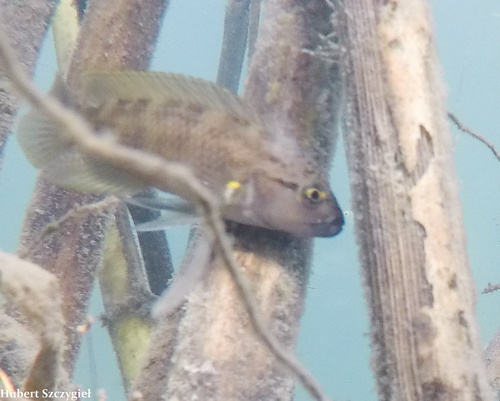
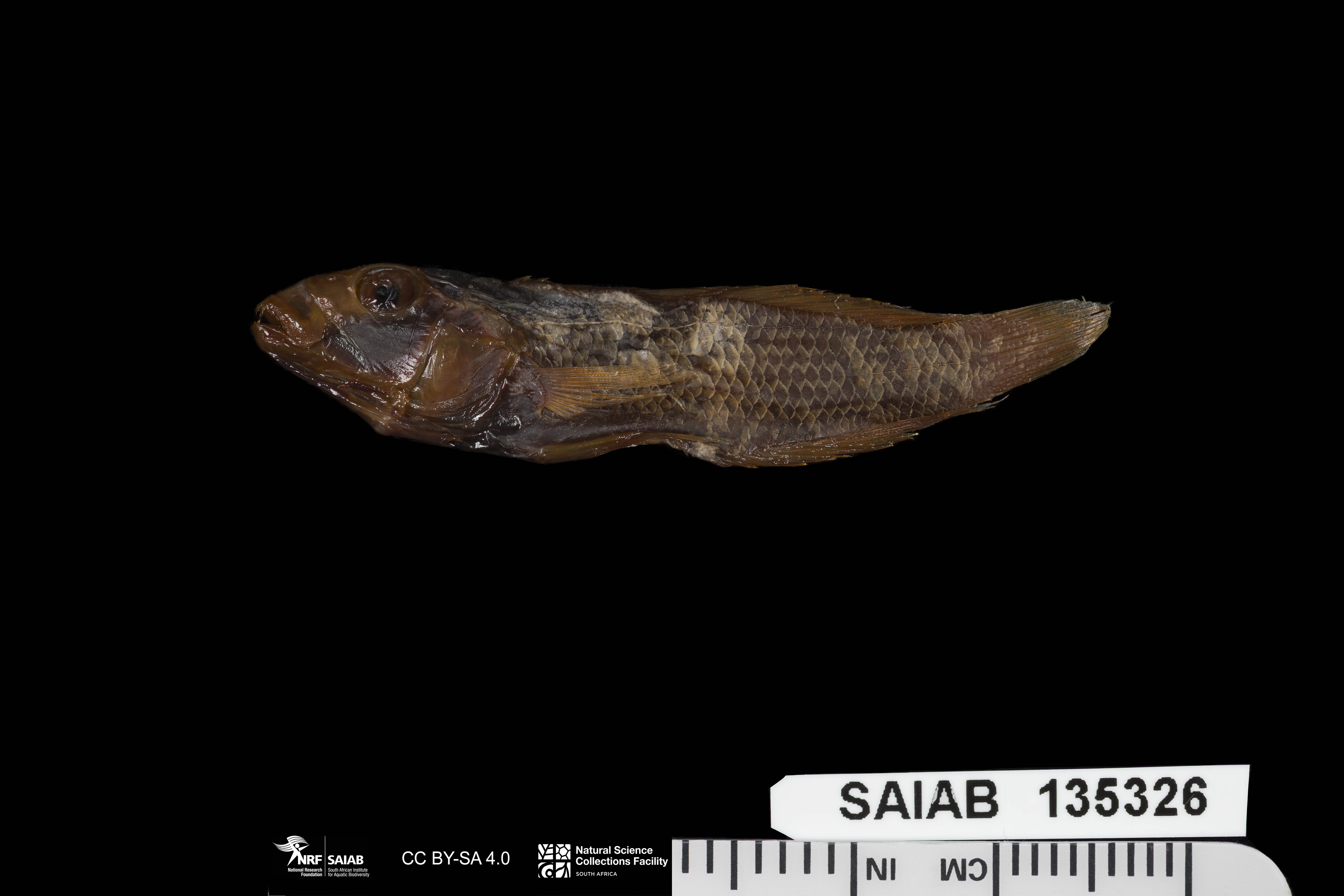
This is not a showy cichlid. Wild adults are a fairly uniform dark brown, deeper through the body than the striped members of the genus, with a robust head and notably heavy jaws for the size. Konings notes a small color spot on the pectoral region whose hue tracks the population — orange in typical dhonti — and the orange-to-red horizontal head markings that some males develop. The bright yellow and orange "strains" circulating in the hobby ("dhonti yellow," the old "orange scribble") are geographic color forms whose vividness is largely an aquarium phenomenon: observers report that adults in the lake stay plainly dark, with the orange aquarium coloration absent in wild fish.
Size is where dhonti gets genuinely confusing, and the honest answer is that it depends on where the fish came from. FishBase gives a maximum of about 4.7 in (12 cm) total length. But the geographic spread is real: southern and Kalemie-area populations often top out around 2.6–2.8 in (65–72 mm), while northern populations between Baraka and the Malagarasi River run much larger, with the biggest recorded individual near 4.4 in (113 mm). Sexual dimorphism is pronounced — males are substantially larger than females, which may be 30–40% smaller — so a "pair" is visibly mismatched.
Range & habitat
Telmatochromis dhonti is endemic to Lake Tanganyika and broadly distributed around it, recorded from south of Baraka in the Democratic Republic of the Congo, through Tanzanian waters south of the Malagarasi River, and into Zambian waters. It favors sediment-rich rocky habitats and the intermediate zones where rock meets sand, frequently in shallow water but also down to roughly 16–50 ft (5–15 m). Crucially, it tolerates turbidity that most rock-dwelling Tanganyikans avoid — it has been found over many kinds of rock substrate even in very muddy water.
That tolerance underlies its most unusual trait: among a genus long considered strictly lacustrine, dhonti is the one species that leaves the lake. It occurs in river deltas and is known from the Lukuga River — Tanganyika's sole outflow — including the Kisimba-Kilia rapids, with reports of it as far as ~60 mi (100 km) downstream. In-situ conditions are the hard, alkaline water typical of the lake: roughly pH 8.5–9.0 and temperatures around 75–79°F (24–26°C).
Ecology & diet
Sources frame the diet two ways that are worth holding side by side. FishBase, drawing on older accounts, calls it omnivorous and a feeder on microorganisms, placing it at a trophic level around 3.5. Field-oriented hobby and biotope summaries lean more carnivorous: stomach analyses are reported to show mainly invertebrates, with midge (chironomid) larvae dominating, consistent with the fish's heavy jaws and bottom-foraging habit. The reasonable synthesis is a benthic invertivore that takes small animal prey and biofilm from rock and sediment surfaces — opportunistic rather than a narrow specialist, which fits a fish that thrives in murky, marginal habitats other rock-dwellers won't use.
Within the Tanganyikan littoral community it sits as a small-to-medium territorial predator of the rock and intermediate zones, sharing space (and competing for cover) with shell-dwellers, gobiocichlines, and other lamprologines. Its turbidity tolerance lets it occupy degraded, silt-laden margins where competition from cleaner-water specialists eases.
Behavior & breeding
Telmatochromis dhonti is a substrate (cave) brooder, not a mouthbrooder. FishBase describes temporary pair bonds in which the male defends a territory while the female tends the eggs and fry; field descriptions add that males commonly hold harems with several females, each female guarding her own nest while the male polices the wider territory and steps in mainly against serious threats. Nests are caves and crevices, shallow burrows scraped beneath stones or wood, and — as with several Telmatochromis — empty snail shells. Reported clutches run from up to about 500 eggs in FishBase's summary down to a more typical 50–100 eggs per spawn in field accounts; the larger figure may reflect cumulative or maximal counts rather than a single typical brood.
The defining behavioral fact is aggression, and here the literature and the lived hobby experience agree emphatically. This is among the nastiest fish in an already pugnacious genus. Across independent keeper reports it is described as extremely aggressive — especially male-to-male — and fiercely territorial toward other species near a nest. One frequently cited keeper account describes a male tearing the jaw off a larger Neolamprologus during a mouth-lock, and fry beginning to kill one another as soon as parental care wanes. Treat single forum stories as color rather than data, but the consensus signal across forums is unusually consistent: dhonti punches far above its modest size.
In the aquarium
Telmatochromis dhonti is uncommon in the trade — wanted by Telmatochromis enthusiasts, rarely stocked — and it is emphatically not a community fish. It demands hard, alkaline Tanganyikan water (pH on the high side of 8, warm but not hot) and a hardscape built around dense rockwork forming caves and crevices, with optional shells and shallow under-rock burrows as spawning sites. A pair can be housed in something like 30 gallons (about 120 L), but that number is misleading: because of the species' temper, most keepers will need a substantially larger, longer footprint to spread out aggression and give subdominant fish — including the smaller females — room to escape.
The honest care picture: this is a fish for someone who specifically wants it, not a colorful centerpiece. Expect relentless territoriality, dangerous male-on-male combat, and trouble with most tankmates, which worsens sharply once a fish spawns. The recurring hobbyist mistake is treating dhonti like an ordinary small lamprologine and underestimating both the jaws and the attitude; pairing it with anything it can intimidate, or housing two males without enough space and sightline breaks, tends to end badly. One useful note of restraint from the community itself: at least one experienced keeper doubts dhonti is truly worse than the also-brutal T. temporalis, so calibrate the "most aggressive African" rankings as enthusiastic anecdote rather than measured fact. Either way, plan for a tough, single-species or carefully curated Tanganyikan setup.
Conservation
Telmatochromis dhonti is assessed by the IUCN as Least Concern. The Cichlid Room Companion cites the 2006 assessment, while FishBase reflects a more recent reassessment dated 24 April 2025 (Red List version 2025-2) that maintains Least Concern. That status fits the biology: the species is widely distributed around the lake, tolerant of turbid and marginal habitats, and not a narrow-range endemic, and it carries no specific collection pressure beyond modest, sporadic aquarium trade. FishBase also rates its fishing vulnerability as low. So at the species level, the straightforward read is: not currently threatened.
That said, "Least Concern" describes the fish, not the water it lives in — and Lake Tanganyika is under real, documented strain. O'Reilly et al. (2003, Nature, doi:10.1038/nature01833) showed that climate warming has stabilized the lake's stratification and reduced deep mixing, with sediment records implying primary productivity may have fallen by roughly 20% and fish yields by around 30%. Cohen et al. (2016, PNAS, doi:10.1073/pnas.1603237113) extended this, finding warming-driven loss of about 38% of the oxygenated benthic habitat in their study areas alongside declines in commercial fishes and endemic molluscs. The pelagic clupeid fishery — the sardine-like Stolothrissa and Limnothrissa, together with their Lates predators — feeds millions across the four riparian nations (Burundi, the DRC, Tanzania, and Zambia), whose shared stewardship runs through the Lake Tanganyika Authority. Closer to dhonti's own world, watershed deforestation and shoreline development drive sedimentation that degrades the rocky littoral on which most of Tanganyika's rock-dwelling cichlids depend (Cohen et al. 1993; Alin et al. 1999). The irony is that this is one of the rare rock-dwellers built to shrug off silt — its turbidity tolerance is exactly the trait that may buffer it where cleaner-water specialists decline. The fair summary: a secure species in a stressed lake, where its dietary flexibility and tolerance of muddy, marginal habitat give it more resilience than most of its rocky-shore neighbors.
Sources
- Eschmeyer's Catalog of Fishes — Telmatochromis dhonti (Boulenger 1919)
- FishBase — Telmatochromis dhonti
- GBIF — Fisheries of Lake Tanganyika (occurrence dataset incl. Telmatochromis dhonti)
- Indermaur et al. 2025 — Morphological diversity of the genus Telmatochromis (Journal of Fish Biology)
- Hanssens & Snoeks 2001 — A revised synonymy of Telmatochromis temporalis (Journal of Fish Biology)
- O'Reilly et al. 2003 — Climate change decreases aquatic ecosystem productivity of Lake Tanganyika (Nature)
- Cohen et al. 2016 — Climate warming reduces fish production and benthic habitat in Lake Tanganyika (PNAS)
- Lake Tanganyika: Status, challenges, and opportunities for research (J. Great Lakes Research, 2023)
- Alin et al. 1999 — Effects of landscape disturbance on animal communities in Lake Tanganyika (Conservation Biology)
- FAO — Lake Tanganyika Authority (four-nation fisheries governance)
- IUCN Red List — Telmatochromis dhonti (Least Concern)
- Cichlid Room Companion — Telmatochromis dhonti (public species page)
- tanganyika.si — Telmatochromis dhonti (biotope, size, breeding, aggression)
- The Cichlid Stage — on Telmatochromis dhonti color forms and habits (citing Konings)
- MonsterFishKeepers — most aggressive cichlid thread (Telmatochromis dhonti keeper account) — community/anecdotal
- Reddit r/Cichlid — Tanganyika tankmate compatibility (dhonti noted as exceptionally aggressive) — community/anecdotal
- Cichlid-Forum — aggression in Telmatochromis (community discussion) — community/anecdotal