Taxonomy & naming
Telmatochromis temporalis was described by the Belgian-British ichthyologist George Albert Boulenger in 1898, from specimens collected on the Zambian shore of Lake Tanganyika at Kinyamkolo (Niamkolo, near present-day Mpulungu) and Mbity Rocks by the explorer J. E. S. Moore. The lectotype and paralectotypes are held at the Natural History Museum in London and at the Royal Museum for Central Africa in Tervuren. The genus name joins the Greek telma ("swamp" or "pool") with chromis, an old name for a perch-like fish; the epithet temporalis refers to the temporal region of the head. Eschmeyer's Catalog of Fishes and the IUCN both treat the name as valid, with Telmatochromis burgeoni Poll, 1942 and Telmatochromis lestradei Poll, 1942 listed as junior synonyms.
That tidy synonymy hides a genuinely tangled history. The taxonomic revision by Hanssens and Snoeks (2001) re-examined the type material and confirmed that T. lestradei collapses into T. temporalis, while reassigning Julidochromis macrolepis to the related T. dhonti rather than to temporalis. Crucially, the same work followed Konings in treating the small, shell-dwelling fish that the hobby long sold as "burgeoni" as nothing more than a dwarf form of T. temporalis, since burgeoni's true type locality lies in the far northeast of the lake, outside the dwarf form's known range. Within the genus, temporalis anchors one of two lineages — the deep-bodied "temporalis complex," alongside T. dhonti and T. brachygnathus, all with faint or absent lateral stripes — as opposed to the elongate, boldly striped group that includes T. vittatus, T. bifrenatus and T. brichardi. In the trade the rock form circulates simply as Telmatochromis temporalis, while the dwarf is sold as T. sp. "temporalis shell" or, still, under the lingering misnomer "burgeoni."
Appearance
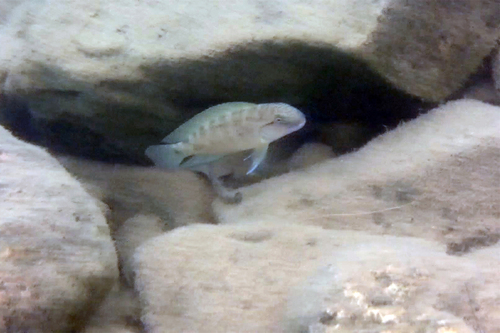

This is a compact, heavy-shouldered fish whose silhouette is its best field mark. Both forms carry a pronounced nuchal hump above the eyes — more swollen in males — that, together with a large head and wide mouth, gives the normal form a faintly pugnacious, bulldog look quite unlike the torpedo shape of most of the genus. Color runs from tan and olive to near-black, usually plain or with only faint traces of longitudinal banding; the deep body and dark, even tone are exactly what separate the temporalis group from its striped congeners.
Size is where you have to be careful, because the two forms differ sharply and the literature and the hobby do not always agree. FishBase gives a maximum of about 4 in (10.2 cm) total length for the species, a figure that reflects the larger rock form. Measured in the wild at Wonzye, Zambia, adult normal-form males run roughly 2.2–3.0 in standard length (56–76 mm SL) and females about 1.3–2.1 in (33–53 mm SL), while dwarf-form males measure only about 1.0–1.6 in (25–40 mm SL) and females a diminutive 0.7–1.1 in (17–27 mm SL). Aquarists report similar spans but stretch the top end: keepers of the dwarf "shell" form variously cite mature males at 2.5 in and, in roomier tanks, well over 3 in, so the honest summary is that the dwarf tops out somewhere around 1.5–2.5 in (4–6 cm) and the rock form around 4 in (10 cm). A third, "slender" morph — lacking the nuchal hump and with a narrower interorbital and more dorsal-fin spines — was described by Takahashi (2020) from Kasenga, Zambia, and is genetically distinct from but closest to the normal form. The species is also dichromatic: pale and dark individuals occupy well-lit and shaded microhabitats respectively, and a fish can reverse its shade when it changes territory, a flexibility read as antipredator matching to the background.
Range & habitat
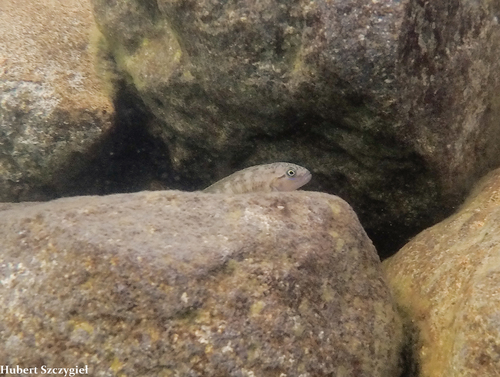
Telmatochromis temporalis is a Tanganyikan endemic with, in the normal form, a lake-wide distribution along the shores of all four riparian nations — Burundi, the Democratic Republic of the Congo, Tanzania and Zambia. It is a fish of the rocky littoral: the normal form lives over hard substrates from clean reef rock to surprisingly murky, sediment-influenced stretches, sheltering and spawning in the spaces beneath and between stones. Field accounts note that it is not light-shy and will swim out in the open, and that it occupies relatively deep water for so small a cichlid — recorded down to about 65 ft (20 m), though it favors the brighter shallows between roughly 16 and 40 ft (5–12 m).
The dwarf form occupies an entirely different niche and a far narrower range. Rather than rock, it inhabits "shell beds" — expanses of sandy bottom carpeted with the empty shells of the endemic snail Neothauma tanganyicense, preserved by the lake's hard, alkaline water — and uses those shells as both refuge and nursery. Critically, while rock and the normal form are distributed all around the lake, the dwarf and its shell beds are geographically restricted; in the well-studied southern basin they are confined to a stretch around the Wonzye–Nkumbula area of Zambia. In-situ conditions are those of the lake at large: pH around 8–9, high carbonate hardness, and warm, stable temperatures near 75–82°F (24–28°C). The contrast between a lake-wide rock generalist and a pocket-sized, shell-bound specialist living a few hundred meters away is the geography behind the speciation story.
Ecology & diet
Telmatochromis temporalis is best understood as a browser of the aufwuchs — the felt of algae, diatoms and the tiny invertebrates living within it that coats sunlit rock throughout the lake's littoral. The Cichlid Room Companion classes it among the "algae pullers," and FishBase places it at a low trophic level of about 2.2, consistent with a largely herbivorous, biofilm-grazing diet; older accounts that call it "omnivorous" and note it taking microorganisms and the occasional small fish simply reflect that an opportunistic grazer will not refuse animal prey. This grazing habit ties the fish tightly to firm, well-lit surfaces, which is one reason the normal form is so faithful to rock.
Its wider ecological interest lies in the dwarf form's relationship with the shell bed. By colonizing empty Neothauma shells, the dwarf exploits a resource left behind by a mollusk and shared with a whole guild of shell-dwelling lamprologines, and its small size is itself an adaptation to that resource. The trade-off is unforgiving: a fish enters its shell head-first to escape predators, but a male grown too large can no longer turn around inside and must back out tail-first, unable to see whether the coast is clear — a direct, mechanical penalty on large body size that field studies invoke to explain why the shell-bed population stays small. In the open rock habitat no such ceiling applies, and the normal form grows freely larger; body size, in other words, is under opposing selection in the two environments.
Behavior & breeding
Both forms are territorial substrate spawners that lay their eggs in a cave — under a rock for the normal form, inside a shell for the dwarf — and guard the resulting fry rather than mouthbrooding them. The mating system is flexible: fish typically form temporary pair bonds in which the male holds and defends a territory while the female tends the eggs and shelters the young, though some males gather small harems and occupy a residence separate from their mate. Broods are modest, on the order of 20–30 fry, and parents defend them vigorously while they are small, the male generally carrying the fight farther from the nest than the female. The dwarf's reproductive biology also includes alternative male tactics: the species is one of those in which small "sneaker" males parasitize the spawnings of larger territory holders, a strategy that shifts the payoff of body size yet again.
The two forms have begun to diverge behaviorally as well as ecologically, and that is the heart of why scientists watch this fish so closely. Tank experiments show that large individuals prefer to mate with large partners and small with small, so the body-size gap between rock and shell populations doubles as a barrier to interbreeding — a clean example of a "magic trait," a single character that is both under divergent natural selection and the basis of assortative mating. Genetic work confirms partial reproductive isolation between the normal, dwarf and slender forms despite their living side by side, and a quantitative-trait-locus study has even begun to map the genes behind the size difference. In aquarium terms, the upshot of all this territoriality is a fish that breeds readily and continuously once settled, with successive broods tending to grow larger as a pair matures.
In the aquarium
Telmatochromis temporalis — most often the dwarf "shell" form in the trade — is hardy, undemanding about water beyond the usual Tanganyikan requirements, and a willing breeder, but it has a reputation among experienced keepers that the words "small" and "shell dweller" badly undersell. As one long-time keeper put it bluntly, these are "one tough SOB": they pack real teeth, are fearless out of all proportion to their size, and will hold their own against, or even rout, more famously aggressive shell dwellers like Lamprologus ocellatus. They want hard, alkaline water (pH roughly 8.5–9.0, high GH/KH) and a temperature in the mid-to-high 70s °F (25–26°C), a sand bed, rockwork, and a cluster of empty Neothauma or escargot shells for the dwarf form to claim.
The honest catch is intraspecific aggression, and keepers' experiences converge on a counterintuitive point: a single pair will breed prolifically — "like guppies," in one account — and a modestly crowded tank can actually stay more stable than a sparse one, because constant low-level tension keeps any one fish from monopolizing space. The same keeper who ran a dozen fish peacefully in a 40-gallon breeder watched the males start seriously fighting once the colony was moved to a roomier 75-gallon, where there was suddenly territory worth contesting. The practical reading is to give the fish a long footprint and plenty of broken sight lines and shell or rock cover, plan around a single pair or a deliberately managed group rather than a random handful, and expect a steady stream of fry. For tankmates, open-water swimmers such as Cyprichromis or Paracyprichromis are ideal because they don't contest the bottom; mixing temporalis with other substrate-hungry shell dwellers in anything but a large tank is asking for a war over the floor. Two mistakes recur: assuming a Tanganyikan "dwarf" will be peaceful, and over-housing a small group in the hope of reducing aggression, which often does the opposite.
Conservation
Telmatochromis temporalis is assessed by the IUCN Red List as Least Concern (assessed 2006; assessment e.T60688A12385552, flagged as needing updating). The rationale is straightforward: it is a widespread fish of the rocky littoral with a lake-wide distribution and no known major threats, and as a hardy grazer it has high reproductive resilience and low fishing vulnerability. The assessment does flag two species-specific pressures, however. It states plainly that the aquarium trade "heavily exploits" this species — collection that bears most directly on the small dwarf "shell" form, with its naturally narrow, patchy distribution on a few shell beds rather than the lake-wide rock form — and it names localized sedimentation of the rocky shore as the single greatest threat.
That second point is where this littoral grazer is tied to the lake's wider trajectory. Lake Tanganyika is an ancient, biologically irreplaceable rift lake shared by four nations (Burundi, the DRC, Tanzania and Zambia), and it is under measurable strain. O'Reilly et al. (2003, Nature) showed that climate warming has strengthened the lake's stratification and diminished the deep mixing that fertilizes its surface waters, driving a long-term decline in primary productivity; Cohen et al. (2016, PNAS), reading paleoecological sediment cores, found that warming has reduced fish yields and shrunk oxygenated benthic habitat, with declines in commercially important fishes and in the lake's endemic mollusks accompanying the temperature rise — and it is those very mollusks, the Neothauma snails, whose empty shells the dwarf form depends on. The pelagic clupeid-and-Lates fishery that feeds millions around the lake adds its own pressure, while catchment deforestation pours sediment onto the inshore rocks. For a fish that grazes aufwuchs off sunlit, sediment-free rock and broods in snail shells, sedimentation is the proximate danger: it smothers the algal film it eats and buries the hard and shelly substrates it needs. Management of these basin-scale threats falls to a four-nation framework — the Convention on the Sustainable Management of Lake Tanganyika (adopted in Dar es Salaam in 2003) and its Lake Tanganyika Authority — whose effectiveness will matter more to this species' long-term security than anything unique to the fish itself. The accurate summary is the careful one: the species is currently Least Concern, but the lake it cannot leave is not.
Sources
- Eschmeyer's Catalog of Fishes — Telmatochromis temporalis (species record)
- FishBase — Telmatochromis temporalis summary
- GBIF — Telmatochromis temporalis (Boulenger, 1898)
- Hanssens & Snoeks (2001) — A revised synonymy of Telmatochromis temporalis (Teleostei, Cichlidae), Journal of Fish Biology
- Aibara et al. (2021) — Mapping of quantitative trait loci underlying a magic trait in ongoing ecological speciation, BMC Genomics
- Takahashi (2020) — A new morph of Telmatochromis temporalis (Cichlidae; Cichliformes) from Lake Tanganyika, Hydrobiologia
- Winkelmann et al. (2016) — Body Size Evolution of a Shell-Brooding Cichlid Fish From Lake Tanganyika (PubMed)
- Mboko & Kohda (1995) — Pale and dark dichromatism related to microhabitats in Telmatochromis temporalis (Semantic Scholar)
- Cichlid Room Companion — Telmatochromis temporalis species profile
- Practical Fishkeeping — Telmatochromis temporalis (Matt Ford)
- The Cichlid Stage — More Telmatochromis temporalis? Yes, please! (the third 'slender' morph)
- The Cichlid Stage — If at first you don't succeed… (keeping and breeding the 'shell' form)
- Cichlid-Forum — Telmatochromis temporalis 'Shell' and Lamprologus ocellatus together? (keeper experience, anecdotal) — community/anecdotal
- IUCN Red List — Telmatochromis temporalis (Least Concern, 2006; Bigirimana)
- O'Reilly et al. (2003) — Climate change decreases aquatic ecosystem productivity of Lake Tanganyika, Nature
- Cohen et al. (2016) — Climate warming reduces fish production and benthic habitat in Lake Tanganyika, PNAS
- Lake Tanganyika: Status, challenges, and opportunities for research (J. Great Lakes Research, 2023)