Taxonomy & naming
Telmatochromis vittatus was described by the Belgian-British ichthyologist George Albert Boulenger in 1898 from material collected at Mbity (Mbita) Rocks on the Zambian shore of Lake Tanganyika. It is the senior, accepted name for the species — not a synonym of anything else — and sits in the family Cichlidae within the rift-lake tribe Lamprologini, the substrate-spawning lineage that also gives us Julidochromis, Neolamprologus, Lamprologus and Altolamprologus.
The genus name blends Greek telma (a swamp or marsh) with chromis, an old catch-all for a perch-like fish; the species epithet vittatus is Latin for "banded" or "striped," a nod to the dark longitudinal stripe along its flank. Telmatochromis itself falls naturally into two body plans: an elongated, almost eel-like group — brichardi, vittatus and bifrenatus — and a stouter group built around temporalis, dhonti and burgeoni. A 2024–2025 morphological revision of the genus, drawing on lake-wide sampling, treated the slender striped fishes as a distinct "Telmatochromis vittatus complex" of highly elongated, short-headed forms, which underscores how tightly related and easily conflated these fishes are.
Appearance
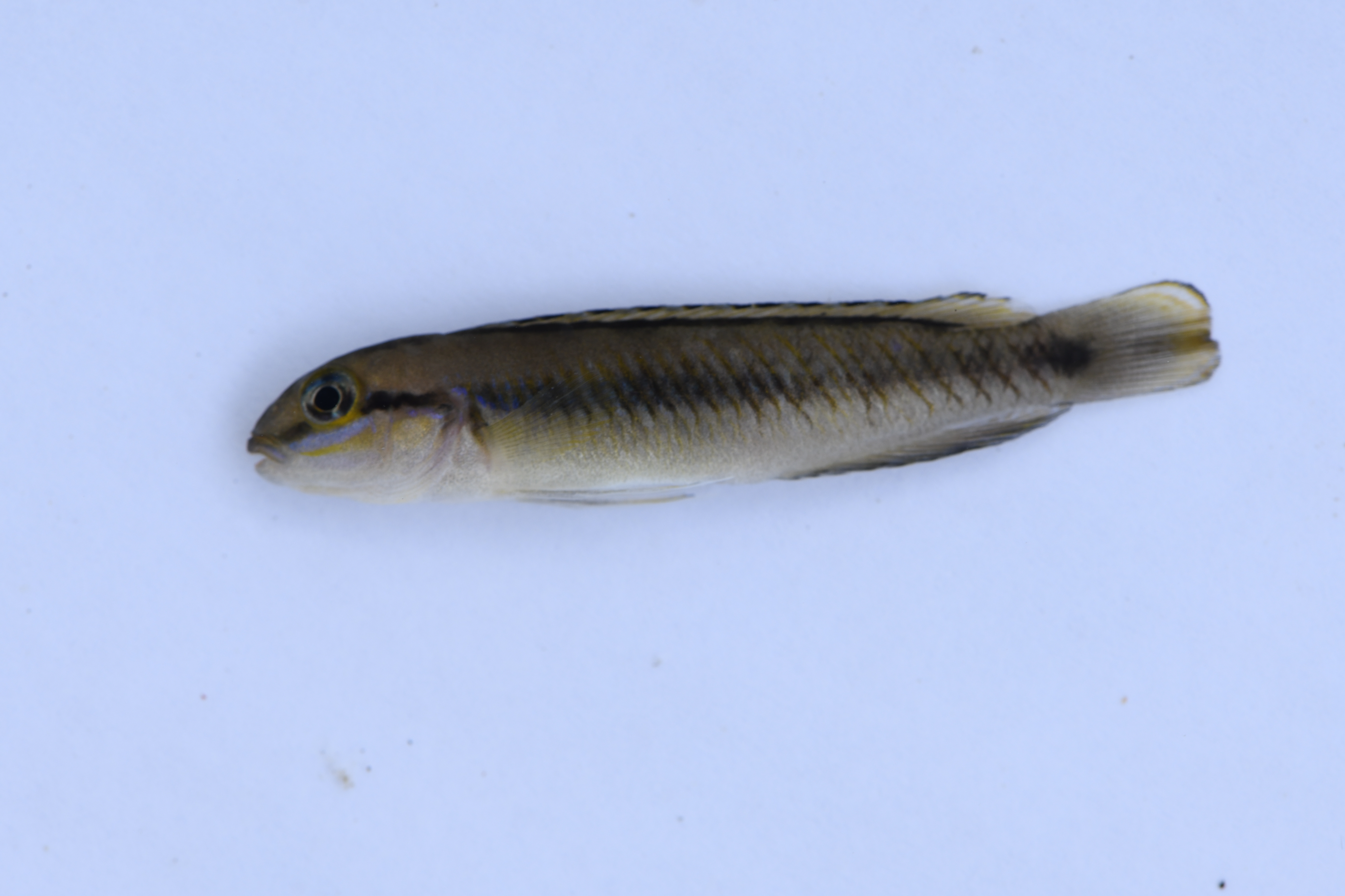
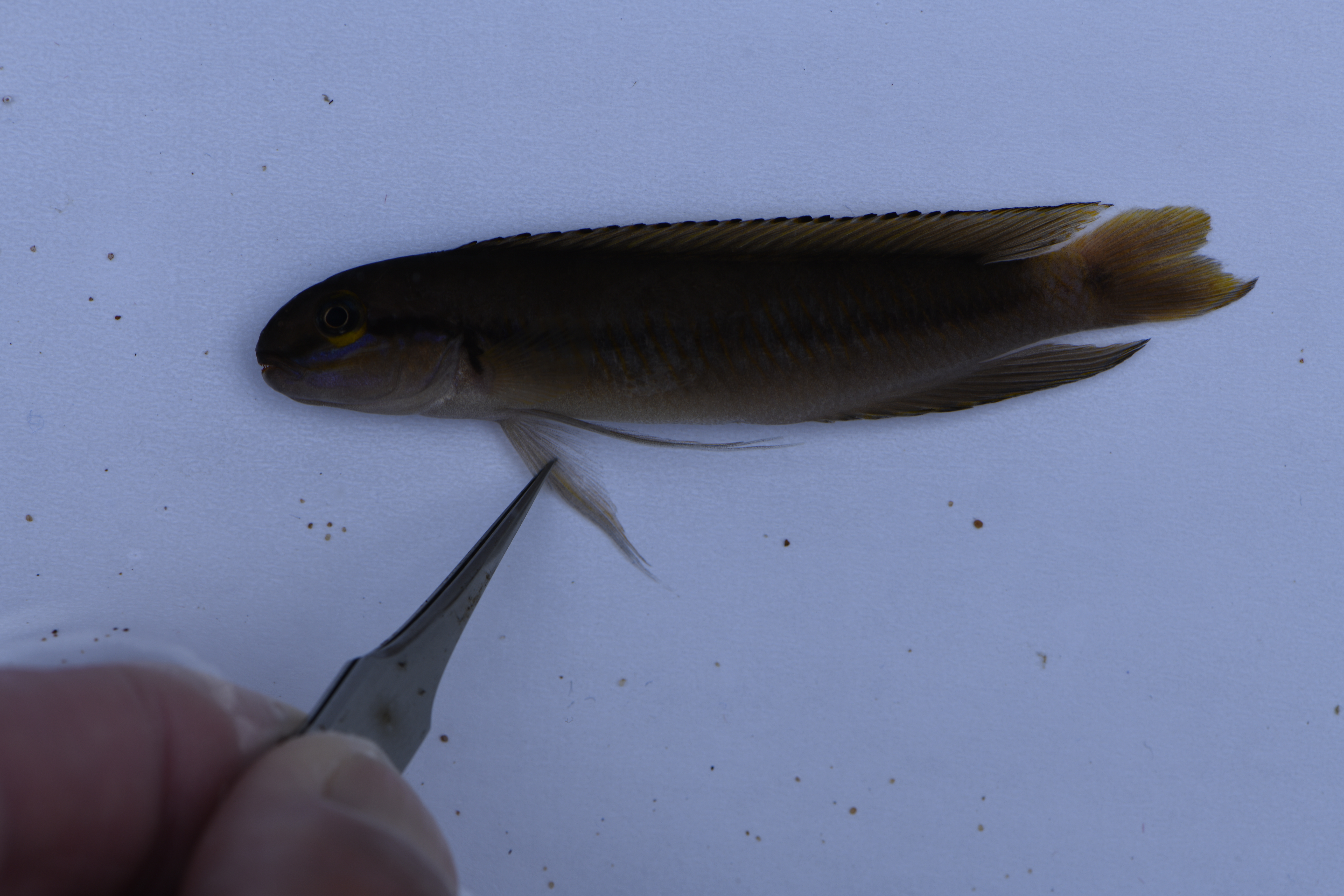
This is a slender, cylindrical fish — a "Tanganyikan torpedo," as keepers fondly call the elongated Telmatochromis. Reported maximum size varies with the source and, importantly, with which ecological form is being measured. The widely cited checklist figure (CLOFFA, via FishBase) is about 3.4 in (8.6 cm) total length; specialist sources following Ad Konings put the rock-dwelling form at roughly 4 in (10 cm), while the smaller shell-associated form tops out closer to 2.4 in (6 cm). Some aquarium-trade listings claim up to 4.3 in (11 cm), which is at the optimistic end and likely tank-inflated. Males grow larger and more slender than females.
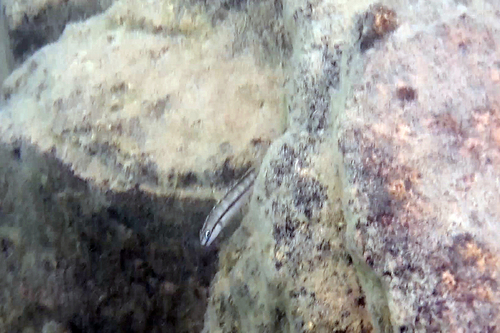
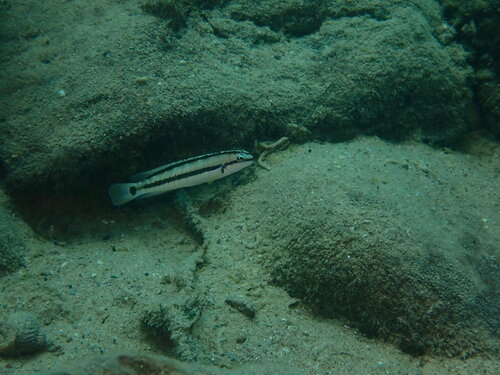
Coloration is understated — base tones of tan, grey and brown — which is part of why the fish is overlooked. The diagnostic feature is the dark lateral stripe: in T. vittatus it runs as an almost continuous, unbroken band, paired with a second band along the junction of the back and the dorsal fin. Its near-twin, T. brichardi, has that lateral band broken into many small oblique bars, a more pointed snout and a proportionally larger eye; T. bifrenatus, the third slender congener, shows additional banding. Telmatochromis are so frequently mislabelled in shops and books that experienced hobbyists treat identification with open caution rather than confidence.
Range & habitat
Telmatochromis vittatus is endemic to Lake Tanganyika — found nowhere else on Earth — but exactly how far around the lake it ranges depends on whom you ask, and the disagreement is genuine. The 2025 IUCN assessment restricts it to the southern half of the lake, between Kalemie on the Congolese (western) coast and Isonga on the Tanzanian (eastern) coast, with a gap between Moba and the Lunangwa River that is occupied by an as-yet-undescribed relative. Konings' lake-survey work instead describes it as distributed around most of the lake except the northernmost sub-basin (Burundi and the adjacent Congolese shore), where it is replaced by T. brichardi or T. bifrenatus. Either way, the picture is of a southern- to central-lake fish whose edges blur into those of its congeners.
It favors the shallow rocky littoral and intermediate zones — rock piles grading into sand — and is closely tied to empty gastropod (snail) shell beds, where it can be strikingly abundant. Although a small fish, it occurs in relatively deep water for its size, recorded down to about 65 ft (20 m) but preferring roughly 16–33 ft (5–10 m). Its in-situ water is hard and strongly alkaline, with FishBase listing pH 8.5–9.0, hardness around 10–20 dH and temperatures of about 75–79°F (24–26°C) — the classic Tanganyika littoral chemistry.
Ecology & diet
Ecologically, T. vittatus is a low-trophic-level grazer-omnivore (FishBase estimates a trophic level near 2.3). It works the rocks for aufwuchs — the carpet of algae, diatoms, microorganisms and tiny invertebrates that coats hard surfaces in the littoral — and the IUCN assessment notes it feeds on the algae growing on the rock. Konings describes a distinctive feeding action: the fish flexes its body into an "S" shape and removes food with a sharp jerking motion, a mechanic shared by several slender lamprologines.
Its role in the community is partly defined by sheer numbers. The IUCN account calls it the most common cichlid on shell beds, where densities can exceed 50 individuals per square metre. That abundance — feeding low on the food web, sheltering in shells, and in turn forming prey for larger rock-dwelling predators — makes it an unglamorous but well-woven thread in the rocky-shore ecosystem. The normal/dwarf, rock/shell habitat split seen in T. vittatus echoes the better-studied case of its stouter relative T. temporalis, in which divergent natural selection tied to available shelter size has repeatedly produced large rock forms and small shell forms; the parallel is suggestive, though the detailed selection work was done on temporalis, not vittatus.
Behavior & breeding
Telmatochromis vittatus is a substrate (cave) brooder rather than a mouthbrooder. It spawns hidden away in a rock crevice, a small hole, or — given the chance — an empty snail shell, with eggs attached to the wall or roof of the chamber. Sources differ on the division of parental labor: FishBase describes a temporary pair bond in which the female tends the eggs and fry while the male defends the surrounding territory, whereas Konings-derived accounts report biparental care of a clutch of roughly 50 eggs. The honest summary is that care is brief and centred on the nest cavity, and that exactly how the duties split likely varies with setting.
Form and field reports paint the courtship as theatrical for so plain a fish. In one detailed aquarium account, the male performed a frantic "dance," hurling himself toward the rocks and apparently signalling the female through shock waves and vibration before she entered the shell. Brood care does not last long: keepers consistently report that adults lose interest once fry are free-swimming, and that fry — small and sand-colored — often go unnoticed until they are already grown. Yields in the tank are modest and trickle out over time; one breeder logged 7–10 fry every six or seven weeks, while another, keeping a small group in a larger setup, was startled to find well over a hundred fry suddenly carpeting the tank floor. Toward its own kind the species can be territorially scrappy, but it is not a brawler by Tanganyikan standards.
In the aquarium
Among Tanganyika keepers, T. vittatus has a reputation as a peaceful, low-drama community fish that mostly minds its own business. Across independent forum reports the refrain is consistent: it sticks to the margins of rocks, caves and shells, is largely ignored by — and ignores — its tankmates, and has been kept successfully alongside Cyprichromis, Paracyprichromis, calvus/compressiceps-type Altolamprologus, and small shell-dwellers like Neolamprologus brevis. Some keepers candidly find it more handsome than entertaining, noting it can be reclusive and doesn't add much visible action to a tank.
A practical, well-decorated setup of around 25–40 gallons (roughly 95–150 L) suits a small group, scaled up if combined into a larger community; provide hard, alkaline water matching the lake, a sand substrate, generous rockwork forming caves, and a scattering of empty snail shells. Two cautions recur. First, identification: buy from knowledgeable breeders or importers, because mislabelled Telmatochromis are the norm rather than the exception. Second, hybridization: because the slender Telmatochromis are closely related to Julidochromis (and likely Chalinochromis), at least one documented case produced cross fry between T. vittatus and Julidochromis dickfeldi in a crowded tank — a good reason not to house elongated Telmatochromis with those genera if you care about pure stock. It is not a fish that demands expertise to keep alive, but it rewards a keeper who understands what they actually bought.
Conservation
The IUCN Red List assesses Telmatochromis vittatus as Least Concern, most recently evaluated on 03 March 2025 (version 2025-2) and Least Concern at its previous assessment in 2006. The assessment finds no major widespread threats: the species is widely distributed across its range and extraordinarily abundant on shell beds — sometimes more than 50 fish per square metre — so although it is collected for the aquarium trade, that harvest is judged to pose no real risk to the population. The one threat flagged is localized: sedimentation of the rocky shore habitat the fish depends on, which can smother the algal aufwuchs it grazes and silt over the rock and shell substrate it shelters in. Population trends have not been formally studied, a caveat the assessors note explicitly.
That individually reassuring verdict sits inside a lake under measurable strain. Lake Tanganyika has warmed over the past century, strengthening the density gradient that separates its surface from its deep water and weakening the seasonal mixing that lifts nutrients into the sunlit zone; O'Reilly and colleagues (2003, Nature, doi:10.1038/nature01833) linked this to a substantial decline in primary productivity and, with it, lower fish yields. Cohen and colleagues (2016, PNAS, doi:10.1073/pnas.1603237113) added paleoecological evidence that warming has accompanied a loss of oxygenated benthic habitat and declines in commercially important fishes and endemic molluscs. Most of that pressure bears on the deep and pelagic lake — the clupeid and Lates fishery that feeds four nations under the shared governance of the Lake Tanganyika Authority — rather than on a shallow rocky-shore grazer. For T. vittatus the more direct concern is the same shoreline-scale sedimentation the IUCN names, driven by deforestation and land-use change in the lake's catchment. The accurate framing is therefore a careful one: the species itself is not currently threatened, but it lives in a basin whose littoral habitats are being degraded locally even as the open lake responds to a warming climate.
Sources
- FishBase: Telmatochromis vittatus (Boulenger, 1898)
- Catalog of Fishes (Cichlidae family details, listing T. vittatus as accepted/original)
- IUCN Red List: Telmatochromis vittatus (Least Concern, assessed 2025)
- Cichlid Room Companion — Telmatochromis vittatus Boulenger, 1898 (Audrey Marquis)
- tanganyika.si — Telmatochromis vittatus 'Mbita Island' (Konings imagery & species data)
- Morphological diversity of the genus Telmatochromis from Lake Tanganyika (recognizing the 'T. vittatus complex')
- Takahashi et al. (2009) — Evidence for divergent natural selection in body size of a Lake Tanganyika cichlid (T. temporalis), Molecular Ecology
- The taxonomic diversity of the cichlid fish fauna of ancient Lake Tanganyika (type locality: Mbity Rocks)
- O'Reilly et al. (2003) — Climate change decreases aquatic ecosystem productivity of Lake Tanganyika, Nature
- Cohen et al. (2016) — Climate warming reduces fish production and benthic habitat in Lake Tanganyika, PNAS
- Tropical Fish Club of Erie County — Breeding Telmatochromis vittatus (keeper account) — community/anecdotal
- Cichlid-Forum — Telmatochromis vittatus in a Tanganyika community tank (keeper reports) — community/anecdotal
- Cichlid-Forum — Telmatochromis vittatus tank setup discussion — community/anecdotal
- The Cichlid Stage — observations of a community Tanganyikan tank (incl. T. vittatus) — community/anecdotal
- Lake Tanganyika: status, challenges, and opportunities for research (basin review)