
Taxonomy & naming
The species was described by the British ichthyologist Charles Tate Regan in 1922 as Haplochromis placodon, from specimens taken in Lake Malawi (then Lake Nyasa). Eccles and Trewavas, in their 1989 revision of the Malawian haplochromines, fixed the lectotype (BMNH 1921.9.6.134) and placed the fish in the genus Trematocranus, where the Catalog of Fishes and FishBase still hold it as valid.
The names describe the animal. Trematocranus blends the Greek trematos ("hole" or "pore") and kranion ("skull"), a nod to the conspicuous sensory pores on the head; the species epithet placodon — roughly "tablet-tooth" — points to the molar-like pharyngeal teeth that define it. Trematocranus was once a catch-all; most of its former members have since been moved to Aulonocara and Alticorpus, leaving only a handful of valid species, of which placodon is the type and best known. In the hobby it is the "snail-crusher hap," and exporters simply list it as "Placodon."
Appearance
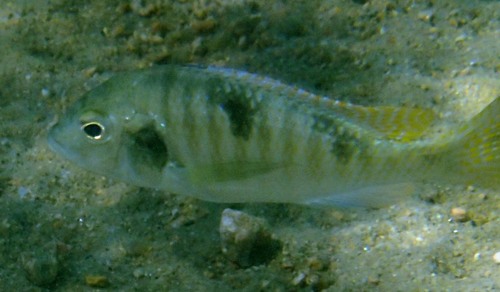
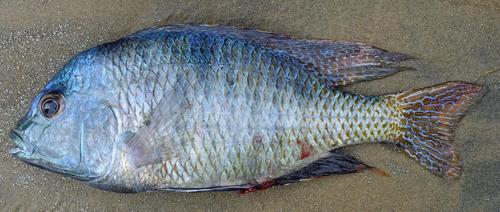
This is a substantial, deep-bodied haplochromine. The Catalog-grade references give a maximum of about 25 cm (10 in) total length, with commercially caught fish topping out near 23 cm (9 in); aquarium males commonly reach roughly 10 in. Females and non-breeding fish are silvery and rather plain, marked with faint vertical bars — good camouflage over pale sand.
The drama belongs to breeding males, which flush into metallic blue over the head and flanks with darker barring and the egg-spot-bearing anal fin typical of the group. Sexual dimorphism is straightforward: males run larger and far more colorful, females smaller and muted. The diagnostic feature is internal rather than showy — an enlarged, robust lower pharyngeal bone paved with rounded molariform teeth, the crushing mill that separates placodon from the slender-jawed, fish- and insect-eating haps it shares the sand with.
Range & habitat
Trematocranus placodon is endemic to the Lake Malawi system. It is widespread through the main lake, occurs in shallower Lake Malombe to the south, and runs down the upper Shire River as far as the Majete Rapids — so while some hobby sources call it a Lake Malawi endemic, the authorities (Catalog of Fishes, FishBase, IUCN) record the broader catchment range, reaching into Malawian, Mozambican and Tanzanian waters.
It is a fish of soft bottoms rather than the rocky reefs that draw most aquarists to Malawi. It favors sandy and muddy shallows, is most common around 5 m (16 ft) — often among swards of the freshwater eelgrass Vallisneria, where many of its prey snails graze — and has been recorded down to about 31–32 m (100–105 ft). FishBase summarizes its lake water as warm and hard-alkaline: roughly 24–26 °C (75–79 °F), pH about 7.0–8.5, the high-conductivity rift-lake chemistry the whole flock is built for.
Ecology & diet
Placodon is the textbook Malawi molluscivore, but a flexible one — a facultative specialist rather than an obligate snail-eater. In the lake it takes gastropods such as Gabiella stanleyi off Vallisneria leaves and, in open water, the burrowing Bulinus nyassanus and the trumpet snail Melanoides; it sits at a trophic level of about 3.4. Free snails are simply sucked in; ones clamped to a leaf or shell are first knocked loose, then drawn back to the pharyngeal mill and crushed (Chiotha, McKaye & Stauffer 1991). Handling time climbs with snail size, tracking how hard a given shell is to break.
The crushing apparatus is not fixed for life. Madsen and colleagues (2010) documented an ontogenetic shift: juveniles eat insects and small snails, and as the lower pharyngeal bone thickens with age the diet moves to larger, harder-shelled snails — with a spike in Bulinus intake just before spawning. That plasticity has a practical edge: hatchery fish raised on soft feed develop weak molariform teeth and crack snails poorly, while a hard diet early in life builds the proper grinding plate (Jere et al.; Kefi et al. 2012).
Behavior & breeding
Like the other sand-dwelling haps, T. placodon is a polygamous maternal mouthbrooder, and the males are arena builders. A ripe male excavates a broad, bowl-shaped crater — a sand "castle" or bower — in open substrate, which he defends and uses as a courtship stage, displaying in full color to passing females. In the lake the breeding season runs roughly July to September.
Spawning follows the classic haplochromine script: the female lays a clutch in the depression, the male fertilizes it, and she takes the eggs into her mouth. A single brood can run to 100 eggs or more, and she carries them for about three weeks without feeding — her swollen buccal pouch an easy tell — before releasing free-swimming fry large enough to take brine-shrimp nauplii at once. Outside breeding, males are intensely intolerant of rival males; females and subadults are far more sociable.
In the aquarium
This is a fish for the larger Malawi setup, not a starter cichlid — and one seen for sale less often than the mbuna and peacocks. Reputable hobby sources and keepers converge on the same plan: a tank around 60–72 in (150–180 cm) or longer, a sandy bottom with open swimming space, scattered rockwork for structure, and ideally some Vallisneria. Lake-like chemistry suits it — about 75–82 °F (24–28 °C), pH on the order of 7.8–8.6, hard water.
The recurring mistake is housing more than one adult male; keepers report males are relentlessly aggressive toward each other, so the standard is a single male with several females, which also frames the natural harem-spawning structure. In genuinely big tanks it mixes with other large haps — Fossorochromis rostratus, Cyrtocara moorii — or even Cyphotilapia frontosa. It eats almost anything offered, but a quality diet that includes the occasional snail keeps the pharyngeal mill working as designed; one forum-circulated photo even shows the species as Ad Konings' own, a reminder of how much of its keeping lore traces back to lake fieldwork rather than tank guesswork.
Conservation
The IUCN Red List assesses Trematocranus placodon as Least Concern (assessed 19 June 2018, amended 2019; Konings & Kazembe), with an unknown population trend. The assessment is candid about a real dent in its numbers: a significant local decline in the southern lake, attributed to heavy beach seining, set against a still-wide distribution across the rest of Malawi, Lake Malombe and the Shire — including places with little fishing pressure, and within Lake Malawi National Park. It is also taken for food by subsistence fishers and collected, modestly, for the aquarium trade. So the honest line is the one the Red List draws: the species itself is not threatened, even though parts of its range clearly are.
That caveat matters because placodon is a sandy-shallows fish, and the shallows are where Lake Malawi's basin-scale pressures land hardest. The 2023 Chavula et al. review in the Journal of Great Lakes Research (49(6):102241) catalogs them: over-fishing and the collapse of the chambo (Oreochromis) fishery; sediment and nutrient loading washing off deforested, farmed catchments; roughly +0.7 °C of warming in the surface layer that strengthens stratification and trims productivity; and the looming risk of invasive species. For a near-shore molluscivore, sedimentation and shoreline disturbance bear most directly — they degrade exactly the soft-bottom, Vallisneria-fringed habitat it and its prey snails depend on. There is a human twist, too: studies tying declines in molluscivorous fish to rising snail densities (Stauffer et al. 1997, 2005; Madsen & Stauffer 2011) suggest that protecting placodon along inhabited shorelines could help hold down the snails that transmit schistosomiasis — a rare case where conserving a cichlid is also a public-health measure.
Sources
- Eschmeyer's Catalog of Fishes — Trematocranus placodon (Regan 1922)
- FishBase — Trematocranus placodon summary
- IUCN Red List — Trematocranus placodon (Konings & Kazembe 2019, amended 2018 assessment)
- Madsen, Kamanga, Stauffer & Likongwe (2010), Biology of the Molluscivorous Fish Trematocranus placodon, Journal of Freshwater Ecology 25:449-455
- Chiotha, McKaye & Stauffer (1991), Prey handling in Trematocranus placodon — abstract
- Kefi, Madsen, Likongwe, Jere & Stauffer (2012), Prey selection by pond-bred Trematocranus placodon, Journal of Freshwater Ecology 27:517-526
- Jere et al., Using a molluscivorous cichlid from Lake Malawi as a biological control agent of schistosomiasis snail hosts (RUFORUM)
- Stauffer et al. (1997), Controlling Vectors and Hosts of Parasitic Diseases Using Fishes: schistosomiasis in Lake Malawi, BioScience 47:41-49
- Stauffer, Madsen et al. (2005), Schistosomiasis in Lake Malawi: fish and snail density vs. human infection, EcoHealth
- Madsen & Stauffer (2011), Density of Trematocranus placodon as a predictor of Bulinus nyassanus density, EcoHealth
- Chavula et al. (2023), Lake Malawi/Niassa/Nyasa basin: Status, challenges, and research needs, Journal of Great Lakes Research 49(6):102241
- Seriously Fish — Trematocranus placodon (Snail-Crusher Hap)
- Cichlid Room Companion / Ad Konings author page
- Cichlid-Forum.com — Trematocranus placodon from Lake Malawi (species profile thread) — community/anecdotal
- American Cichlid Association group — sand-dwelling Lake Malawi cichlids (community discussion) — community/anecdotal
- JRS Biodiversity Foundation — Red List Assessment of Lake Malawi finds fish species threatened