
Taxonomy & naming
The species was described by the British ichthyologist Charles Tate Regan in 1920 as Limnochromis otostigma, from syntypes collected at Masambu and Mshale in Lake Tanganyika. It was later moved to its own genus, Triglachromis, where it remains the single recognized species; Eschmeyer's Catalog of Fishes lists it as valid as Triglachromis otostigma (Regan, 1920) and treats the original Limnochromis name as a synonym.
The genus name pairs the Greek trigla, the red mullet or gurnard, with chromis, an old name for a perch-like fish. The allusion is to the gurnards, marine fishes that creep along the bottom on detached, finger-like pectoral rays, an apt parallel for what this cichlid does in fresh water. The species epithet otostigma ("ear spot") refers to dark markings on the body. Within the lake's species flock the fish sits in the tribe Limnochromini, a group of mostly deeper-water, soft-bottom cichlids, and is sometimes called the "Tanganyika gurnard" in the hobby, though it carries no widely standardized common name.
Appearance
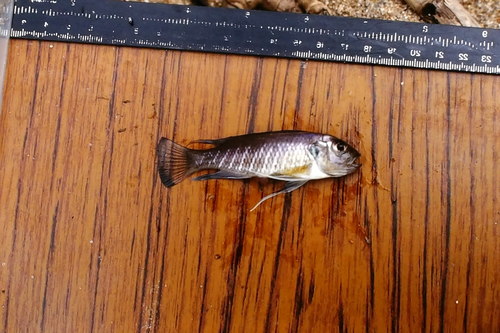
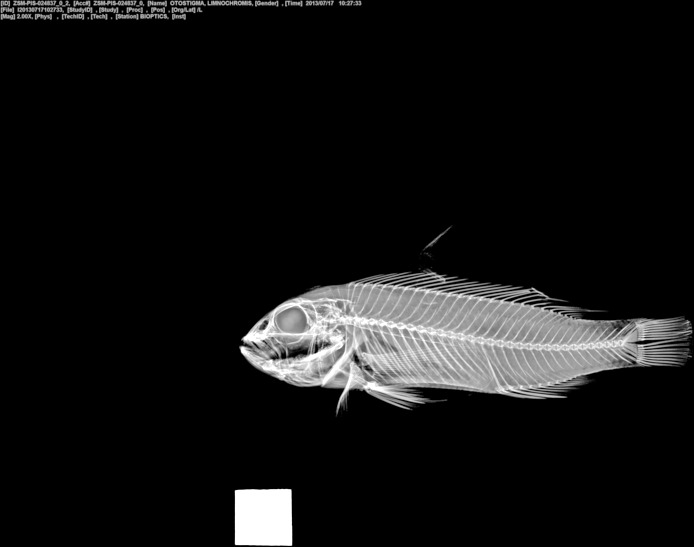
Triglachromis otostigma is an elongated, fairly plain cichlid with a rounded head and a small, sub-terminal mouth set for working the substrate. Body color is a muted grey-brown to olive, often with a faint pattern of dark blotches and a subtle iridescent sheen on the flanks, the kind of camouflage that suits an animal that spends its life over mud. The defining trait is in the pectoral fins: the lowermost rays project beyond the fin membrane as stiff, separated filaments that the fish drags across the bottom as tactile, prey-detecting feelers.
Reports of maximum size vary. FishBase gives 12 cm (4.7 in) total length, the specialist site tanganyika.si cites roughly 10 cm (4 in) in the wild with aquarium fish reaching 12 to 13 cm (about 5 in), and experienced keepers routinely describe adults around 5 in (13 cm). It is, in short, a small-to-medium cichlid often labeled a "dwarf," though large adults have notably big mouths for their size. Sexual dimorphism is weak: there is no reliable color difference between the sexes, but aquarists report that the first few dorsal-fin rays may carry dark pigment, and males tend to run slightly larger. Juveniles are easier to read, wearing a conspicuous ocellated spot (an eye-like "tilapia mark") on the dorsal fin that fades as they mature.
Range & habitat
The species is endemic to Lake Tanganyika and occurs lake-wide in suitable habitat, with recorded presence in the waters of all four riparian nations: Burundi, the Democratic Republic of the Congo, Tanzania, and Zambia. Unlike the lake's famous rock-dwelling cichlids, it is a specialist of soft, muddy bottoms, and is found both in shallow water near river mouths and at depth; the IUCN assessment gives a depth range of roughly 2 to 50 m (about 6 to 165 ft).
Its habitat is the open mud flat, a biotope most Tanganyikan cichlids avoid. There the fish digs clusters of burrows and tunnels in the soft sediment, with several holes grouped close together (entrances around 5 cm across, sometimes ringed by a low collar of excavated sand) and each cluster apparently occupied by a single family group. In-situ conditions match the lake's characteristically hard, alkaline water: FishBase records a pH of about 8.5 to 9.0, a hardness of roughly 10 to 15 dH, and temperatures around 24 to 26 °C (75 to 79 °F). There is no documented geographic color variation across the lake, which fits a fish whose featureless muddy world looks much the same from shore to shore.
Ecology & diet
Triglachromis otostigma is a substrate-sifting micro-feeder. It mouths the soft bottom, swallowing edible particles, diatoms, micro-organisms, and small invertebrates, and passing large quantities of mud through the gut more or less as ballast. The finger-like pectoral rays function as sensory probes, helping the fish locate buried prey by touch before it engulfs a mouthful of sediment. FishBase places it at a low trophic level of about 2.7, consistent with an omnivore that leans heavily on detritus, algae, and tiny benthic animals rather than on other fish.
This trophic and structural specialization lets the species exploit a niche, the open mud plain, that the rock- and sand-associated cichlids largely leave alone. In doing so it forms part of the benthic community that recycles material on the lake floor. FishBase rates it a low-vulnerability species with high resilience, reflecting a small, quick-maturing fish that can rebuild numbers rapidly.
Behavior & breeding
Socially the fish is organized around the burrow. In the wild a cluster of tunnels is typically home to a male, a female, and their juveniles; young fish stay in the parental burrow and can be seen ducking in and out of the large entrance holes even at a few centimeters long, only digging their own galleries once they mature and lose their juvenile dorsal-fin spot. Keepers describe the species as relatively peaceful for a Tanganyikan cichlid when young or unpaired, but firmly territorial once a pair forms and stakes out breeding ground, when it will charge and flare to push tankmates to the far side of a tank, though usually without inflicting real injury.
Reproduction is the most striking part of the biology: this is a bi-parental mouthbrooder, an uncommon strategy among the lake's cichlids. Spawning takes place inside the tunnel and has not, as of the published accounts, been directly observed in the wild. Clutches are reported at roughly 250 to 300 small eggs (1.5 to 2.5 mm). Drawing on the breeding account of Jonas and Jonas (2009), the IUCN assessment notes that the pair stays together after spawning and that the eggs, larvae, and fry are repeatedly passed back and forth between the two parents during incubation; the fry are free-swimming by about the second week and continue to be taken back into the parents' mouths until roughly four weeks of age. Aquarists who have bred the species corroborate the shared, turn-taking parental care, while reporting somewhat smaller surviving broods of around 125 to 150 fry, and note a strong, durable pair bond.
In the aquarium
This is a rewarding but demanding fish, and not a beginner's project. It appears in the ornamental trade, but successful keeping and especially breeding hinge on giving it what it has in the lake: deep, fine sand and the freedom to dig. Hobbyists with breeding success describe burying lengths of PVC pipe, often elbowed at an angle, under a thick sand bed to seed the tunnel system the fish would otherwise have to excavate itself; one recurring lesson is that a single bag of sand is rarely enough, since the fish move substrate constantly. Reasonable water is the lake's own: hard, alkaline (pH well above 8), and warm.
For a non-breeding group, several individuals can share a larger tank (a 6-foot footprint is comfortable) with fishes that keep to the rocks and won't be bullied, such as medium Lamprologus, Julidochromis, or open-water Cyprichromis; the trigs claim the sand. The common mistake is housing them with small, vulnerable tankmates: paired adults have large mouths, relish fry, and will dominate the lower tank, so delicate shell-dwellers like Lamprologus ocellatus are a poor match. Breeding essentially requires a dedicated species tank: a pair, the rest removed once a bond forms, a 3-foot minimum (4 to 6 feet better), abundant sand, and patience. Keepers also warn that the fish are skittish and prone to bolting (and to abandoning fry) when startled, so they reward a quiet, undisturbed setup. Captive spawns remain uncommon enough that breeders treat them as a real achievement.
Conservation
On its own account, Triglachromis otostigma is in good standing. The IUCN Red List assessed it as Least Concern in March 2025 (assessor C. Sibomana, reviewed by A. Konings), reaffirming an earlier Least Concern listing from 2006. The justification is straightforward: the fish is widely distributed throughout Lake Tanganyika, common at most known localities, with no major widespread threats identified. It is collected for the aquarium trade nationally and internationally, but at a level the assessment does not flag as a population concern, and its quick maturity and high resilience work in its favor. The population trend is listed as unknown, and the assessment calls mainly for population monitoring rather than active intervention.
That clean bill of health sits inside a lake under real strain, and the distinction matters. Lake Tanganyika has warmed and stratified more strongly over the past century; O'Reilly et al. (2003, Nature, doi:10.1038/nature01833) linked that warming and reduced vertical mixing to roughly a 20% drop in primary productivity, with knock-on declines of up to about 30% in fish yields. Cohen et al. (2016, PNAS, doi:10.1073/pnas.1603237113) found that warming has been associated with a substantial loss of oxygenated benthic habitat in the deep lake, on the order of a 38% reduction, and shoreline sedimentation from deforestation and land-use change continues to degrade nearshore habitats (Cohen et al. 1993). The lake also supports a pelagic clupeid-and-Lates fishery that feeds four nations and is managed jointly through the Lake Tanganyika Authority. For a soft-bottom, partly shallow species like this one, the most relevant of those pressures are sedimentation and oxygen loss on the lake floor that it depends on; for now, though, the honest summary is that the species itself is Least Concern even as the water body that holds it faces mounting, basin-wide change.
Sources
- Eschmeyer's Catalog of Fishes — Triglachromis otostigma (Regan, 1920)
- FishBase — Triglachromis otostigma summary
- GBIF occurrence dataset — Fishes of Lake Tanganyika
- iNaturalist — Triglachromis otostigma taxon page
- IUCN Red List — Triglachromis otostigma (Sibomana 2025, e.T60700A47210099)
- O'Reilly et al. 2003, Climate change decreases aquatic ecosystem productivity of Lake Tanganyika, Nature
- Cohen et al. 2016, Climate warming reduces fish production and benthic habitat in Lake Tanganyika, PNAS
- Cichlid Room Companion — Triglachromis otostigma profile (public page)
- tanganyika.si — Triglachromis otostigma species page
- The Cichlid Stage — Triglachromis otostigma
- Fishipedia — Triglachromis otostigma fish sheet
- Cichlid-Forum — Triglachromis otostigma (keeping & breeding thread) — community/anecdotal
- Cichlid-Forum — What type/size of tunnel for Triglachromis otostigma? — community/anecdotal
- Cichlid-Forum — Triglachromis otostigma info wanted — community/anecdotal
- MonsterFishKeepers — My Triglachromis Otostigma — community/anecdotal