Taxonomy & naming
Tropheops biriwira was formally described by Shan Li, Ad Konings, and Jay Stauffer in their 2016 Zootaxa revision of the Pseudotropheus elongatus species group (Zootaxa 4168(2):353-381), the paper that also erected the genus Chindongo and named six other new species. The fish was no stranger to ichthyologists before it had a name: it appears in the literature first as part of Pseudotropheus elongatus 'yellow tail' in Ribbink et al.'s landmark 1983 survey, then as Pseudotropheus sp. 'elongatus greenback' (Reinthal 1990) and Tropheops sp. 'elongatus greenback' (Konings 2007). Those cheironyms are still the names most hobbyists know it by.
The species epithet is refreshingly literal. Biriwira is Chichewa for 'green,' chosen for the greenish cast a male takes on in territorial dress; it is used as a noun in apposition. Placement in Tropheops rests on the genus's hallmark feeding anatomy: a steeply sloped vomer (75.3 degrees in the holotype), a small retrognathic (under-shot) lower jaw, bicuspid teeth in the outer tooth rows, and enlarged conical teeth at the rear of the jaws. The describing authors noted that these elongate Tropheops seem less pugnacious than the true Pseudotropheus elongatus they were once lumped with, and behave more like typical Tropheops around small and medium rocks.
Appearance
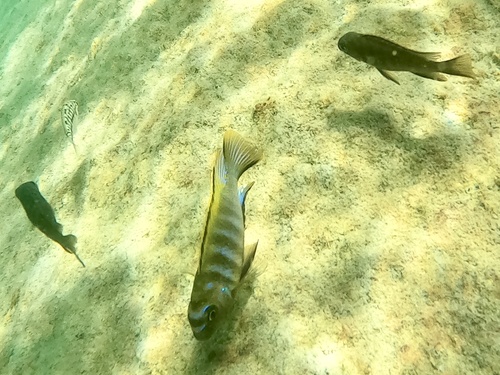
This is a small fish. The type series tops out at 6.9 cm standard length (about 2.7 in), with the holotype a 67.7 mm male; most measured specimens fell between roughly 4.5 and 6.9 cm SL. The body is distinctly elongate for a mbuna (body depth 26.8-32.1% of standard length), with the dorsal fin carrying 18-19 spines and 8-10 soft rays.
Color is where the species earns both its scientific and its trade name. A territorial male shows an olive-green to light-blue ground color with a green dorsal fin and yellow-green highlights, the 'greenback' look. Females and non-dominant fish stay in muted juvenile dress: light brown with four or five faint darker bars, a beige-brown belly, and a dark opercle spot with green flecks. Pectoral and pelvic fins carry pale blue margins. Honestly, T. biriwira is hard to tell apart from its close relatives on body shape alone, and females are essentially indistinguishable from those of T. kumwera. The describers leaned on color and fine detail: breeding males of the look-alikes T. kumwera and T. kamtambo wear blue ground color and a blue dorsal fin rather than green, and T. biriwira has a comparatively larger eye and shorter snout, plus fewer tooth rows (2-5) than most other Tropheops (6-8).
Range & habitat
Tropheops biriwira is a Lake Malawi endemic with one of the tightest distributions of any described cichlid in the lake: it is recorded only from Mumbo Island and Otter Island (with the adjacent Otter Point on the western tip of the Nankumba Peninsula), both in the lake's far south. The type material was collected at Otter Island in 2004. IUCN puts the estimated extent of occurrence at a startling 20 square kilometers across just two locations.
Like other mbuna, it is a rock-dweller. The group as a whole lives over rocky substrate in water shallower than about 40 m, and the elongate Tropheops in particular favor small to medium rocks rather than sheer boulder faces. The stretches of open sand and deep water between rocky headlands act as barriers these fish rarely cross, which is exactly why Malawi's rock cichlids fragment into so many narrowly localized forms in the first place. Lake Malawi's surface water sits warm and stable, roughly 75-84 F (24-29 C), hard and alkaline at pH around 7.7-8.6 with high mineral content, the conditions this fish is adapted to.
Ecology & diet
T. biriwira is an aufwuchs grazer, like the rest of the mbuna guild. Aufwuchs is the felt of filamentous algae and the tiny invertebrates, diatoms, and detritus tangled within it that coats sunlit rock. What separates the feeding tribes of Malawi is mechanics, not menu: where Metriaclima rake loose material from the algal mat and members of Chindongo aggressively defend lush algal gardens, Tropheops species shear and twist strands of algae from the rock, typically biting at a 30-60 degree angle to the substrate. The elongate, slightly under-shot Tropheops jaw is built for that combing-and-tearing action.
In the wider community it is a minor player, never abundant. Konings notes that only a few individuals are usually seen on any given dive, so its grazing footprint on the reef is modest compared to the swarming Pseudotropheus and Maylandia that dominate the same rocks.
Behavior & breeding
Like all Lake Malawi haplochromines, T. biriwira is a maternal mouthbrooder: the female takes the fertilized eggs into her mouth and incubates them there, releasing fully formed fry weeks later with no further parental defense of a nest. Spawning follows the standard mbuna script of male display and the egg-spot 'dummy egg' lure on the male's anal fin, though the specifics have not been documented in detail for this particular species.
The genus shows strong sexual dimorphism: males grow larger and brighter, females hold onto juvenile coloration, and a male only flushes his full green territorial dress when defending a patch or asserting rank in the hierarchy. Mouthbrooding females sometimes show a muted version of male colors. The describing authors specifically flagged that these slender Tropheops are less aggressive than the true Pseudotropheus elongatus group, a useful difference, since reputation for ferocity is precisely what makes many of their rock-dwelling neighbors hard to house.
In the aquarium
There is no real body of dedicated keeping experience for T. biriwira specifically; it is rare in the wild and uncommon in the trade, and what little circulates does so under the 'elongatus greenback' label. So the honest advice is to treat it as a typical small Tropheops and reason from there rather than from a species-specific care sheet.
That means mbuna conditions: a long tank (four feet/55 gallons is a sensible floor, more for a colony), plenty of rockwork to break sightlines and create territories, hard alkaline water around pH 8 in the high-70s F, and the African-cichlid standard of overstocking somewhat to spread aggression rather than letting one bully monopolize a single target. These are small fish that punch within their weight class, less belligerent than many mbuna but still territorial males that will not tolerate a rival in tight quarters. Keep them as a group with a male and several females, avoid pairing them with other green-blue Tropheops or Maylandia that they could hybridize with or that would out-compete them, and resist the common Malawi-tank mistake of mixing too many superficially similar mbuna. If you ever do find genuine biriwira, you are essentially maintaining an ark for a fish with a 20-square-kilometer wild range, which is reason enough to keep the line clean and not cross it.
Conservation
The IUCN Red List assessed Tropheops biriwira as Near Threatened (criteria B1a+2a) on 19 June 2018, on the strength of its extremely small range, an estimated extent of occurrence of just 20 square kilometers spread over two locations, with the population trend listed as Unknown and increasing sedimentation flagged as a potential but unquantified threat. It is not fished commercially: it is too small and too slender to be caught in the gill nets that target larger cichlids, and Konings, who co-described it, argues the species is scarce enough and narrowly enough distributed that he would rank it Vulnerable rather than Near Threatened, since two pinpoint localities leave essentially no population buffer against a local environmental shock.
That species-level picture sits inside a strained basin. The 2023 review of the Lake Malawi/Niassa/Nyasa basin by Chavula and colleagues (Journal of Great Lakes Research 49(6):102241) catalogs the pressures: over-fishing and the long decline of the chambo tilapia fishery, heavy sediment and nutrient loading off catchments stripped by deforestation, burning, and overgrazing, climate warming that strengthens the lake's permanent thermal stratification and limits the mixing that brings nutrients up to the productive surface layer, and the looming risk of invasive species. For a shallow rock-dwelling endemic like T. biriwira, sedimentation is the pointed threat: silt smothers the algae-coated rock its grazing depends on and can blur the clear-water visual cues that keep closely related cichlids from interbreeding. The species itself is not yet considered at high risk, but with a wild range you could swim across in an afternoon, it has very little room to absorb the deterioration the wider lake is already experiencing.
Sources
- Li, S., Konings, A.F. & Stauffer, J.R. (2016). A revision of the Pseudotropheus elongatus species group (Teleostei: Cichlidae) with description of a new genus and seven new species. Zootaxa 4168(2):353-381 (original description)
- FishBase — Tropheops biriwira (species summary, morphometrics, IUCN line)
- GBIF — Tropheops biriwira Li, Konings & Stauffer, 2016 (accepted taxon, occurrences)
- Catalog of Fishes (Eschmeyer) — Tropheops biriwira species record
- Cichlid Room Companion — Tropheops biriwira (Ad Konings, public profile incl. conservation notes)
- malawi.si — Tropheops biriwira 'Mumbo Island' / 'Otter Point' (location photos & trade name)
- IUCN Red List — Tropheops biriwira (Near Threatened, assessed 2018)
- Chavula, G.M.S. et al. (2023). Lake Malawi/Niassa/Nyasa basin: Status, challenges, and research needs. Journal of Great Lakes Research 49(6):102241
- iNaturalist — Tropheops biriwira taxon page (range, IUCN status)
- Practical Fishkeeping — The mbuna keeper's survival guide (general mbuna care, tank size, aggression)
- Cichlid Fish Forum (cichlid-forum.com) — Tropheops keepers thread (community keeping experience) — community/anecdotal
- Cichlid Room Companion — Tropheops sp. 'red fin' overview (genus habitat/depth context)
- Fishkeeping News — Ultimate guide to keeping mbuna cichlids (rockwork, overstocking practice) — community/anecdotal