Taxonomy & naming
Tropheops kumwera was described by Shan Li, Ad Konings, and Jay Stauffer Jr. in 2016, in a revision of the Pseudotropheus elongatus species group published in the journal Zootaxa (4168[2]:353-381). The holotype, an adult male of 66.8 mm standard length, was collected at Boadzulu Island in the southeastern arm of Lake Malawi. Catalog of Fishes and FishBase both treat the name as valid, placing the fish in family Cichlidae, subfamily Pseudocrenilabrinae.
The species had a long informal history before it got a Latin binomial. Ribbink and colleagues catalogued it as Pseudotropheus elongatus 'boadzulu' in their landmark 1983 survey of Malawi's rock-dwelling cichlids, and Konings later listed it as Tropheops sp. 'elongatus boadzulu.' Aquarists still trade it under that older label, frequently with a collecting-locality tag such as "Elongatus Boadzulu, Kanchedza Island."
The specific name kumwera means "south" in Chichewa, the principal language of Malawi, and refers to the fish's distribution in the southern part of the lake; the describers used it as a noun in apposition. Tropheops is a genus of roughly two dozen described mbuna plus many undescribed forms, characterized by a steep, blunt head and a small, downturned (retrognathic) mouth built for scraping. Within that genus, T. kumwera belongs to a tight cluster of slender, elongate species that also includes its close relatives T. biriwira and T. kamtambo, both named in the same 2016 paper.
Appearance
This is a small cichlid. The 2016 type series ranged from about 52 to 70 mm standard length, and FishBase records a maximum of 7.1 cm (2.8 in) SL; the IUCN assessment gives a maximum total length of roughly 9 cm (3.5 in), the difference reflecting whether the tail is included. In the aquarium trade the fish is usually quoted at about 4 in (10 cm) total length. The body is noticeably elongate for a Tropheops, its depth running 24-31% of standard length, and the head profile is concave to nearly straight before rounding up to the dorsal fin. The fins carry 17-19 dorsal spines and three anal spines.
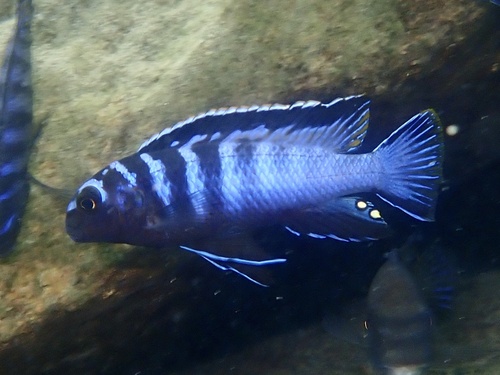
Color is where the species shows itself, and it is strongly sex-linked. A territorial male turns a clean blue over the flank and dorsal fin, with a black head crossed by one or two pale blue bars between the eyes, and an anal fin marked by four to six yellow egg-spots (ocelli) and a light blue margin. Breeding males typically display only the first three or four of their dark flank bars distinctly, the rest fading toward the tail. Females and non-breeding fish are a far more subdued purple to dark blue with six to eight darker bars. The describers noted that color varies between populations: fish from Makokola Reef and Tsano Rock differ from the Boadzulu type fish in the exact shade of the flank and in opercular highlights of green or orange.
Separating T. kumwera from its lookalikes takes a careful eye. It has a relatively small eye for the genus, and breeding males are told from the similar T. biriwira by their blue (rather than olive-green to yellow-green) ground color and dorsal fin. From T. kamtambo they differ in showing only the first few flank bars rather than the full set of nine or ten.
Range & habitat
Tropheops kumwera is a lacustrine endemic, found nowhere outside Lake Malawi and, within it, restricted to the rocky shores of the southeastern arm. The type series came from Boadzulu Island, Makokola Reef, and Tsano Rock, and the IUCN assessment maps the range along the western shore of the southeastern arm from the northern tip of Domwe Island south to Makokola Reef. That is a small footprint: the estimated extent of occurrence is on the order of 825 km2, with an area of occupancy near 56 km2 and six recognized locations.
The fish lives among small and medium-sized rocks, in what hobbyists call the intermediate zone where boulders give way to open substrate, at depths recorded from about 3 m (10 ft) down to at least 40 m (130 ft). This is firmly within the lake's well-oxygenated, alkaline upper layer. Lake Malawi runs hard and basic, with pH typically around 7.8-8.6 and stable warm temperatures in the upper twenties Celsius (high 70s to low 80s F) at the depths this fish occupies. The rocky biotope it depends on is also where the lake grows its richest film of attached algae, the resource the whole mbuna community is built around.
Ecology & diet
Tropheops kumwera is an algae grazer, part of the rock-dwelling guild the lake's Tonga-speaking fishers named mbuna, "the rockfish." Its small, downturned mouth and bicuspid outer teeth, backed by enlarged conical teeth at the corners of the jaws, are the toolkit of a fish that scrapes the aufwuchs, the dense mat of filamentous and blue-green algae plus the tiny invertebrates living in it, from rock surfaces. Field observation summarized in the IUCN assessment notes that it picks blue-green algae from the substrate and will switch to feeding on plankton when enough is suspended in the water, a flexibility common among mbuna that helps them ride out seasonal swings in the algal crop.
Ecologically this places T. kumwera among the lake's grazers rather than its predators or sand-sifters, converting primary production on the rocks into fish biomass that in turn feeds larger piscivores. Like most mbuna it does not stray far from the rocks that both feed and shelter it, a habitat fidelity that is central to how the Malawi cichlid flock fragmented into so many narrowly distributed species in the first place.
Behavior & breeding
Socially, T. kumwera is loosely organized rather than rigidly territorial. The IUCN account describes males as only weakly territorial and females as non-territorial, with non-breeding fish living a solitary life among the rocks. That is a milder temperament than many mbuna, and it matches what keepers report for the trade form, which is usually rated only mildly aggressive.
Reproduction follows the classic Lake Malawi pattern: it is a maternal mouthbrooder. A displaying male colors up over a patch of substrate and courts passing females; after spawning, the female takes the fertilized eggs into her mouth and broods them there. The egg-spots on the male's anal fin play their well-documented role in this system, drawing the female to snap at them and so take up sperm as she collects her clutch. Brooding females of this species are secretive, hiding among the rocks and rarely seen in the open, which is why they turn up so seldom in field counts. Generation length is short, roughly a year, and FishBase rates the species as having high resilience with a population doubling time under fifteen months, a profile typical of small, fast-maturing rock cichlids.
In the aquarium
Tropheops kumwera reaches hobbyists chiefly as the trade form "Elongatus Boadzulu," sold by specialist breeders and rare-fish importers, often as wild-locality F1 juveniles. It is a reasonable mbuna for a keeper who already runs an African rift-lake tank: hardy, modest in size, and only mildly aggressive by mbuna standards, with hobby references generally rating its difficulty low.
The care requirements are the standard Malawi recipe and should not be improvised. The water wants to be hard and alkaline, roughly pH 7.8-8.6 and warm, around 78-82 F (26-28 C), matching the lake. Aquascape with plenty of stacked rock to create the broken sightlines and grazing surfaces this fish evolved for, over a sandy floor. The honest caveats are the same that apply to all mbuna and that beginners routinely get wrong: these are not community fish for a peaceful tank, their aggression is best diffused by keeping them in a crowded, single-zone mbuna setup rather than sparsely, and because the genus is herbivorous they should be fed a spirulina- or algae-based diet, not a protein-heavy one. Overfeeding rich, meaty foods is a leading cause of the digestive disease keepers call Malawi bloat. One further point matters for this species in particular: Tropheops hybridize freely, so a fish kept for its looks or to preserve the wild line should not share a tank with congeners it could cross with.
Conservation
The IUCN Red List assesses Tropheops kumwera as Near Threatened (criteria B1a+2a), in an assessment by Ad Konings dated 19 June 2018. The species is described as common where it occurs and its population trend is listed as stable, but its very small range, six locations within a single arm of one lake, brings it close to the thresholds for a threatened category. The trigger the assessors named is sedimentation: the southeastern arm has suffered the lake's sharpest decline in water clarity and light penetration from increasing turbidity, and because this fish relies on algal growth in the deeper, dimmer parts of its rocky habitat, reduced light directly threatens its food base. A secondary, lower-level pressure is collection for the ornamental fish trade. Most of the range falls within Lake Malawi National Park, which affords some protection.
That species-level picture sits inside a strained lake. The basin review by Chavula and colleagues (Journal of Great Lakes Research, 2023) documents Lake Malawi/Niassa/Nyasa under mounting anthropogenic and climatic stress: over-fishing and the long collapse of the chambo (the prized Oreochromis tilapias), heavy sediment and nutrient loading washing off deforested catchments, and warming of the shallow water by roughly 0.7 C that strengthens stratification and cuts the mixing that fuels productivity, with invasive species an added risk. For a shallow-water rocky-shore grazer like T. kumwera, the sediment-and-light story is the one that bites hardest, and it is exactly the pressure the IUCN assessors flagged. The honest summary is this: the fish itself is not currently endangered and remains locally common, but it is a narrow endemic whose food base is tied to clear, sunlit rock in the most turbidity-stressed corner of the lake, which is why it is watched rather than dismissed.
Sources
- Eschmeyer's Catalog of Fishes: Tropheops kumwera
- FishBase: Tropheops kumwera Li, Konings & Stauffer, 2016
- GBIF: Tropheops kumwera occurrence search
- Li, Konings & Stauffer (2016), A revision of the Pseudotropheus elongatus species group, Zootaxa 4168(2):353-381 (PDF)
- Li et al. (2016), Zootaxa revision (PubMed record)
- Li et al. (2016), Zootaxa revision (ResearchGate)
- Plazi TreatmentBank: Tropheops kamtambo / elongatus group treatment
- Chavula et al. (2023), Lake Malawi/Niassa/Nyasa basin: Status, challenges, and research needs, J. Great Lakes Research 49(6):102241
- IUCN Red List: Tropheops kumwera (Near Threatened, 2018)
- Cichlid Room Companion: Tropheops kumwera profile (public page)
- Cichlid-Forum species profile: Tropheops sp. "Elongatus Boadzulu" — community/anecdotal
- Reddit r/Cichlid: mbuna stocking suggestions including Tropheops kumwera — community/anecdotal
- Capital Cichlid Association forum: Tropheops kumwera "Elongatus Boadzulu" availability — community/anecdotal
- malawi.si: Tropheops genus / biotope notes (rocky-shore mbuna)
- Practical Fishkeeping: The mbuna keeper's survival guide
- Aquarium Science: Lake Malawi Cichlids (stocking and aggression)