
Taxonomy & naming
Ethelwynn Trewavas described this fish in 1935 as Pseudotropheus microstoma, in her landmark "A Synopsis of the Cichlid Fishes of Lake Nyasa" (Annals and Magazine of Natural History, series 10). It is now placed in Tropheops, a genus erected for the short, high-backed, steep-headed mbuna that earlier authors had bundled under Pseudotropheus. The genus name is itself a backhanded compliment: it joins Tropheus — the famous algae-grazing cichlid of Lake Tanganyika — with the Greek ops, "eye" or "face," and means roughly "looks like Tropheus." The epithet microstoma is plainer: micro (small) and stoma (mouth), distinguishing it from the broader-mouthed Tropheops tropheops.
Older hobby and museum labels still carry the synonyms Pseudotropheus microstoma and Pseudotropheus tropheops microstoma, the latter from a period when the whole tropheops complex was treated as a swarm of subspecies and local forms. Tropheops remains one of the thornier mbuna genera taxonomically: many populations are known only by location names ("Masasa Reef," "Otter Point") and the boundaries between described species and undescribed forms are genuinely unsettled. T. microstoma is one of the relatively few that carries a formal Linnaean name, which makes it a useful anchor in an otherwise fluid group.
Appearance
This is a compact, deep-bodied cichlid with a steep, almost rounded forehead and the small, ventrally set mouth that gives it its name. Recorded maximum size in the scientific literature is modest — about 9.8 cm (3.9 in) standard length — while aquarium and import figures, which include the tail, run closer to 10-12 cm (4-4.7 in) total length for males, occasionally to around 14 cm (5.5 in) on rich tank diets. Females stay smaller, roughly 10 cm (4 in).
The sexes are easy to tell apart. Dominant males turn a vivid sky-blue overlaid with broad blue-black vertical bars — typically four or so that stand out as unusually wide for the genus — and carry a yellow margin along the dorsal and caudal fins plus a row of egg-spots (ocelli) on the anal fin. Females and subordinate males are a duller blue-grey to silvery brown with faint barring. Within Tropheops, the combination of exceptionally broad bars, a steep angular head, the narrow mouth, and that saturated blue is what observers use to separate male T. microstoma from look-alike congeners and the many "sp." forms sharing its reefs.
Range & habitat
Tropheops microstoma is a Lake Malawi endemic with one of the tightest ranges of any named mbuna. It is confined to the northern half of the Nankumba Peninsula at the lake's southern end, recorded from Otter Point through Domwe Island to Masasa Reef — but, tellingly, absent from nearby Thumbi West Island. The type locality is Monkey Bay. The IUCN puts its extent of occurrence at roughly 160 km² and its area of occupancy at about 48 km², small enough that the entire population is treated as a single location.
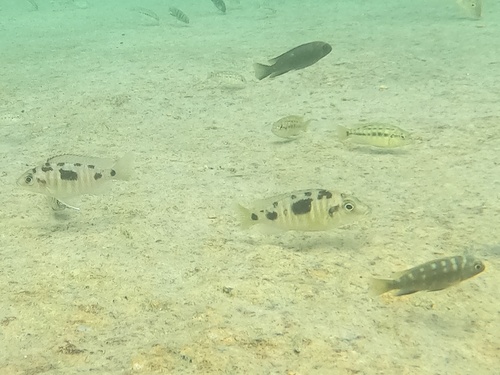
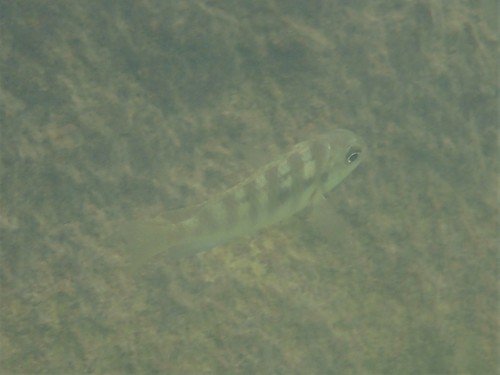
It is a fish of the intermediate zone — the transitional habitat where rocky reef gives way to open sand — and is found over both sediment-rich and clean substrate, favoring the calm water of sheltered bays. It is most common between about 5 and 25 m (16-82 ft) but will track the rock-sand interface from very shallow water down to at least 40 m (130 ft), and has even colonized an artificial reef in 3-5 m (10-16 ft). Juveniles take a different tack, foraging over open sand at places like Chembe beach and ducking into the empty shells of the large lake snail Lanistes nyassanus for cover. In-situ temperatures sit around 24-26 °C (75-79 °F).
Ecology & diet
Like most mbuna, T. microstoma earns its living grazing aufwuchs — the dense felt of algae, diatoms, and the tiny invertebrates living within it that coats the lake's rocks. Its feeding mechanics are characteristically tropheops: it sets its closely packed teeth against attached algal strands and shakes its head and body to tear them loose from the stone, a technique built for cropping tough, firmly anchored growth rather than picking loose particles. Stomach analyses also turn up invertebrates, and observers have reported it taking plankton, so it is best read as a primarily algivorous grazer that opportunistically supplements. FishBase places it at a trophic level of about 2.8, squarely in the herbivore-to-low-omnivore band.
Ecologically it is one cog in Lake Malawi's extraordinary mbuna machine, where dozens of rock-grazing species partition the same reefs by microhabitat, depth, feeding angle, and behavior. The narrow mouth and steep head of T. microstoma point to a particular grazing niche, and its occupancy of the rock-sand fringe — rather than the densest rubble — keeps it somewhat apart from the reef-core specialists it shares water with.
Behavior & breeding
T. microstoma is a maternal mouthbrooder, the reproductive mode that defines the Malawi rock cichlids. A male establishes and defends a territory, excavating a small pit beneath a stone and holding the site for hours while courting passing females with quivering displays of his blue flanks. Spawning itself is brief: the female lays a few eggs, immediately takes them into her mouth, and is induced to snap at the egg-spots on the male's anal fin, drawing in his milt to fertilize the clutch. She then withdraws among the rocks and broods the developing eggs and fry in her buccal cavity for roughly three weeks before releasing free-swimming young. The fish is short-lived and fast-breeding — generation length is about a year, and juveniles reach maturity within several months.
The behavioral headline, and the one keepers most need to absorb, is aggression. Males are strongly territorial toward their own kind, with disputes peaking around spawning; field observers note pronounced daily rhythms, mornings spent defending the patch followed by spells when several males tolerate one another to feed nearby. That genus-wide intensity is echoed across hobbyist reports of related Tropheops — keepers repeatedly describe lone males in undersized tanks going on "killing sprees," a pattern consistent enough across independent accounts to take seriously as a husbandry warning rather than a one-off.
In the aquarium
This is a rewarding fish but not a forgiving one, and it is not a beginner's centerpiece. Plan on a tank at least 120 cm (4 ft) long — around 300 L (about 75 US gal) is a sensible floor — aquascaped with plenty of rock structure, caves, and crevices, but with open sand left deliberately exposed to mirror the rock-sand fringe it occupies in the wild. The proven social arrangement is a harem: one male to at least five or six females, which spreads his attention and dilutes the relentless pressure a single female would otherwise absorb. Keeping two males together is asking for trouble in anything short of a very large tank.
Water should be hard and alkaline, in keeping with Lake Malawi — pH roughly 7.5-8.5 and temperatures around 24-26 °C (75-79 °F). Feed an algae-based staple such as spirulina or other vegetable flake, with only sparing amounts of richer foods; like other mbuna, it is prone to digestive trouble on a too-rich, too-meaty diet. Suitable tankmates are other robust, comparably assertive mbuna — genera such as Metriaclima (Maylandia), Pseudotropheus, Melanochromis, and Cynotilapia — kept in enough numbers to keep aggression diffuse. The common mistakes are predictable: too small a tank, too few females, and pairing it with timid fish it will simply overrun. Fry rarely survive in a busy community tank, so deliberate rearing means stripping or isolating a brooding female.
Conservation
The IUCN Red List classifies Tropheops microstoma as Near Threatened (assessed by Ad Konings in 2018, errata published 2019; reviewer Jos Snoeks), an improvement on its 2006 listing of Vulnerable. The reasoning hinges on its geography: because its entire range on the Nankumba Peninsula is treated as a single location, a tiny area of occupancy (~48 km²) sits close to the thresholds for a threatened category, and the assessors flag sedimentation as the pressure most likely to affect the whole population at once. Collection for the ornamental trade is noted as a further, lower-grade pressure — the species is exported irregularly under its scientific name rather than as a mass-market staple. A genuine mitigating factor is that much of its range lies within Lake Malawi National Park.
That species-level status sits inside a lake under real strain. The basin review by Chavula and colleagues (2023, Journal of Great Lakes Research 49(6):102241) catalogs the trajectory: heavy over-fishing and the long decline of the commercially vital chambo (Oreochromis spp.); rising sediment and nutrient loading washing off deforested catchments; roughly +0.7 °C of warming in the shallow surface layer that strengthens stratification, limits mixing, and trims primary productivity; and the looming risk of invasive species such as introduced Nile tilapia. For a shallow-water, rock-sand-fringe grazer with a pinprick range, sedimentation is the most direct of these threats — smothering the algae-coated rocks it feeds on and clouding the sheltered bays it favors is exactly the mechanism the Red List assessment singles out. The honest summary is that the fish itself is not endangered today, but it is a narrow-range endemic whose habitat is squarely in the path of the lake's worsening sediment and shoreline pressures, which is why it sits a notch above Least Concern.
Sources
- FishBase — Tropheops microstoma
- Eschmeyer's Catalog of Fishes (Tropheops microstoma, species record)
- GBIF — Tropheops microstoma occurrence records
- IUCN Red List — Tropheops microstoma (Near Threatened, 2018/2019 errata)
- Trewavas, E. 1935. A Synopsis of the Cichlid Fishes of Lake Nyasa. Ann. Mag. Nat. Hist. ser. 10 (original description)
- Chavula, G. et al. 2023. Lake Malawi/Niassa/Nyasa basin: Status, challenges, and research needs. J. Great Lakes Res. 49(6):102241
- Cichlid Room Companion — Tropheops microstoma (profile, curator Patrick Tawil)
- malawi.si — Tropheops microstoma 'Masasa Reef' (biotope, distribution, husbandry)
- AquaInfo — Tropheops microstoma (care, breeding, etymology)
- Practical Fishkeeping — The mbuna keeper's survival guide
- Cichlid Forum — Tropheops sp. 'Chilumba' (Red top Tropheops): keeper aggression accounts — community/anecdotal
- Cichlid Forum — Tropheops Chilumba, keepers? (aggression and breeding anecdotes) — community/anecdotal
- Reddit r/Cichlid — Stocking opinions: mbuna tank (harem ratios, aggression) — community/anecdotal
- Fishlore Cichlid Forum — 1 male in a female-only tank? (mbuna harem ratios) — community/anecdotal