Taxonomy & naming
The fish was first described by J. Colombé in 1979 as Pseudotropheus tropheops romandi — a named subspecies rather than a distinct species — in the French aquarium journal Revue française d'Aquariologie et de Herpétologie. The holotype (MNHN 1978-0763, with three paratypes) is held at the Muséum national d'Histoire naturelle in Paris, and the type locality is recorded as Likoma Island.
Its status then bounced around for two decades. Maréchal (1991) treated it as a valid subspecies of Pseudotropheus tropheops; Ufermann (2001) sank it outright into Tropheops tropheops. The modern consensus, reflected in Eschmeyer's Catalog of Fishes, is that it is valid as Tropheops romandi (Colombé 1979), following Konings (2016) and Li et al. (2016). That last name change rides on the broader move — led by Goldstein's 2009 Penn State revision of the genus and subsequent work — to pull the shallow-bodied "tropheops" group out of the catch-all Pseudotropheus and recognize Tropheops as its own genus of Lake Malawi mbuna.
The species epithet honors Dr Raymond Romand, a French evolutionary neurobiologist and geneticist. "Mbuna" is the Tonga word for the rock-dwelling cichlids of Lake Malawi, the radiation to which this fish belongs. One historical wrinkle is worth flagging: although the type locality is officially Likoma Island, specialists note that the original material was most likely collected near Thumbi West Island in the far south, an example of the muddled locality data attached to several Malawi cichlids exported in the 1970s.
Appearance
This is a modestly sized, deep-headed mbuna with the blunt, slightly upturned snout typical of the genus. FishBase lists a maximum of 6.3 cm (2.5 in) standard length for examined specimens, while field and hobby accounts put adults at around 4 in (10 cm) total length in the wild; well-fed aquarium fish run a little larger, as captive mbuna generally do.
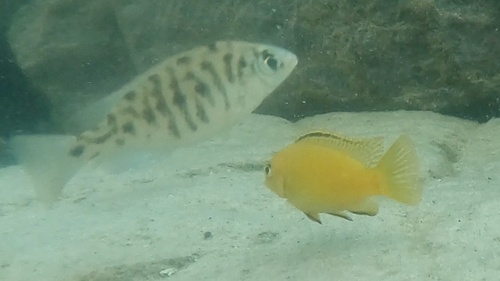
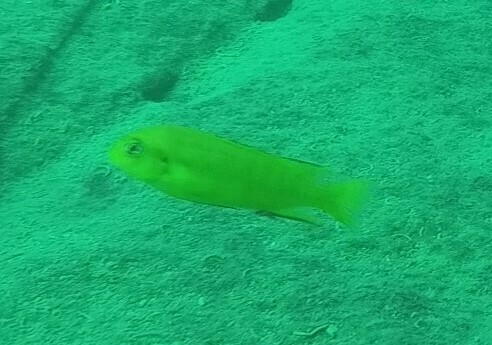
The sexes are strongly dimorphic in color, as is the rule among mbuna. Males are dark blue-grey with longer, more pointed fins and larger egg-spots (ocelli) on the anal fin. Females and juveniles are a vivid, even yellow. In both sexes a conspicuous pale submarginal band runs along the dorsal and anal fins — a useful field mark. Within Lake Malawi's crowded Tropheops flock, T. romandi sits among the shallow-bodied, comparatively unspecialized forms of the intermediate zone, and it is easily confused with undescribed local variants (the trade names "red fin" and "red cheek" attach to related Tropheops, not to this species). Because so many Tropheops overlap in form and color, reliable identification often leans as much on collection locality as on the fish in hand.
Range & habitat
Tropheops romandi is a lacustrine endemic with one of the smaller ranges in the genus, confined to the south of Lake Malawi around the Nankumba Peninsula. It is reported from Thumbi West Island and along the eastern shore from Domwe Island south to the Nkhudzi headland, including the reefs and islands in between (Mazinzi Reef among them). The historical Likoma Island record is regarded with caution for the reasons noted above.
It is a fish of the "intermediate" habitat — the transitional ground where rocky reef gives way to open sand, with sediment-dusted slabs and patches of sand between the boulders, rather than the clean wave-washed rock that some mbuna prefer. It occurs from the shallows down to at least 25 m (about 80 ft). Distribution within that band is sex-structured: territorial males concentrate over sand patches and slabs among the rocks and are rare shallower than about 5 m (16 ft), while females and juveniles range more widely — into the extreme shallows, across purely rocky ground, and even into beds of the aquatic plant Vallisneria. Lake Malawi itself supplies the water chemistry these fish are built for: hard, alkaline, mineral-rich water with a pH around 7.8–8.6 and stable warm temperatures, conditions that have shaped mbuna physiology over the radiation's history.
Ecology & diet
Like most mbuna, T. romandi makes its living grazing aufwuchs — the carpet of algae, biofilm, and associated micro-invertebrates that coats rock and other hard surfaces in the lake's sunlit shallows. Field accounts describe it picking blue-green (cyanobacterial) algae from the substrate, and switching opportunistically to zooplankton when blooms make that worthwhile. That flexible, algae-leaning omnivory is typical of the less morphologically specialized Tropheops; it lacks the extreme scraping adaptations of, say, Labeotropheus, whose underslung mouth lets it strip algae flat against the rock.
Within the lake's densely packed rocky-shore community, this trophic niche — a mid-shallow grazer of the intermediate zone — is one of many fine subdivisions that let hundreds of mbuna species coexist along the same coastline. Each species tends to work a slightly different combination of food type, feeding angle, and microhabitat, which is a large part of why Lake Malawi holds more fish species than any other lake on Earth.
Behavior & breeding
T. romandi is a maternal mouthbrooder, the reproductive mode shared by all of Lake Malawi's mbuna. Males hold territories over sand patches and slabs among the rocks and excavate shallow spawning pits — on the order of 3–5 cm deep and 14–26 cm across — beneath or alongside rocks. After courtship and spawning, the female takes the eggs into her mouth and incubates eggs and fry there for roughly three weeks before releasing free-swimming young; the male contributes no parental care.
By mbuna standards its temperament is moderate. Territorial aggression is aimed mainly at other males of its own kind — the rivals that actually threaten a male's breeding patch — while females and juveniles are non-territorial and roam without staking ground. Notably, brooding females are seen out in the open rather than hiding among the rocks, which fits a fish whose females spend much of their time away from the male-dominated sand patches. As with all mbuna, males do not pair-bond: a male's strategy is to defend prime real estate and mate with any receptive female that visits.
In the aquarium
T. romandi is an uncommon aquarium fish — it appears in the trade only sporadically, mostly via occasional collection at Mazinzi Reef — but where it is kept, it follows standard mbuna husbandry. That means hard, alkaline water (pH comfortably above 7.5, often 7.8–8.6), warm temperatures around 75–79 °F (24–26 °C), strong filtration, good oxygenation, and a rockwork-and-sand layout that provides both grazing surfaces and broken sight-lines. Specialists recommend a tank of roughly 300 L (about 80 gal); keeping more than one displaying male calls for length — on the order of a 5 ft (about 150 cm) footprint — so rivals can establish separate territories.
The honest cautions are the genus-wide ones. First, diet: these are algae-grazers, and the classic keeper's mistake is feeding rich, protein-heavy foods meant for carnivores, which is widely linked to "Malawi bloat." A vegetable-forward diet and the occasional fast suit them far better. Second, aggression management depends on stocking it like a wild mbuna community — a crowd of similar-sized fish, with females outnumbering each male — rather than as a sparse pair. Third, and specific to a fish with so many close relatives, hybridization is a real risk: keep it away from congeneric Tropheops and similar mbuna, since cross-breeding muddies the very locality-defined diversity that makes these fish worth keeping. It is a reasonable choice for an intermediate keeper already running a Malawi rock tank, less so as a first cichlid.
Conservation
The IUCN Red List assesses Tropheops romandi as Least Concern (assessed 19 June 2018 by Ad Konings; published 2018), with a population trend judged stable and, at some sites within its range, described as very common. That is an improvement on paper over its 2006 listing as Vulnerable — but the change reflects taxonomy as much as biology: in 2006 it was assessed as the subspecies Tropheops tropheops ssp. romandi, and the 2018 assessment of the full species concluded that no major threats had been identified for it. The assessment does flag specific, lower-grade pressures: localized sedimentation, competition from introduced species at Thumbi West Island, and irregular collection by the ornamental fish trade (mainly at Mazinzi Reef). It is endemic to Lake Malawi with a fairly narrow range around the Nankumba Peninsula, and crucially, most of that range falls within Lake Malawi National Park — a meaningful protection for a fish this geographically restricted.
That "Least Concern" label should be read against the strain on the lake as a whole, not as a clean bill of health. The basin review by Chavula et al. (2023, Journal of Great Lakes Research 49(6):102241) frames Lake Malawi/Niassa/Nyasa as a system under serious and worsening anthropogenic and climatic stress — over-fishing (the collapse of the commercially vital chambo, Oreochromis spp., being the emblem of it), rising sediment and nutrient loading washing off deforested catchments, climate-driven warming and variability, and the spread of invasive species. For a shallow rocky-and-intermediate-zone grazer like T. romandi, the most directly relevant of these are sedimentation — which smothers the rock surfaces its aufwuchs grows on and can blur the clear-water microhabitats that keep neighboring species reproductively distinct — and the invasive-species and collection pressures already named in its own assessment. So the accurate statement is the careful one: the species itself is not currently threatened and is partly shielded by a national park, but it lives in a lake whose nearshore habitats are demonstrably under pressure, and a fish with a range this small has little geographic room to absorb local degradation.
Sources
- Eschmeyer's Catalog of Fishes — Tropheops romandi (species record)
- FishBase — Tropheops romandi summary
- FishBase — Tropheops tropheops (congener feeding/behavior reference)
- IUCN Red List — Tropheops romandi (Konings 2018, e.T60803A47216081)
- Chavula et al. 2023 — Lake Malawi/Niassa/Nyasa basin: Status, challenges, and research needs (J. Great Lakes Research 49(6):102241)
- Chavula et al. 2023 — full article (ScienceDirect)
- Goldstein 2009 — Taxonomic review of the genus Tropheops (Penn State M.S. thesis)
- Ribbink et al. 1983 — A preliminary survey of the cichlid fishes of rocky habitats in Lake Malawi (cited via Cichlid Room Companion)
- malawi.si — Tropheops romandi 'Thumbi West Island' (Konings-based profile)
- Cichlid Room Companion — Tropheops sp. 'red fin' (related Tropheops, public profile)
- Practical Fishkeeping — The mbuna keeper's survival guide
- FishBase — all fishes reported from Malawi (endemism checklist)
- TRAFFIC — IUCN Red List update 2018: Lake Malawi fishes at risk
- JRS Biodiversity — Red List assessment of Lake Malawi finds fish species threatened
- Reddit r/Cichlid — Malawi bloat / mbuna stocking discussion (community, anecdotal) — community/anecdotal
- Cichlid Fish Forum (cichlid-forum.com) — mbuna keeping community — community/anecdotal