

Taxonomy & naming
Charles Tate Regan described this fish in 1922 as Pseudotropheus tropheops, working from specimens collected in what was then Lake Nyasa, in his monograph on the cichlid fishes of the lake. The two syntypes still reside in the Natural History Museum, London. The species name is a compound flagging the resemblance Regan saw to the Lake Tanganyika genus Tropheus — "tropheops" reads roughly as "Tropheus-like face" — a nod to the deep body and steep forehead the two share through convergence rather than close kinship.
In 1984 Ethelwynn Trewavas split the sprawling Pseudotropheus–Melanochromis complex apart and erected the genus Tropheops, choosing this very species as its type. That makes T. tropheops the anchor of the genus, even though the binomial Tropheops tropheops (Regan, 1922) only became standard usage decades later, with the authority for the combination carried by Konings and by Li, Konings & Stauffer. Eschmeyer's Catalog of Fishes lists it as valid in that form. The older name Pseudotropheus tropheops still circulates in the hobby and in pre-1990s literature.
The genus has been a moving target. A 2016 revision by Shan Li, Ad Konings and Jay Stauffer (building on Goldstein's 2009 Penn State thesis) added seven new species and re-sorted the group, leaving a handful of formally described species alongside dozens of geographically distinct, still-undescribed forms that the trade labels by colour and locality — "red cheek," "chilumba," "olive," and so on. Most of those are not T. tropheops proper, a distinction worth keeping straight when reading care notes online.
Appearance
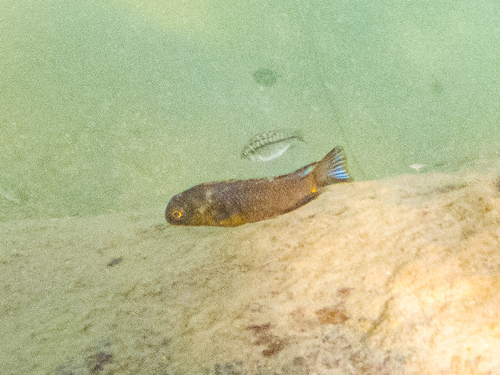
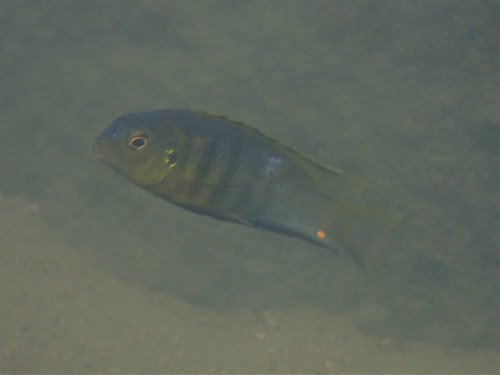
Tropheops tropheops is a compact, high-bodied mbuna reaching about 5.5 in (14 cm) total length, with most adults a little smaller. The silhouette is the giveaway: a tall, almost squarish body, a short snout and a steeply sloping, angular forehead that drops to a small, low-set mouth — the classic grazer's profile, mouth pointed down toward the rock.
Like most Malawi rock cichlids it is sexually dimorphic. Dominant males are larger and more vividly coloured, typically a metallic grey-blue darkening over the head, and they carry yellow-to-orange egg-spots (ocelli) on the anal fin used in spawning. Females and subordinate males are plainer, running to brown, tan or muted yellow — the source of endless forum complaints that "the females are drab."
Colour in this species is genuinely variable, partly because it is polymorphic: the IUCN assessment notes that some subpopulations carry orange-blotch (OB) morphs, a mottled orange-and-black pattern that in Malawi mbuna is sex-linked and appears mostly in females. Because so many congeners and local colour forms overlap, reliable identification leans on body shape and the small, ventral mouth rather than colour alone — colour names in the trade are a poor guide to actual species.
Range & habitat
The species is a lacustrine endemic — found only in Lake Malawi and nowhere else on Earth. The IUCN assessment places its core range in the south-eastern arm of the lake, around the Nankumba Peninsula from Msaka to Crocodile Rocks and the islands of that sector, including Chinyankwazi and Chinyamwezi. FishBase summarises the documented range as Maleri Islands to Chinyamwezi Rocks. As with most mbuna, distribution is patchy: these fish are tied to rock and cannot cross the stretches of open sand that separate one rocky shore from the next, so populations are effectively islands.
It is a shallow-water rock dweller, occurring throughout the rocky habitat but concentrated in the sediment-free upper zone where wave action keeps the stone clean and the algal turf productive. In-situ conditions are the hard, alkaline water typical of the lake — roughly pH 8.0–8.5, moderate to high hardness, and warm temperatures around 75–79 °F (24–26 °C). The broader Tropheops genus is notable for spreading across a depth gradient, with different forms keyed to shallow versus deeper rock; T. tropheops itself sits firmly at the shallow, sunlit end of that spectrum.
Ecology & diet
Tropheops tropheops is an Aufwuchs grazer — Aufwuchs being the dense mat of filamentous algae, diatoms and small invertebrates that coats the rocks of the lake's littoral. It feeds in a characteristic head-down posture, angled at about 45 degrees to the substrate, and rather than simply scraping it nibbles, tears and wrenches the tougher, tightly attached algal filaments loose with sharp tugs of the body. That mechanical, jerking feeding style is part of what the small mouth and steep head are built for.
The diet is flexible at the margins. Field observations summarised in FishBase, drawing on Konings, note that the species will switch to feeding on plankton when it is abundant — opportunism that is common among mbuna otherwise pigeonholed as strict algae specialists. Within the rocky community it occupies the herbivore/detritivore grazing guild alongside dozens of other mbuna, and the fine partitioning of feeding niches among these fishes is one of the engines thought to drive Lake Malawi's extraordinary cichlid diversity. Research on Tropheops specifically has used the way its jaw and head bones differ between shallow and deep populations as a model for how feeding morphology shifts as fish colonise new depths.
Behavior & breeding
This is a territorial, pugnacious fish. Mature males defend patches of rock — typically the upper surfaces and crevices — and drive off rivals and other grazers that compete for the same algae and spawning sites. Aggression spikes around breeding and is directed hardest at conspecific males, the usual mbuna pattern.
Reproduction follows the maternal mouthbrooding strategy shared by the Malawi rock cichlids. A ready male clears a small pit or court beneath or beside a stone and courts passing females with displays and quivering body movements, leading a receptive female to the site. The female lays a small clutch — FishBase cites up to about 40 eggs — and takes them into her mouth almost immediately; the egg-spots on the male's anal fin play into the spawning sequence, drawing the female to fertilise the clutch she is already brooding. She then incubates the eggs and fry in her mouth for roughly three weeks, not feeding while she carries, and continues to shelter the fry in her mouth for a short time after they are free-swimming. Brood sizes are modest, which is typical for mouthbrooders trading egg number for the survival advantage of carrying young internally.
In the aquarium
Tropheops tropheops and its many colour forms are kept by mbuna enthusiasts, but they are not beginner fish and the gentle "care sheet" framing some retailers use is misleading. They are among the more aggressive Malawi rock cichlids, and they get larger than many tankmates — experienced keepers report males approaching 6 in and dominant females close to 5 in, noticeably bigger than the usual mbuna. A standard 55-gallon tank is widely considered too small; a 75-gallon as a practical minimum and a 6-ft (roughly 125-gallon) tank for a proper group is the realistic advice that recurs across community reports.
The hardest problem keepers describe is intraspecific aggression, and not only from males. A consistent thread in long-term accounts is that a dominant female will systematically harass, weaken and ultimately kill rival females until a single breeding pair is left — so the textbook "one male, several females" harem can be difficult to hold together in a tank. Heavy rockwork to break sight lines, generous tank length and careful stocking help, but this is a fish that tests an aquarist's crowd management.
Water should match the lake: hard, alkaline, stable, and clean, with strong filtration and current. Diet matters for health as much as colour — as a dedicated algae grazer the species needs a vegetable-based, low-protein diet. Overfeeding rich, meaty foods is a known route to the digestive disorder hobbyists call Malawi bloat, a recurring theme in keeper discussions of mbuna husbandry. Do not mix it casually with peaceful community fish, and be cautious about combining it with closely related Tropheops or similar-looking mbuna, both for aggression and to avoid hybridising the many barely-distinguishable forms.
Conservation
The IUCN Red List assesses Tropheops tropheops as Least Concern (assessment by A. Konings, published 2018), with a population described as stable and the species reported as very common within its range. The listed threats are modest and framed as potential rather than active: sedimentation of its rocky habitat, and collection for the ornamental fish trade. As a shallow rocky-shore endemic with a fairly wide distribution and no targeted commercial fishery, it is in a relatively comfortable position compared with many of the lake's narrow-range or deep-water species.
That said, a Least Concern fish still lives in a lake under real strain. The basin-scale review by Chavula and colleagues (2023, Journal of Great Lakes Research) documents the pressures on Lake Malawi/Niassa/Nyasa: heavy and in places over-extended fishing — most visibly the collapse of the chambo tilapia stocks — together with rising sediment and nutrient loading washed off deforested, increasingly cultivated catchments, an invasive-species risk, and warming of roughly 0.7 °C in the shallow surface waters. That warming strengthens the lake's stratification, slowing the mixing that lifts nutrients into the sunlit layer and trimming overall productivity.
For a shallow-water algae grazer like T. tropheops, the threat that bites first is sedimentation. Its food — the clean algal turf of wave-washed, sediment-free rock — is exactly what silt smothers when eroded soil reaches the shoreline, and the species is concentrated in precisely the sunlit upper zone most exposed to runoff and shoreline development. The honest summary is the one the data support: the species itself is not currently at risk, but the habitat it depends on is being chipped at, and its security rests on the rocky littoral staying clean rather than on any special resilience of the fish.
Sources
- Eschmeyer's Catalog of Fishes — Tropheops tropheops (species record)
- FishBase — Tropheops tropheops (Regan, 1922) summary
- FishBase — Tropheops tropheops (mirror, SpecCode 2381)
- Cichlid Room Companion — Tropheops tropheops profile (curator P. Tawil)
- Cichlid Room Companion — Tropheops genus (Trewavas, 1984; type species)
- Goldstein, H. M. 2009. Taxonomic review of the genus Tropheops with descriptions of new species (M.S. thesis, Penn State)
- Li, Konings & Stauffer 2016 — A revision of the Pseudotropheus elongatus species group (Zootaxa, PDF)
- Conith et al. 2020 — Ecomorphological divergence and habitat lability in Tropheops (BMC; depth partitioning & jaw morphology)
- Ribbink et al. 1983 — A preliminary survey of the cichlid fishes of rocky habitats in Lake Malawi (Aufwuchs feeding)
- Roberts et al. 2009 — Sexual conflict and the OB color polymorphism in Malawi cichlids (Science)
- IUCN Red List — Tropheops tropheops (Konings 2018, Least Concern; range, threats)
- Chavula et al. 2023 — Lake Malawi/Niassa/Nyasa basin: status, challenges, and research needs (J. Great Lakes Research 49(6):102241)
- malawi.si — Tropheops sp. 'red cheek' (genus biotope, dimorphism & breeding notes)
- Cichlid-Forum — Red Cheek Tropheops owners/info (size, aggression, female-on-female aggression) — community/anecdotal
- Cichlid-Forum — Tropheops sp. "Red Cheek" species article (N. Andreola; genus diagnosis, mouth shape) — community/anecdotal
- Reddit r/Cichlid — Mbuna cichlids diet (vegetable diet, bloat avoidance) — community/anecdotal