
Taxonomy & naming
Tropheus annectens was described by the prolific Belgian-British ichthyologist George Albert Boulenger in 1900, in his series on the fishes of the Congo basin ("Matériaux pour la faune du Congo"). It belongs to the genus Tropheus, which Boulenger had erected two years earlier in 1898; the name derives from the Greek tropaion, a battle trophy or memorial, a nod to the genus's conspicuously specialized teeth — the obvious hardware of a dedicated algae grazer.
Tropheus is a small genus by the standards of the rift lakes — only about six valid species (annectens, brichardi, duboisi, kasabae, moorii, and polli) — but it fractures into a bewildering patchwork of geographic color forms, and that is where the taxonomy gets contentious. In 1977 Herbert Axelrod described Tropheus polli from south of Bulu Island in Tanzanian waters. Ad Konings, who has spent decades diving these shores, regards polli as simply a population of T. annectens on grounds of color, morphology, distribution, and behavior, and formally treated it as a synonym in 1992; FishBase and the 2025 IUCN assessment follow that lumping. The disagreement is not trivial: a 1992 mitochondrial-DNA study by Christian Sturmbauer and Axel Meyer (Nature 358:578–581) recovered relationships that placed some annectens populations closer to other Tropheus forms than to each other. Konings's reply, still worth reading, is that counting mutations measures the age of isolated populations, not whether they are separate species — a useful caution about reading too much into a short stretch of sequence. The fish has no established English common name; in Swahili it is called Mbeka.
Appearance
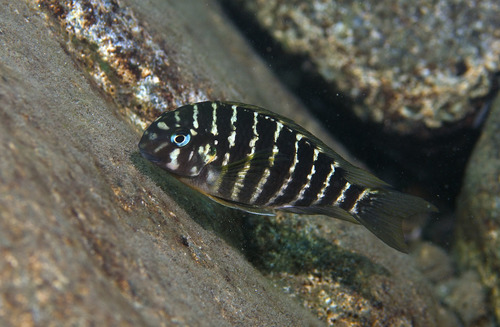
This is a small, deep-bodied cichlid with the blunt, downturned snout typical of a rock-grazer. Reported maximum size is about 3.1 in (8 cm) total length, putting it at the petite end of the genus. Like all Tropheus it carries a battery of fine, closely set teeth at the front of the jaws — a comb built for rasping the algal film off stone.
Color is where annectens earns its keep among hobbyists, and it does not give a single answer. The species shows sexual dichromatism (the sexes differ in color), and crucially, each isolated population on each rocky patch has evolved its own livery, so that fish from the Congolese shore and fish from the Tanzanian shore look distinct even though they are the same species. Wild forms tend toward dark, often near-black bodies broken by a paler flank bar or yellow-to-cherry markings on the cheek and side, with the exact pattern diagnostic of the collection point rather than the species as a whole. That same trait — color tied to locality — is what makes Tropheus a magnet for collectors and a headache for anyone trying to write a one-line description that fits every population.
Range & habitat
Tropheus annectens is a Lake Tanganyika endemic with an unusually broken distribution: it is known from four widely separated rocky shores, two on each side of the lake, with long stretches of sand between them that the fish will not cross. Along the western (Democratic Republic of the Congo) shore it occurs at Katenga bay and on the rocky coast between Cape Tembwe and M'toto; along the eastern (Tanzanian) shore it is found between Bulu Point and Kalya, and between Isonga and Kekese. FishBase summarizes this simply as the "west central coast," but the reality is a scatter of small, isolated colonies. The IUCN's 2025 assessment puts the estimated area of occupancy at just 56 km² (about 22 mi²).
The habitat is narrow in the vertical sense too. This is a fish of the upper few meters of the rocky littoral — the sunlit zone where algae grow fastest. It wants rock that stays put: bedrock anchored to the coast, interlocking rubble, or even sandstone slabs lining a sand beach. What it avoids, per Pierre Brichard's and Konings's field observations, is loose pebbles rolling in the surf, open sand, and silted-over surfaces where the algal turf can't establish. In effect it claims some of the best grazing real estate on the reef, which is exactly why disturbance to that thin shoreline band matters so much for this species.
Ecology & diet
Functionally, Tropheus annectens is an aufwuchs grazer — "aufwuchs" being the German term, standard in the cichlid literature, for the carpet of algae and the tiny invertebrates living within it that coats sunlit rock. The fish rasps this film off the substrate with its specialized comb of teeth, and FishBase places it at a trophic level of about 3.3, reflecting a diet that is mostly plant matter with an incidental animal fraction picked up along with the algae.
It forages in schools rather than as scattered individuals, a behavior that does double duty: a crowd overwhelms the territorial defenses of other algae-eaters competing for the same turf, and it spreads the risk from predators across many eyes. In the broader community of the rocky shore, annectens is one of a guild of small herbivorous cichlids — Tropheus, Petrochromis, and others — that together convert the lake's prolific rock-algae into fish biomass, forming a base layer of the littoral food web that larger piscivores draw on.
Behavior & breeding
Like every Tropheus, this is a maternal mouthbrooder: after a brief courtship and spawning over rock, the female takes the fertilized eggs into her mouth and broods them there, releasing fully formed, free-swimming fry several weeks later with no larval helplessness in between. Clutches are small — a trade-off the genus makes for producing large, well-developed young — and the female does the parenting alone.
Socially, Tropheus run hot. They are territorial and persistently aggressive toward their own kind, and dominant males stake out and defend patches of rock. The genus's well-known coping strategy, borne out across decades of keeping experience, is numbers: in a large enough group the aggression of any one fish is diluted across many targets rather than concentrated on a single victim. The flip side of all that isolation in the wild is rapid divergence — because populations on separate reefs don't interbreed, each has drifted into its own color form, which is the engine behind the genus's spectacular morph diversity. It also means that in captivity, mixing two forms invites hybridization and muddied colors, something serious keepers go to lengths to avoid.
In the aquarium
Tropheus annectens itself is rare in the trade — most "Tropheus" tanks are stocked with the many forms of T. moorii, T. sp. "Black," or T. duboisi — but the care template is the same across the genus, and it is not a beginner's fish. The hard-won consensus among experienced keepers is to start with a sizeable colony from a single collection point (commonly 12 to 20-plus individuals) to disperse aggression, and to give them room: 75 gallons is a frequently cited practical minimum, with a six-foot tank if you want to run two colonies, and keepers report the fish genuinely thrive only with that space. Tanganyikan water is hard and alkaline — roughly pH 8 to 9 — and Tropheus reward heavy filtration, strong flow, and large, frequent water changes; turnover rates of around ten times tank volume per hour and weekly changes of half the tank or more are typical of successful setups.
The one mistake that defines this genus is diet. Tropheus are committed herbivores with long guts adapted to algae, and they are notoriously prone to "bloat" — a frequently fatal digestive and bacterial syndrome triggered by too much protein, overfeeding, or stress. Keepers consistently stress a vegetable-based diet (spirulina, algae-based pellets and flakes) fed in modest amounts, and they treat stress management during acclimation as the front line of bloat prevention. Done right, the payoff is a tank of intensely colored, busy, intelligent fish; done casually, it is a recurring lesson in how quickly a Tropheus colony can crash.
Conservation
Tropheus annectens was reassessed by the IUCN in 2025 (Mabo & Fermon) and listed as Endangered under criterion B2ab(iii). The reasoning is geographic: the species occupies an estimated area of just 56 km² across only four isolated rocky shores, and the assessors flag a continuing decline in habitat quality. The two named threats are sedimentation — driven by deforestation on the steep rift-valley slopes, especially along the Congolese shore — smothering the algae-bearing rock the fish depends on, and over-exploitation for the aquarium trade in parts of the western range. It is worth being precise here: on the Tanzanian side the species is reported as not particularly threatened and is somewhat abundant at Isonga and Kekese, and one population sits inside Mahale Mountains National Park, where fishing is banned within about a mile (1.6 km) of shore. The older 2006 Red List assessment had rated it Least Concern, so the 2025 uplisting reflects both a narrower documented range and growing concern over shoreline erosion rather than a sudden collapse.
That species-level picture sits inside a larger story about Lake Tanganyika. The lake is warming and its water column is mixing less, which suppresses the upwelling of nutrients that fuels primary production: O'Reilly et al. (2003, Nature, doi:10.1038/nature01833) estimated roughly a 20% decline in productivity with a comparable hit to fish yields, and Cohen et al. (2016, PNAS, doi:10.1073/pnas.1603237113) documented an extensive loss of oxygenated benthic habitat as the oxygenated layer shrinks. Those basin-scale pressures fall hardest on the deep and pelagic communities — and on the four-nation clupeid (Stolothrissa and Limnothrissa) and Lates fishery that feeds the region — more than on a shallow rock-grazer. For annectens, the immediate danger is more local and more tangible: sediment running off cleared hillsides into the narrow band of sunlit rock it cannot live without. Managing that is partly a governance question, coordinated across Burundi, the DRC, Tanzania, and Zambia through the Lake Tanganyika Authority. The honest summary is that this is a habitat specialist with a tiny footprint, genuinely at risk from shoreline degradation in part of its range, in a lake whose deeper systemic strains form the backdrop rather than the proximate threat to this particular fish.
Sources
- Tropheus annectens — FishBase species summary
- Eschmeyer's Catalog of Fishes — Tropheus annectens (species record)
- Tropheus annectens — IUCN Red List (Mabo & Fermon 2025, EN)
- Tropheus annectens — Cichlid Room Companion species profile (A. Konings)
- Tropheus — genus profile, Cichlid Room Companion
- Speciation, DNA and Tropheus (A. Konings, Cichlids Yearbook 3, 1993)
- Sturmbauer & Meyer 1992 — Genetic divergence, speciation and morphological stasis in a lineage of African cichlid fishes, Nature 358:578–581 (reference record)
- Tropheus annectens — iNaturalist taxon page (status & taxonomy)
- Difficulty: Discus vs Tropheus? — Cichlid-Forum (keeper experience: colony size, filtration, bloat) — community/anecdotal
- Tropheus: Everything you need to know — Québec Cichlidés (care overview)
- Tropheus keeping and an experience in Bloat Treatment — Cichlid Room Companion
- Best treatments for bloat in tropheus — r/AfricanCichlids (community diet/bloat discussion) — community/anecdotal
- Does anyone have a surefire treatment for bloat in Tropheus? — r/Cichlid — community/anecdotal
- Tropheus breeding behavior in community tank — Hill Country Cichlid Club (large groups to disperse aggression) — community/anecdotal
- O'Reilly et al. 2003 — Climate change decreases aquatic ecosystem productivity of Lake Tanganyika, Nature
- Cohen et al. 2016 — Climate warming reduces fish production and benthic habitat in Lake Tanganyika, PNAS