Taxonomy & naming
Tropheus brichardi was described in 1975 by Mark Nelissen and Dirk Thys van den Audenaerde from specimens collected near Nyanza-Lac, on the Burundian shore at the lake's northern end, which remains the type locality. The species honours Pierre Brichard (1921-1990), the Belgian-born collector and exporter whose decades on Lake Tanganyika supplied much of the early aquarium trade and a good deal of what scientists first knew about the lake's fish fauna. The genus name Tropheus derives from the Greek for a trophy or war-memorial, a nod to the elaborate, specialised grazing teeth that make these fish such obvious feeding specialists.
The binomial is settled, but the boundaries of the species are not. In the hobby T. brichardi long circulated under the trade name 'Chocolate moorii,' a reminder of how easily Tropheus morphs blur together. More substantively, authorities disagree on how much the name should cover: Ad Konings treats several regional forms, including the populations called 'lukuga,' 'kipili' and 'mtosi,' as geographic variants of T. brichardi, whereas the African Diving collectors regard those as distinct species and reserve 'true' brichardi for fish from the type locality and the stretch north of the Malagarasi River. The name is also not to be confused with Neolamprologus brichardi, an unrelated, slender 'fairy cichlid' that shares the same eponym. A caution worth flagging: much online 'brichardi' care advice actually describes that Neolamprologus, not this Tropheus.
Appearance
This is a deep-bodied, blunt-headed cichlid built for clinging to rock and rasping it clean. Reported maximum size varies enough to be worth stating honestly: FishBase lists 10 cm (about 4 in) total length, Seriously Fish gives a maximum standard length of 11.5 cm (4.6 in), and the field-oriented tanganyika.si puts well-grown males near 14 cm (5.5 in) total, with females a couple of centimetres smaller. The truthful summary is a fish of roughly 4 to 5.5 in (10-14 cm), with wild males at the upper end.
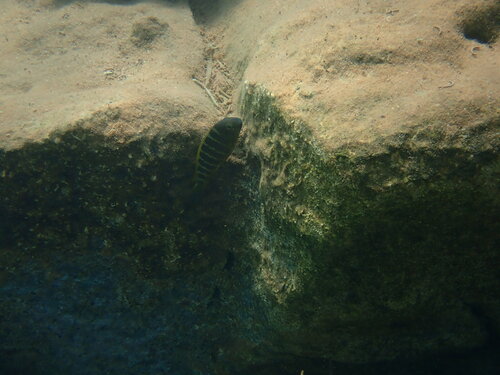
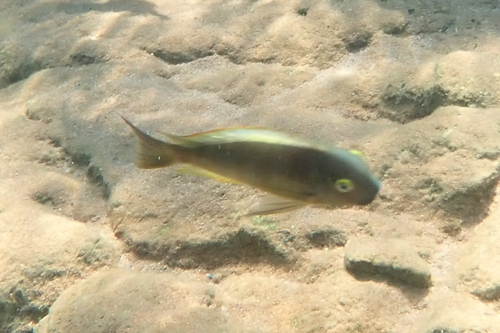
Colour is strongly age- and sex-linked. Juveniles and young females carry a pattern of dark vertical bars on a paler ground. As males mature the barring dissolves into a fairly uniform dark olive-green to brown body; what often persists is one or two yellow patches, which are simply the original pale interspaces rather than any reversal of the pattern. Local populations layer their own signatures over this template: fish from around Kipili in Tanzania are known for a vivid turquoise eye and, as juveniles, an almost orange brilliance that fades with age, while the Nyanza-Lac and Kigoma forms show conspicuous yellowish saddle and belly marks. Sexing is genuinely difficult and the only reliable method is venting, examining the genital papilla, which is pointed in males and rounded in females.
Range & habitat
Tropheus brichardi is a lacustrine endemic, found only in Lake Tanganyika and nowhere else on Earth. The IUCN describes it as widely distributed through most of the lake but absent from the far north, with native populations recorded in Burundi, the Democratic Republic of the Congo, Tanzania and Zambia. The collector-defined 'true' brichardi occupies the northeastern shore from the Malagarasi estuary up through the Kigoma and Gombe region to Nyanza-Lac; whether the southern 'kipili' and 'mtosi' fish belong to the same species is the open question noted above.
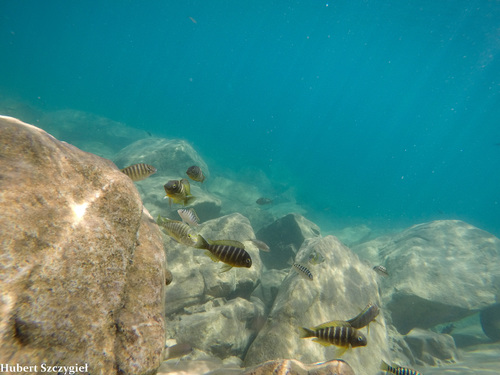
It is a rock-dweller, living over solid coastal rock, interlocking rubble and even the sandstone slabs that line some beaches, but avoiding loose surf-rolled pebbles. Its useful quirk is silt tolerance: where many Tropheus demand clean, sediment-free rock to feed from, brichardi will graze sediment-rich aufwuchs, so it persists in murkier zones and on deeper reef than its relatives. At its southern limit at Mtosi it lives alongside T. moorii, which appears to push it down into the deeper, siltier rock that moorii avoids. Depth records bear this out: divers report it from about 1 to 20 m (3-65 ft), commonly in the upper 10-15 m. Its water is the hallmark Tanganyika chemistry, hard and strongly alkaline (roughly pH 7.5-9, well buffered) and warm, around 24-27 degrees C (75-81 F) in the oxygen-rich surface layer it inhabits.
Ecology & diet
Tropheus brichardi is a trophic specialist, an algae 'puller' that grazes the aufwuchs, the felt-like biofilm of algae, diatoms and associated micro-invertebrates coating sunlit rock. Its specialised teeth and long, looping gut are adaptations to a bulky, low-protein, plant-based diet, and FishBase places it at a trophic level of about 3.3. In Lake Tanganyika this aufwuchs grazing is partitioned with surgical precision among many cichlid species, a textbook case of niche separation by trophic specialisation described by Sturmbauer and colleagues; brichardi's particular trick is feeding from the sediment-laden biofilm that cleaner-feeding grazers cannot exploit.
A focused 2017 study by Robin Richardson-Coy at Wright State University looked at exactly what brichardi pulls from that film. The periphyton it grazes is built from diatoms, green algae and cyanobacteria, which differ in food value, diatoms being the richest in the fatty acids fish need to grow. The work found that T. brichardi selects slightly for diatoms, though whether that reflects a nutritional preference or simply which cells are easiest to reach was not resolved, and the grazing did not measurably reshape the algal community. The practical upshot for the wild fish is a near-continuous grazing existence: small territories on productive rock, defended and worked over throughout the day.
Behavior & breeding
Tropheus do not school. Both sexes hold and defend feeding territories on the rock, an unusual arrangement among the lake's cichlids, with male territories typically one to two times the size of female ones. That territoriality, directed most fiercely at their own kind, is the engine of their famously complicated social lives and their reputation for aggression. Field observers and aquarists alike note that hostility falls hardest on conspecifics while other species are tolerated comparatively well.
The species is a maternal mouthbrooder. Spawning follows the classic Tropheus pattern: a receptive female enters the dominant male's territory, eggs are laid one at a time over a flat surface and immediately taken into her mouth, and the male fertilises them there. Broods are small, on the order of 5 to 16 large eggs, a low-fecundity, high-investment strategy. The female carries the developing young for roughly three and a half to four weeks (about 24-26 days) before releasing free-swimming fry and guarding them briefly; the male takes no part in brood care. A distinctive detail, well documented for the genus, is that brooding females keep feeding while holding, their distended jaws still working at the algae. Fish typically mature at around a year old.
In the aquarium
Tropheus brichardi is rewarding but not a beginner's fish, and honesty here matters more than enthusiasm. Two realities dominate. First, it is acutely prone to 'bloat,' a digestive collapse driven by the wrong diet and poor water quality; its long herbivore gut cannot handle high-protein foods, and beefheart or other animal meats are a known way to kill a colony. The staple should be spirulina-based flake or pellet and blanched greens, fed sparingly. Pristine water is non-negotiable, with large regular changes and strong oxygenation, since these fish come from the lake's clear, oxygen-saturated surface layer.
Second is social management. Tropheus are kept as colonies precisely to diffuse their intraspecific aggression: experienced keepers and specialist references converge on groups of roughly 15-25, started as juveniles and grown out together, since adding adults or single fish to an established group usually ends in violence. Small groups of five or six often fail, with subordinates harried to death. That argues for a long tank: a 4-ft, 110-litre footprint suits a single specimen, but a real colony wants a 5-to-6-ft tank, around 500 litres or more. Use sand and piled rock to break sightlines. The widely repeated 'extremely aggressive' label is partly a hobby myth, Seriously Fish and field-experienced keepers both note it is no worse than its congeners and reasonably peaceful toward other species, but the bloat risk and group dynamics are very real. Critically, never mix geographic colour morphs: they interbreed freely, and hybridising distinct populations is both an aesthetic and a conservation mistake.
Conservation
Tropheus brichardi was assessed as Least Concern on the IUCN Red List in 2025 (assessment by C. Sibomana), unchanged from its 2006 listing, on the grounds that it is widely distributed across the lake with no major widespread threats. That status is genuine and should not be overstated. But the assessment also records pressures that bear directly on this fish: it is in high demand for the international ornamental trade, especially in Tanzania, where divers extract individuals from their rock crevices, and local declines have been reported in Tanzanian and Zambian waters. Encouragingly, since 2023 Tanzanian divers have begun capping how many can be taken, though no formal protections exist. The assessment also flags shoreline deforestation, which drives erosion and sedimentation onto the very rocky biofilm habitat the species grazes.
That last point links brichardi to the wider state of Lake Tanganyika, which is healthier than Malawi in places but under real strain. The lake is warming and mixing less: O'Reilly and colleagues (2003, Nature, doi:10.1038/nature01833) tied a roughly 20 percent decline in primary productivity to reduced vertical mixing, with downstream losses in fish yields, and Cohen and colleagues (2016, PNAS, doi:10.1073/pnas.1603237113) estimated that warming has already cost on the order of 38 percent of the lake's oxygenated benthic habitat. Sedimentation from cleared catchments degrades the rocky littoral (Cohen et al. 1993), and a clupeid-and-Lates pelagic fishery feeds millions across the four riparian nations whose shared stewardship runs through the Lake Tanganyika Authority. For a silt-tolerant, shallow-to-mid-depth rock grazer like brichardi, the most immediate of these is sedimentation, which smothers the algal film it depends on, with collection pressure a second, locally significant concern. The species itself is not currently threatened, but the habitat guild it belongs to is squarely in the path of the basin's principal stresses.
Sources
- Tropheus brichardi summary page
- Eschmeyer's Catalog of Fishes (Tropheus brichardi species entry)
- GBIF: Tropheus brichardi Nelissen & Thys van den Audenaerde, 1975
- ITIS Report: Tropheus brichardi (TSN 648933)
- Sibomana, C. 2025. Tropheus brichardi. The IUCN Red List of Threatened Species 2025
- Richardson-Coy, R. 2017. Feeding Selectivity of an Algivore (Tropheus brichardi) in Lake Tanganyika (M.S. thesis, Wright State University)
- Sturmbauer, Mark & Dallinger 1992. Ecophysiology of Aufwuchs-eating cichlids in Lake Tanganyika: niche separation by trophic specialization
- O'Reilly et al. 2003. Climate change decreases aquatic ecosystem productivity of Lake Tanganyika, Africa (Nature)
- Cohen et al. 2016. Climate warming reduces fish production and benthic habitat in Lake Tanganyika (PNAS)
- Cichlid Room Companion: Tropheus brichardi (Anikstein, 2003)
- Cichlid Room Companion: Tropheus brichardi field videos (Konings)
- Seriously Fish: Tropheus brichardi
- tanganyika.si: Tropheus brichardi ('Bulombora' page, with biotope and breeding notes)
- Cichlid Room Companion: Tropheus genus overview
- Cichlid-Forum.com: 'Tropheus beginner' thread (colony keeping, bloat, aggression) — community/anecdotal
- Cichlid-Forum.com: 'Tropheus brichardi spawn video' thread — community/anecdotal