

Taxonomy & naming
The Belgian biologist Georges Marlier described Tropheus duboisi in 1959 from material collected near Bemba (Memba) on the lake's northwestern Congolese coast, in a paper on the littoral biology of Lake Tanganyika; the holotype is held at the Royal Museum for Central Africa in Tervuren (MRAC 119883). Eschmeyer's Catalog of Fishes lists the name as valid and unchallenged, with no junior synonyms. The species epithet honors Jean Dubois, a limnologist and colleague of Marlier; the genus name derives from the Greek trophos, meaning nurse or feeder, a reference to the maternal mouthbrooding for which these cichlids are known.
Within its genus, duboisi is the odd one out. Only six Tropheus species have ever been formally named, and molecular studies consistently recover duboisi not as the sister of the others but as a distinct, early-diverging lineage, so distinct that phylogeneticists routinely use it as the outgroup when reconstructing relationships among the remaining color morphs. That genetic isolation is the factual basis for the hobby's habit of calling it the genus's "oldest" or "most primitive" member: it really does sit on its own branch.
In the aquarium trade the fish travels under a thicket of names tied to collecting sites — "Maswa," "Kigoma," "Bemba," "Karilani," "Halembe," "Kabogo" — alongside the catch-all "white-spotted cichlid." Around the lake itself it is known in Swahili as kimpuma (the mpuma group) and as lupuma.
Appearance
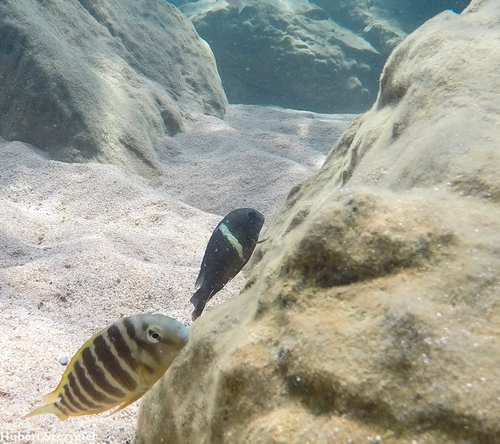
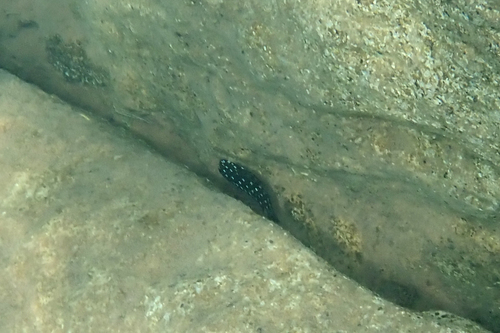
Few cichlids change so completely with age. Juveniles are velvet black and covered in neat rows of white to pale-blue spots arranged in vertical lines across the flanks and head — the pattern that sells the fish. As the fish matures, usually between about 2 and 3 in (5–7 cm), the spots fade and break up, the head takes on a blue-grey wash, and a single broad vertical bar appears across the dark body just behind the gills. This kind of age-linked transformation is called ontogenetic color change, and in duboisi it is unusually abrupt.
The color of that adult bar is the main thing that separates one local form from another. Populations around Kigoma carry a clean white bar with no yellow pigment at all, while the popular "Maswa" fish from south of the Malagarasi River show a bar that is yellow above and white below, sometimes fully yellow. Researchers examining ten populations found these differences are more than skin-deep: the white-barred and yellow-barred fish, though genetically almost identical, build the bar differently, the yellow version recruiting carotenoid pigment the white version lacks. A handful of other forms exist, including a Burundian population at Muguruka reported as entirely black, with no bar at all.
Adults reach about 4.7 in (12 cm) total length by the standard reference figures, though aquarists and field workers regularly cite larger fish, sometimes 5.5–6 in (14–15 cm) on captive diets. Sexes look alike — there is no difference in pattern — with males averaging slightly larger than females. Useful identifying details include a narrow, rounded, slightly underslung mouth and five spines in the anal fin.
Range & habitat
Tropheus duboisi is endemic to Lake Tanganyika and, unlike some of its wide-ranging cousins, is confined to the northern half of the lake in a markedly patchy, broken distribution. Confirmed populations sit at a short stretch around Cape Munene (Bemba/Pemba) in the Democratic Republic of the Congo, near Muguruka in Burundi, along the Tanzanian coast from roughly Kigoma north to Gombe, and at a string of Tanzanian sites south of the Malagarasi — Maswa, Cape Kabogo and Halembe — plus offshore rocky points such as Bulu Point, Karilani Island and Luagala Point. The fish also reaches Zambian waters, though records there are thin. Biologists suspect the species once occupied a more continuous range and has since been fragmented.
Like all Tropheus it is a creature of solid rock, hugging anchored boulders and broken rubble and avoiding both loose, surf-rolled pebbles and open sand. What sets duboisi apart ecologically is depth. It lives shallow but consistently deeper than the other Tropheus it shares reefs with, densest at roughly 20–30 ft (6–10 m) and ranging from the surface down to about 100 ft (30 m). That offset is widely read as competitive displacement: more aggressive Tropheus and the bulldozing Petrochromis monopolize the prime shallow grazing, pushing the gentler duboisi into slightly deeper, more sediment-tolerant ground. The water it inhabits is hard and alkaline, around pH 8.5–9.0 and 24–26 °C (75–79 °F), oxygen-rich and famously clear in the lake's upper layers.
Ecology & diet
Tropheus duboisi makes its living grazing aufwuchs — the dense felt of filamentous algae, diatoms and associated micro-invertebrates that coats sunlit rock. The genus's specialized comb-like teeth and a very long, convoluted gut are adaptations for stripping and digesting this fibrous, low-protein film, and the species sits at a modest trophic level of around 3.3. Small animals living in the algal turf are taken incidentally, but plant matter is the core of the diet; this is a committed herbivore, not an opportunist that merely tolerates greens.
That dietary specialization has direct consequences for how the fish must be kept, and it also shapes its place in the lake. Sharing reefs with several other algae-grazers, duboisi avoids head-to-head competition mainly by working deeper water rather than by eating anything different — a tidy example of how a crowded community of look-alike specialists partitions a single food resource by depth rather than by menu.
Behavior & breeding
Socially, Tropheus are restless, gregarious fish that spend much of the day chasing one another across the rocks; in duboisi this near-constant low-grade jostling is normal behavior rather than serious fighting. Both sexes hold feeding territories in the wild — unusual among the lake's cichlids — with male territories running larger than females'. Of the genus, duboisi is generally regarded as among the least aggressive, though "least aggressive Tropheus" still describes a pushy fish.
Reproduction is maternal mouthbrooding, with no pair bond and no male help. A receptive female follows a courting, territorial male and lays her eggs a few at a time, scooping each into her mouth almost immediately, where the male fertilizes them. The eggs are large — roughly 0.2–0.3 in (5–7 mm) — so broods are small, on the order of 6 to 20, and most sources cluster around a dozen. The female carries the developing young for about 24–26 days, then releases free-swimming fry and shadows them protectively for a few more days before they are on their own. Tropheus females are notable for continuing to feed while brooding, which helps them recover for the next cycle. Sexual maturity comes slowly for a fish this size, generally around a year or more, and several lines of keeping experience converge on there being no need to engineer a precise sex ratio — colonies sort out their own hierarchies.
In the aquarium
Tropheus duboisi is rewarding but unforgiving, and it is not a beginner's fish. The cardinal rule is to keep it in a crowd: a group of roughly a dozen to two dozen spreads aggression so no single fish is hounded to death. Experienced keepers consistently put about 12–14 in a standard 75-gallon (about 285 L), four-foot tank as a workable minimum, with larger colonies wanting a six-foot footprint; specialist references recommend a tank at least 5 ft (150 cm) long. Aquascape with plenty of rock to break sightlines over a sand base. Single specimens and tiny groups are a recipe for a bullied, stressed fish, and mixing different geographic variants is strongly discouraged because they interbreed and muddy the distinct local forms.
The single most important thing to get right is diet, because it ties directly to the disease that kills more Tropheus than anything else: "bloat," a digestive collapse linked to inappropriate, protein-rich food. Their long herbivore gut cannot handle high-protein fare, so the staple should be a spirulina- or algae-based flake or pellet, fed in small amounts, with rich foods like beef heart and excess animal protein avoided entirely. Keepers across forums report the same hard lessons — bloat appearing after a diet slip and spreading fast, and the need for heavy, frequent water changes to hold nitrate down in these densely stocked, heavily fed tanks. Water should be hard and alkaline (pH comfortably above 7.5), warm but never hot (ideally around 75–80 °F / 24–27 °C), and very well oxygenated. Reasonable tankmates are other rock-dwelling Tanganyikans of similar diet and temperament — some Petrochromis, the small goby cichlids, certain Julidochromis — but many keepers ultimately conclude a species-only colony is the safest and best-looking option.
Conservation
In 2025 the IUCN reassessed Tropheus duboisi as Endangered, an uplisting from the Vulnerable status it held in 2006. The assessment paints a stark picture: a conservative estimate of just five surviving relict populations, an area of occupancy of only about 92 km², and a declining trend. The drivers are twofold. First is overcollection for the aquarium trade — a narrow-range, slow-maturing, charismatic fish is exactly the kind of target that intense harvesting can hollow out, and the prized "Maswa" form in particular has been heavily overfished, with some Tanzanian populations reduced to a few juveniles by around 2020. Second is habitat degradation: sedimentation from deforestation and farming near river mouths smothers the rock the fish depends on, compounded by sewage and nutrient pollution near growing lakeside cities such as Kigoma.
There are bright spots. Some populations fall within the protected waters of Gombe and Mahale Mountains national parks, where shoreline fishing is restricted, and — strikingly — divers around Kigoma collectively chose to stop collecting the species in 2020 to let it recover, an informal, locally driven measure rather than any official ban, which assessors credit with a local rebound. It is a reminder that for a fish this restricted, the people who catch it hold much of its future in their hands.
Sources
- Eschmeyer's Catalog of Fishes — Tropheus duboisi (species record)
- FishBase — Tropheus duboisi summary page
- IUCN Red List — Tropheus duboisi (Sibomana 2025, Endangered)
- Egger, Koblmüller, Sturmbauer & Sefc 2007 — Nuclear and mitochondrial data reveal different evolutionary processes in the Lake Tanganyika cichlid genus Tropheus (BMC Evolutionary Biology)
- Van Steenberge et al. 2013 — Complex geographical variation patterns in Tropheus duboisi Marlier, 1959 (Hydrobiologia)
- Maan & Sefc 2013 — Colour variation in cichlid fish (figure: adult and juvenile patterns of T. duboisi)
- Cichlid Room Companion — Tropheus duboisi species profile (Patrick Tawil)
- tanganyika.si — Tropheus duboisi (Konings-based species and variant notes)
- Fishipedia — Tropheus duboisi fish sheet
- Cichlid Room Companion — The Tropheus Genus: A Beginner's Experience
- Cichlid-Forum.com — Tropheus Duboisi inquiry (colony size, aggression, sex ratio) — community/anecdotal
- Cichlid-Forum.com — Tropheus Duboisi killing each other off; how to move forward? — community/anecdotal
- Cichlid-Forum.com — How do I treat bloat in Tropheus? — community/anecdotal
- Cichlid-Forum.com — Tropheus duboisi (Maswa) growth and coloration — community/anecdotal
- Cichlid Room Companion 'Ask Pam' — T. duboisi Maswa breeding (maturity timing) — community/anecdotal
- WaFishBox forum — Tropheus duboisi in cichlid community tank? — community/anecdotal