
Taxonomy & naming
George Albert Boulenger described this fish in 1900 as Pelmatochromis polylepis, working from specimens collected at Albertville (now Kalemie) on the Congolese shore of Lake Tanganyika. Melanie Stiassny moved it into the genus Tylochromis and designated a lectotype (MRAC 257) in her 1989 revision of the group, and that placement has held ever since across the standard references. The genus name pairs the Greek tylos, a callus or knob, with chromis, an old name for a perch-like fish; the species epithet polylepis means "many-scaled," a fair nod to its unusually high scale counts.
What makes the fish taxonomically interesting is its isolation within the lake. Tylochromis is a largely riverine genus of roughly two dozen species spread across the Congo basin and West Africa, and T. polylepis is the only one that lives in Lake Tanganyika — the single Tanganyikan member of the tribe Tylochromini (subfamily Pseudocrenilabrinae). Genetic work by Koch and colleagues (2007) found it diverged from its Congo-system relatives less than about 510,000 years ago, marking it as a recent colonizer rather than an ancient founder of the lake's cichlid flock.
Appearance
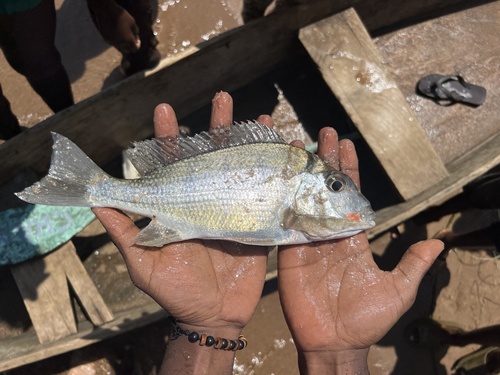
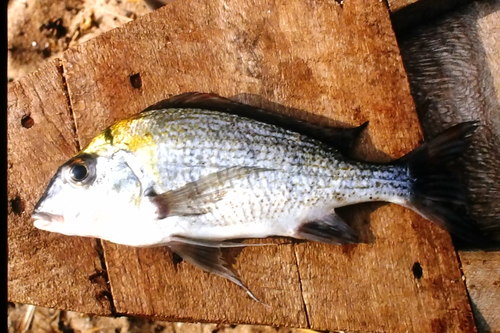
This is a robust, deep-bodied cichlid built more like a riverine tilapiine than like the slender rock-dwellers Tanganyika is famous for. FishBase gives a maximum length of about 43.5 cm (17.1 in), though that is the upper extreme; most aquarium and field specimens are considerably smaller. The body is short and deep, the head large, and the coloration is generally a plain, reflective silver-grey — handsome in a understated way rather than gaudy, with the metallic sheen of a fish that spends its life moving over open sand.
The diagnostic features are in the counts. The dorsal fin carries roughly 14–16 spines and 13–15 soft rays, the anal fin three spines and 7–9 soft rays, and there are about 30 vertebrae. The standout trait — and the source of the name — is the high lateral-line scale count of 54–59, with small scales overall. Sexual dimorphism is muted; the species lacks the dramatic male nuptial coloring seen in many lake cichlids, which is part of why it is more a connoisseur's fish than a beginner's centerpiece.
Range & habitat
Tylochromis polylepis is endemic to Lake Tanganyika and its outflow, the Lukuga River, where it has been recorded downstream as far as Niemba. Within the lake it occupies the gentle, low-energy margins rather than the dramatic rocky reefs: shallow inshore zones, sandy and muddy bottoms, lagoons, and river mouths and estuaries. FishBase even lists it as a swamp-dweller, and the evolutionary literature characterizes it as a generalist living over muddy substrate both in the lake proper and in the inflowing-river estuaries.
Its ecology shifts with age. Juveniles are coastal and gregarious, hanging together in the shallows, while adults tend to wander the sandy flats alone. The species is demersal — bottom-associated — and ranges across the lake's broad latitudinal sweep from roughly 3°S to 9°S. Its preference for soft sediment over hard rock is a key part of its story: it lives where the lake's celebrated rock-cichlid radiation is thinnest, which helped a riverine intruder find an open niche.
Ecology & diet
Functionally, T. polylepis is a benthic forager that works the substrate the way an earth-eater does, picking small edible items out of sand and mud. FishBase describes the diet as mainly crustaceans and insects with some plant matter, and several sources add molluscs to the menu — the comparative work of Van Staaden and colleagues classes this fish among the pharyngeal-crushing molluscivores, fish whose strengthened throat (pharyngeal) jaws let them crack snail shells. Its assigned trophic level of about 3.0 reflects this mixed, mid-level feeding rather than strict specialization.
That generalist, soft-bottom feeding niche is exactly what let a latecomer establish itself. Tanganyika's endemic cichlids are famous for fine-tuned niche segregation, packed so tightly that the system is thought to resist outside colonizers. By exploiting muddy and sandy habitats and a broad invertebrate diet — rather than competing head-to-head with the lake's algae-scraping, snail-shell-dwelling, or scale-eating specialists — T. polylepis slotted into a comparatively underused part of the community.
Behavior & breeding
Like the great majority of Tanganyikan cichlids, T. polylepis is a maternal mouthbrooder: after spawning, the female takes the fertilized eggs into her mouth and incubates them there, releasing free-swimming fry only once they can fend for themselves. The species does not form a lasting pair bond — males and females come together to spawn and then part. Females have been observed carrying around 100 eggs, which are large for a cichlid at roughly 6 mm in diameter, a clutch that trades high numbers for well-provisioned, well-protected young.
Beyond reproduction, the social picture matches the habitat. Young fish school in the shallows for safety, while adults are largely solitary roamers of the open sand. The genetic study by Koch and colleagues even suggested fine-scale population structuring around the lake, possibly because breeding sites are geographically separated — a hint that local groups don't mix as freely as the lake's open water might imply.
In the aquarium
This is a specialist's fish, not a community centerpiece, and the honest framing starts with size. Hobbyist reports converge on the reality that the oft-quoted ~18 in (45 cm) maximum is rarely reached in tanks; keepers more commonly see fish in the 10–12 in (25–30 cm) range, which is still a large, heavy-bodied cichlid that needs a long, wide footprint and serious filtration. A deep open sand bed is not optional — it is the substrate the fish is built to sift, and an open floor plan suits a roaming, bottom-oriented animal better than a rock maze.
New imports can frustrate keepers: wild-caught Tylochromis often ignore brine shrimp, mysis, and other mid-water frozen foods at first, because they are wired to pick edibles off the bottom rather than chase food in the column — sinking foods placed on the sand work better. As a soft-water, alkaline Tanganyikan, it wants hard, basic water (roughly pH 8–9) and warm temperatures. It is best kept with other large, robust Tanganyikans that can hold their own; it is not a fish for small, peaceful, or shell-dwelling tankmates. Reliable, documented aquarium breeding is uncommon, and most of what circulates online is anecdotal — treat single-keeper reports as leads rather than gospel.
Conservation
On its own account, Tylochromis polylepis is in reasonable shape: the IUCN Red List assessed it as Least Concern (assessment dated 31 January 2006), reflecting its wide distribution across Lake Tanganyika and its outflow and the absence of any species-specific threat. It is collected for the aquarium trade, but at a modest scale that does not appear to pressure wild populations, and as a large-bodied generalist it is more resilient than the lake's narrow-range endemics.
The caveat is the lake itself, which is under real and measurable strain even where individual species are not yet flagged. O'Reilly and colleagues (2003, Nature) found that a warming climate has slowed the deep mixing that fertilizes Tanganyika's waters, with sediment records implying roughly a 20% drop in primary productivity and on the order of a 30% decline in fish yields. Cohen and colleagues (2016, PNAS) extended this, reporting that reduced mixing has shrunk the oxygenated bottom habitat by about 38% in their study areas — directly killing off bottom-dwelling animals including the freshwater snails that a mollusc-crushing, sand-foraging fish like this one depends on. Add nearshore sedimentation and nutrient loading from deforestation and shoreline development, which smother soft-bottom habitats, and the muddy-and-sandy margins T. polylepis favors sit squarely in the path of the basin's main pressures. Management is coordinated across the four riparian nations through the Lake Tanganyika Authority, but the broad signal is clear: this species is not itself threatened today, yet it lives in a lake whose productivity and benthic habitat are shrinking, and its fortunes are tied to how that wider decline is checked.
Sources
- Eschmeyer's Catalog of Fishes: Tylochromis polylepis (Boulenger 1900)
- FishBase: Tylochromis polylepis summary
- FishBase: Tylochromis polylepis territory/distribution (Congo, Lukuga)
- Koch et al. (2007), J. Zool. Syst. Evol. Res. — Evolutionary history of T. polylepis: a recent intruder to a mature adaptive radiation
- Koch et al. (2007) abstract & full text (ResearchGate)
- Koblmüller et al. — The Adaptive Radiation of Cichlid Fish in Lake Tanganyika (review)
- Stiassny — Tylochromis, relationships and the phylogenetic status of the African Cichlidae
- Van Staaden et al. — Microhabitat Use, Trophic Patterns and Brain Structure in African Cichlids (lists T. polylepis as pharyngeal-crushing molluscivore)
- Cichlid Room Companion — Tylochromis polylepis species profile (public page)
- tanganyika.si — Tylochromis polylepis locations & images
- tanganyika.si — Lake Tanganyika Habitats overview
- IUCN Red List — Tylochromis polylepis (Least Concern, 2006)
- O'Reilly et al. (2003), Nature — Climate change decreases aquatic ecosystem productivity of Lake Tanganyika
- Cohen et al. (2016), PNAS — Climate warming reduces fish production and benthic habitat in Lake Tanganyika
- Spatial variability in nearshore sediment pollution in Lake Tanganyika (ScienceDirect)
- MonsterFishKeepers — 'Tylochromis Sp.' thread (keeper notes on size & feeding) — community/anecdotal
- Cichlid Fish Forum (cichlid-forum.com) — community keeping discussions — community/anecdotal