
Taxonomy & naming
Charles Tate Regan described this fish in 1922 as Haplochromis macrostoma, working from a single specimen out of "Lake Nyassa" (the older name for Lake Malawi) now held at the Natural History Museum in London. The genus Tyrannochromis was erected later, by Eccles and Trewavas in their 1989 reclassification of the Malawi haplochromines, to gather the lake's largest piscivorous "haps" under one name. The genus name pairs the Greek tyrannos, despot or tyrant, with chromis, an old catch-all for perch-like fishes; the species epithet macrostoma simply means "large mouth" (Greek makros + stoma) — between them, an apt portrait of a big-mouthed predatory tyrant.
The species sits inside a small but taxonomically messy genus. Two older names, Haplochromis maculiceps (Ahl) and H. polyodon (Trewavas, 1935), were once treated as distinct Tyrannochromis species but are now widely regarded as the same biological species as T. macrostoma. Ad Konings argued for that synonymy from field and aquarium material, and Eschmeyer's Catalog of Fishes follows it, listing both polyodon and maculiceps as synonyms of macrostoma. Snoeks and Hanssens (2004) accepted the lumping only "tentatively," noting they had not examined the relevant type specimens, and FishBase, IUCN and the Catalog of Fishes now treat maculiceps and polyodon as synonyms of T. macrostoma, following Konings (1996) and Snoeks & Hanssens (2004), who accepted the lumping tentatively because they had not examined the type specimens — so it is widely followed but not fully settled. In the trade the fish is sold as the "Big-Mouth Hap" or, confusingly, under its old genus as "Haplochromis Macrostoma."
Appearance
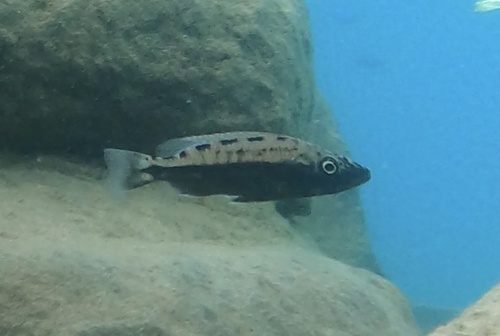
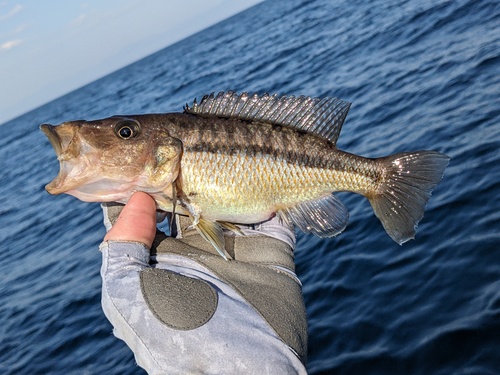
This is a large, laterally compressed cichlid with an elongated body, a big head and a deeply cleft mouth built for seizing other fish. Reported maximum size varies with the source: FishBase gives 30 cm (about 12 in) total length, while Konings and the hobby literature describe males reaching roughly 35 cm (14 in). Females stay considerably smaller, commonly around 24 cm (9.5 in), with very large females over 30 cm reported as rare — a marked size dimorphism typical of the genus.
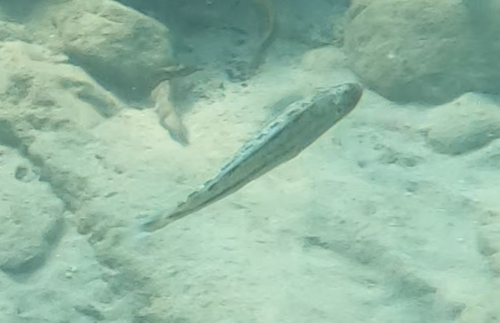
Color is strongly tied to sex and mood. Juveniles and females are a yellowish grey-silver, often patterned with a dark mid-lateral stripe and faint broken bars, a look easily mistaken for a Protomelas. Breeding males transform to a brilliant light blue with a pale yellow belly. The signature feature, though, is the dark lower body: hunting adults develop an almost black belly and lower flank — reversed countershading, where the underside is darker than the back. This shows up best in adults and is the most reliable way to tell macrostoma from its near-twin T. nigriventer, whose breeding males turn entirely blue and which lacks the persistent black belly. Separating juveniles of the two is notoriously hard; keepers and Konings alike fall back on the premaxillary pedicel (the bony ridge on the snout), which sits closer to the eye in macrostoma than in nigriventer.
Range & habitat
Tyrannochromis macrostoma is endemic to Lake Malawi and is found lake-wide, along the shores of Malawi, Mozambique and Tanzania; the IUCN puts its area of occupancy near 1,220 km2 within an extent of occurrence of roughly 29,600 km2. Unlike many of the lake's brightly colored rock-dwellers, it shows little geographic color variation — the fish looks much the same from one end of the lake to the other.
Its preferred biotope is the sediment-influenced rocky and intermediate zone rather than clean, surge-washed reef. Field descriptions place it mainly over rocky areas in sediment-rich settings, with adults more common below about 10 m and habitat noted from roughly 15-30 m; mouthbrooding females are seen shallower, around 5-10 m among the rocks. As a Malawi cichlid it lives in hard, alkaline water — the lake runs warm (surface temperatures generally in the low-to-mid 20s Celsius), with pH around 7.4-8.4 and high carbonate hardness. That habitat preference matters for conservation: a fish tied to the lower rocky shore is exposed to whatever settles out of the water column above it.
Ecology & diet
This is a specialist piscivore — FishBase places its trophic level around 4.2, near the top of the lake's food web. It hunts by cruising the rocks and poking into cracks and holes after smaller cichlids, above all the mbuna (the lake's rock-dwelling cichlids) and half-grown haplochromines, which it engulfs with its outsized mouth. Observers describe a deliberate stalking sequence: the fish tilts to a head-down posture of around 45 degrees, fixes on its target with one eye, eases closer, then strikes with a sudden sideways dash.
The reversed countershading appears to be wired into this hunting style. Because the fish so often approaches prey at a steep, tilted angle, a dark belly — rather than the usual pale one — better blends the animal against the lake bottom or the lit water as it closes in, making it harder for prey to pick out. The same inverted scheme shows up independently in the upside-down catfish Synodontis nigriventris, a textbook case of form following the angle at which an animal habitually swims. In Lake Malawi, macrostoma is one of several large open-water and rocky-shore predators (alongside the likes of Aristochromis christyi and Exochromis anagenys) that crop the dense mbuna populations and help structure the rocky-shore community.
Behavior & breeding
Like nearly all Malawi cichlids, T. macrostoma is a maternal mouthbrooder. Field observations describe non-territorial males for most of the year that become territorial when breeding, each defending a temporary spawning site built against or between rocks — a relatively small crater-shaped pit or sand dish on the order of 30-50 cm across (notably smaller than the meter-wide craters of T. nigriventer). A male courts by displaying his blue-and-yellow breeding dress, flaring fins and gill covers to lure a ripe female to the pit, where the pair circles and the female takes the eggs into her mouth, fertilizing them in the typical egg-spot fashion. A large clutch may run to around 150 eggs.
The female then broods alone, carrying the developing young for roughly three weeks before they are released. Brood care is unusually extended for the genus: fry-guarding females continue to shelter young in the mouth for some weeks after first release, and the fry are reported to become fully independent at about 3.5-4 cm, when they disperse to live as solitary hunters in the rocks. Breeding males have been seen throughout the year rather than in a single season. Crucially, the species nests as single territorial males rather than in dense colonies — a social pattern worth knowing before you try to house it.
In the aquarium
This is a fish for keepers with space and realistic expectations, not a starter cichlid. It is uncommon and usually pricey in the trade, and it grows large: plan around a six-foot tank as a practical minimum, and experienced Malawi-predator keepers on the forums routinely push toward eight feet for adults of this size class. Seriously Fish lists a 180 cm (about 485 L) tank as a baseline; Konings-derived sources recommend more. Decor can be relatively sparse — large rocks for cover and a sand substrate over which a breeding male can scrape his pit — backed by strong filtration to handle a big predator's waste.
The non-negotiable rule is the obvious one: it eats fish. Tankmates smaller than roughly 5 in (13 cm) will eventually disappear, and mbuna — its natural prey — are an especially poor choice despite the temptation to recreate the wild pairing. It mixes best with other large haps too big to swallow; community reports describe it as a comparatively even-tempered predator outside breeding, the aggression flaring mainly in territorial males. Keep one male with several females, or run an all-male predator display where only single specimens of each species coexist. On diet, although it is a born piscivore, it adapts readily to prepared and frozen foods (prawn, mussel, lancefish, quality pellets) — and that, not live feeder fish, is the responsible way to feed it. A common mistake is buying a juvenile mislabeled as (or genuinely confused with) T. nigriventer; the two are near-indistinguishable young, so buy from a knowledgeable source.
Conservation
On its own account, T. macrostoma is in good standing. The IUCN Red List assesses it as Least Concern (assessment dated 19 June 2018, published 2019 by Konings and Kazembe as an amended version), with a stable population trend, justified by its lake-wide distribution and the absence of major species-specific threats. It is widespread, relatively common on the rocky shore, and occurs within the protected waters of Lake Malawi National Park. The recognized pressures are modest and local: it is collected for the ornamental trade (exported as "Haplochromis Macrostoma") and taken by subsistence fishers, though it is reportedly hard to catch on hook and line — Konings notes it seems to need live prey found among the rocks — so direct fishing pressure on it is limited.
The honest framing is that the species is secure while its lake is increasingly strained. Basin-scale reviews of Lake Malawi/Niassa/Nyasa (e.g. Chavula et al. 2023 in the Journal of Great Lakes Research) flag over-fishing and the collapse of the commercially vital chambo (Oreochromis) fishery, heavy sediment and nutrient loading washing off deforested catchments, and shallow-water warming of roughly +0.7 °C that strengthens stratification and depresses the nutrient mixing the lake's productivity depends on, plus the looming risk of invasive species. For a fish bound to the sediment-rich lower rocky shore, the sediment and nutrient story is the one to watch: increased siltation degrades exactly the crevice habitat where it hunts and where its females brood, and a decline in mbuna prey through that habitat loss or through fishing would ripple up to a top predator like this one. None of that is reflected in its current status — so the accurate statement is the careful one: the species itself is Least Concern today, even as the lake that holds it faces real and growing pressure.
Sources
- Eschmeyer's Catalog of Fishes: Tyrannochromis macrostoma (Regan 1922)
- Eschmeyer's Catalog of Fishes: Haplochromis polyodon (synonym of T. macrostoma)
- FishBase: Tyrannochromis macrostoma
- GBIF: Tyrannochromis macrostoma occurrence and taxonomy
- IUCN Red List: Tyrannochromis macrostoma (Least Concern, 2018 assessment)
- Chavula et al. (2023), Lake Malawi/Niassa/Nyasa basin: Status, challenges, and research needs, J. Great Lakes Research 49(6):102241
- Cichlid Room Companion: Tyrannochromis macrostoma (profile by Ad Konings)
- Seriously Fish: Tyrannochromis macrostoma (Big-Mouth Hap)
- malawi.si: Tyrannochromis macrostoma 'Gome' biotope and natural-history notes
- AquaInfo: Tyrannochromis macrostoma (care, etymology, breeding)
- FishBase common names list: Tyrannochromis macrostoma
- Australian Cichlid Enthusiasts Forums: Tyrannochromis species discussion (macrostoma vs. nigriventer ID) — community/anecdotal
- Cichlid-Forum.com: Malawi predator tank stocking and aggression — community/anecdotal
- MonsterFishKeepers.com: Tyrannochromis nigriventer (genus keeping/aggression) — community/anecdotal
- African Cichlid Breeders community: Tyrannochromis macrostoma breeding and care — community/anecdotal