
Taxonomy & naming
Tyrannochromis nigriventer was described by the British-South African ichthyologist David H. Eccles in 1989, in the monograph Malawian Cichlid Fishes: The Classification of Some Haplochromine Genera, co-authored with Ethelwynn Trewavas. The holotype, a specimen now held at London's Natural History Museum (BMNH 1956.6.4.6), came from Nkhata Bay on the lake's western shore. Eschmeyer's Catalog of Fishes treats the name as valid, a status upheld through subsequent checklists and revisions (Maréchal 1991; Snoeks & Hanssens 2004; Konings 2016).
The fish belongs to the cichlid subfamily Pseudocrenilabrinae and the tribe Haplochromini — the vast "hap" lineage whose explosive diversification produced most of Lake Malawi's open-water and rock-dwelling predators. The genus name fuses the Greek tyrannos, despot or tyrant, with chromis, an old word for a perch-like fish; it is an apt label for a clade of large, fish-eating hunters. The type species is T. macrostoma (Regan, 1922), the better-known "big-mouth hap," and the two are easily confused. The species epithet nigriventer means "black belly," a reference to the dark ventral coloration breeding males can develop.
Appearance
This is a streamlined, deep-bodied predator built on the standard Tyrannochromis plan: an elongate head, a large and strongly protrusible mouth, and the powerful caudal region of a fish that hunts by acceleration. Reports of maximum size vary, and the discrepancy is worth flagging. FishBase records a maximum of about 6.7 in (17 cm) standard length, drawn from the African freshwater-fish checklist literature; hobby references commonly cite roughly 8 in (around 20 cm) for dominant males; and experienced keepers describe wild-caught males approaching 12 in (30 cm) in total length. The honest summary is that adult males are large fish — somewhere in the upper end of that range once the long tail is included — and noticeably bigger than females.
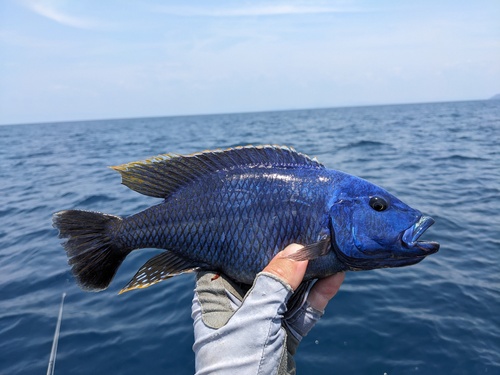
Color is where the species earns its keepers. Dominant males turn a clean metallic blue, sometimes with a blue head over a paler, peachy or "sunspot" body, while females and subordinate males stay a more muted silvery brown crossed by faint vertical bars. The pattern is the main source of confusion: side by side with the larger T. macrostoma or with Nimbochromis fuscotaeniatus, an unfamiliar eye struggles to tell them apart, and hobbyists report that T. nigriventer is frequently sold under the wrong name. Learning the genus's bar and blotch patterns is the reliable way to separate them.
Range & habitat
Tyrannochromis nigriventer is endemic to Lake Malawi (also called Lake Nyasa or Niassa), the long, deep rift lake shared by Malawi, Mozambique and Tanzania; like most of the lake's cichlids it occurs nowhere else on Earth. It has been recorded around the rocky shores at sites such as Nkhata Bay and the offshore Chinyamwezi Island, and the museum and survey record places it broadly along the lake's coasts rather than in any single bay.
The fish is a creature of the rocky littoral. FishBase characterizes it as preferring sediment-free rocky habitats in shallow water — the clean, current-washed boulder zones where mbuna and other small cichlids are abundant and where a hunter can stalk among the cracks. Recorded in-situ conditions track the lake's stable, hard, alkaline chemistry: a pH band of roughly 7.5 to 8.3, moderate to high hardness, and warm surface temperatures around 75-79 °F (24-26 °C). Because it keeps to shallow, oxygen-rich rock, it is tied to exactly the shoreline habitats most exposed to changes in water clarity.
Ecology & diet
T. nigriventer is a piscivore — a fish-eater near the top of the rocky-shore food web. FishBase assigns the species a trophic level of about 4.2, placing it among Malawi's predatory cichlids rather than the algae-grazers and invertebrate-pickers that make up most of the rock community. Its diet in the wild is dominated by smaller fish.
The hunting style is best documented in its close relative T. macrostoma, which moves deliberately around rocks and probes into crevices, then engulfs unwary mbuna with a sudden lunge of its large mouth — the mouth doing the work that speed alone cannot in tight cover. T. nigriventer shares the same body plan and the same reef habitat, and the available evidence points to the same ambush-and-engulf approach. In a lake whose rocky reefs are packed with hundreds of small cichlid species, a generalist piscivore like this functions as a significant predator on juvenile and small adult fish, helping shape the structure of the community it lives in.
Behavior & breeding
Like the overwhelming majority of Lake Malawi haplochromines, T. nigriventer is a maternal mouthbrooder. Spawning follows the familiar haplochromine script: a colored-up male defends a territory and courts females, the female takes the fertilized eggs into her mouth, and she incubates the developing young there, releasing free-swimming fry only after they have absorbed the yolk. Direct breeding data specific to this species are thin in the literature, but its better-studied congener T. macrostoma guards its offspring for more than three weeks, with young dispersing as solitary hunters once they reach about 1.5 in (3.8-4.0 cm) — a reasonable guide to what this fish does.
Behaviorally it is a large, territorial predator, and that shapes everything about keeping it. Hobbyists consistently describe it as intelligent and watchful, and as aggressive in the way a big hunting cichlid is — though some keepers note that a given individual can be calmer than the superficially similar Nimbochromis fuscotaeniatus. The recurring theme across independent accounts is that this is a real predator with the bulk to back up its temperament, not a community fish.
In the aquarium
T. nigriventer is an uncommon, specialist's fish rather than a beginner's. It surfaces only occasionally in the hobby, often misidentified, and wild-caught males command a premium. Keepers across forums converge on the same point: this is a big, predatory hap that needs serious space. A 180-gallon tank (about 680 L, on a 6 ft footprint) is widely treated as a practical minimum for a male with a few females, and several experienced keepers argue that even that is tight once the fish reach full size and other haps are added. A smaller "grow-out" tank works only while the fish are young.
Replicate the lake: hard, alkaline water (pH in the high 7s to low 8s), warm temperatures in the mid-70s °F, robust filtration, and a rockwork layout that gives subdominant fish sightline breaks. Tankmates should be chosen with care — other large, sturdy Malawi haps rather than anything small enough to read as prey or any fish too meek to weather the aggression. The most common mistakes are predictable: undersizing the tank, buying the fish under the wrong name and being surprised by its eventual size and temperament, and pairing it with delicate mbuna or smaller cichlids that simply disappear. Sourced honestly and given room, it rewards keepers with one of the more striking blue males in the genus.
Conservation
The IUCN Red List assessed Tyrannochromis nigriventer as Least Concern on 19 June 2018 (assessment by Ad Konings and Jacqueline Kazembe). The reasoning is straightforward: as a rocky-reef fish, it is not a target of the commercial food fishery that lands open-water and inshore species, and it is not considered threatened in its existence. There is no evidence of a population in decline, and the species is not listed by CITES. That said, it is a Lake Malawi endemic with a naturally patchy, reef-bound distribution, and it does move through the ornamental-export trade — collection pressure that the wider literature on Malawi's aquarium fishery (e.g. Msukwa and colleagues) has flagged as needing watching for rock-dwelling species generally, even where individual species remain secure.
The more honest worry is the lake itself. The basin review by Chavula et al. (2023, Journal of Great Lakes Research) catalogs a system under real strain: heavy over-fishing and the collapse of the prized chambo (Oreochromis) fishery, rising sediment and nutrient loading washing off deforested catchments, roughly 0.7 °C of warming in the shallow waters that strengthens stratification and depresses the lake's already low productivity, and the looming risk of invasive species such as Nile tilapia spreading into the catchment. For a sediment-sensitive, shallow rocky-reef hunter, the loading and clarity problems are the pointed ones — silt smothering the clean rock and the mbuna prey base it depends on would erode the habitat this predator is built for. So the accurate framing is the careful one: T. nigriventer is Least Concern as a species today, but it lives in a lake whose rocky shores are under growing pressure, and its long-term security is tied to the health of those reefs.
Sources
- Eschmeyer's Catalog of Fishes: Tyrannochromis nigriventer (California Academy of Sciences)
- FishBase: Tyrannochromis nigriventer Eccles, 1989
- FishBase: Tyrannochromis macrostoma (Regan, 1922) — genus/diet/breeding context
- FishBase territory list: Tyrannochromis nigriventer
- Cichlid Room Companion: Tyrannochromis nigriventer (curated by Ad Konings)
- Eccles, D.H. & Trewavas, E. (1989). Malawian Cichlid Fishes: The Classification of Some Haplochromine Genera — original description, pp. 101-103
- IUCN Red List: Tyrannochromis nigriventer (Least Concern, assessed 2018)
- Chavula, G.M.S. et al. (2023). Lake Malawi/Niassa/Nyasa basin: Status, challenges, and research needs. Journal of Great Lakes Research 49(6):102241
- Chavula et al. (2023) — full reference list incl. Msukwa ornamental-trade vulnerability studies (OUCI mirror)
- Cichlid Fish Forum: N. fusco vs T. nigriventer (coloration, ID, trade rarity) — community/anecdotal
- MonsterFishKeepers.com: Tyrannochromis nigriventer (tank size, aggression, size reports) — community/anecdotal
- Fishipedia: Tyrannochromis nigriventer (size, predatory behavior, biotope, care)
- FishBase: Tyrannochromis macrostoma synonymy/Catalog of Fishes cross-reference
- Sayer, C.A., Palmer-Newton, A.F. & Darwall, W. (2019). Conservation priorities for freshwater biodiversity in the Lake Malawi/Nyasa/Niassa Catchment. IUCN
- Msukwa et al. (2021). Vulnerability assessment of Lake Malawi's ornamental fish resources to export ornamental trade. Fisheries Research 238:105869