Taxonomy & naming
George Albert Boulenger described this fish in 1898 as Lamprologus moorii, the species epithet honoring the British biologist John Edmund Sharrock Moore, who collected on Lake Tanganyika in the 1890s. For most of the twentieth century it was shuffled through the catch-all rift-lake genera, appearing in much of the older literature and hobby trade as Neolamprologus moorii. In 1985 Colombe and Allgayer erected the monotypic genus Variabilichromis for it, using patterns in the bony infraorbital series of the Lamprologini to set it apart; the name nods to the striking ontogenetic color change that distinguishes it. Catalog of Fishes and FishBase both now treat Variabilichromis moorii (Boulenger, 1898) as the valid combination, with Lamprologus moorii and Neolamprologus moorii as synonyms.
Phylogenetic work places the genus near the base of the Lamprologini, the tribe of substrate-spawning Tanganyikan cichlids that also includes Neolamprologus, Lamprologus, Altolamprologus, Telmatochromis and the Julidochromis group. Its exact branching has long been argued over by specialists and aquarists alike — some place it close to the brichardi complex, others nearer Altolamprologus — and the keeping of a single peculiar species in its own genus reflects that unsettled, basal position rather than a clean answer.
Appearance
This is a modestly sized, deep-bodied lamprologine. Wild fish reach about 10 cm (4 in) total length — FishBase lists a maximum of 10.3 cm — and aquarium specimens often run a couple of centimeters larger, with old females sometimes pushing 13 cm (5 in). The species is essentially monomorphic: males and females share the same body shape and color, and males average only a few millimeters longer, so external sexing is famously unreliable.
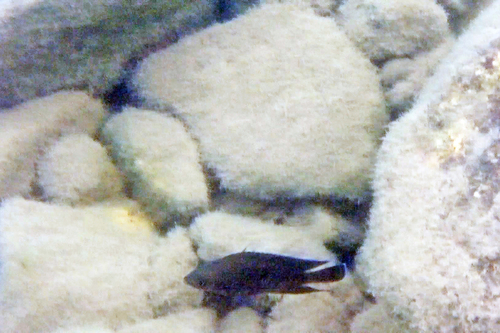
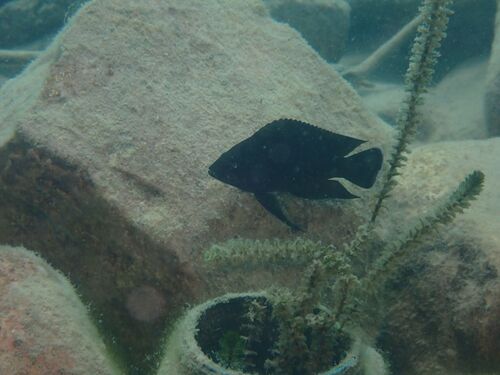
The arresting feature is how much the fish changes as it grows. Juveniles are bright yellow, orange or beige; adults turn a uniform dark brown to near-black, usually finished with a thin pale-blue or white margin along the trailing edges of the dorsal, anal and caudal fins. The age at which that switch happens varies between populations, and a few populations keep their juvenile brightness almost to adulthood — the kind of phenotypic variation that earned the genus its name. Hobbyists also note that the black is mood-dependent: a dominant, breeding fish blackens up intensely, while a stressed or subordinate one fades toward brown.
Range & habitat
Variabilichromis moorii is endemic to Lake Tanganyika and confined to the southern half of the lake. The IUCN gives its range as running between Kapampa in the Democratic Republic of the Congo and Nkondwe Island in Tanzania; on the eastern shore it reaches roughly as far north as Cape Mpimbwe, and it is among the most abundant cichlids on the rocky shores of southern Zambia. Like many Tanganyikan rock-dwellers it is split into geographically isolated, location-named variants in the trade ("Kasanga," "Kapampa," "Kashia Island," and others).
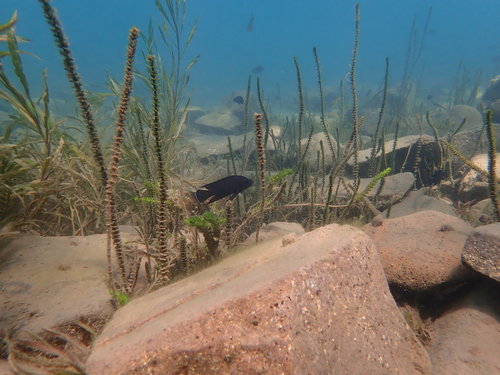
It is a fish of the shallow, sunlit rocky littoral. Underwater surveys on the Zambian shore found it concentrated in gravel- and rubble-dominated rock at depths of roughly 0.6 to 3.6 m (2 to 12 ft), among the shallowest of the lake's herbivorous cichlids — precisely the zone where light, and therefore algal growth, is richest. The water there is warm (around 24–26 °C, 75–79 °F), hard and alkaline, typically near pH 8.5 to 9.0 with high mineral content, the demanding chemistry shared by all Tanganyikan cichlids.
Ecology & diet
Most lamprologines are predators on invertebrates or small fish, which makes V. moorii unusual: it is one of the few in its tribe that grazes filamentous algae. Ecologists classify it as a territorial "browser" feeding on aufwuchs — the felt of algae, cyanobacteria, diatoms and the tiny invertebrates living within it that coats the rocks. A pyrosequencing study of stomach contents by Hata and colleagues (2014) found the ingested algae to be roughly 65% blue-green algae (cyanobacteria), 30% diatoms and about 5% green algae, alongside crustaceans and other small fauna gleaned from the mat. The literature has accordingly called it everything from herbivore to algivore to omnivore; the honest summary is that it eats the algal turf and the animals embedded in it, and FishBase places it at a middling trophic level of about 3.3.
That diet drives its behavior. Each fish defends a patch of rock as a private algal garden, and it does so aggressively, chasing off other grazers to keep the turf to itself. Field studies have documented how its territory size and the intensity of its defense shift with depth, and it shares the shallow grazing guild with browsers such as Tropheus and grazers such as Petrochromis, the community partitioning the rock by depth and feeding style.
Behavior & breeding
Unlike the mouthbrooding Tropheus it grazes alongside, V. moorii is a biparental substrate spawner and socially monogamous, forming a pair bond that both partners defend together. The female lays her eggs — clutches can run up to about 250 — on a concealed vertical rock face or inside a crevice within the territory; they hatch in three to four days, and both parents guard the fry zealously for up to roughly three months, until the young reach about 3 cm. Brood timing is tied to the moon: Rossiter's classic 1991 study showed spawning synchronized to the lunar cycle, with most broods produced around the first-quarter moon so that newly mobile fry are best defended against nocturnal predators like catfish when the full moon arrives.
The twist is genetic. Despite that tidy social monogamy, parentage analyses of wild broods found that pair-bonded, brood-tending males sire only about 63% of the fry they raise on average, the rest fathered by sneaking "cuckolder" males — chiefly unpaired bachelors rather than neighboring tending males, with as many as nine sires contributing to a single brood. Follow-up work tracking the same population across seasons found these cuckoldry rates fluctuate, higher in the rainy season and lower in the dry, possibly tracking changes in water turbidity. It is one of the better-studied natural cases of extra-pair paternity in a monogamous fish, and a reminder that the male's ferocious devotion to "his" brood is, in part, misplaced.
In the aquarium
Long-time keepers are consistent on one point: this is a hard, aggressive fish, and one of the most belligerent of the commonly traded Tanganyikans. A bonded pair is calm with each other — owners describe them as nearly inseparable — but the territory they hold is defended with deadly intent, and an adult, fully grown female can monopolize a square foot or more of tank and drive everything else into the corners. Because the sexes look alike and cannot be reliably told apart young, the standard approach is to buy a group of about six unsexed juveniles and let a pair form naturally, rehoming the rest before the survivors are bullied.
For a single pair, keepers report a 29-gallon (110 L) tank can work, but that is a floor, not a target: as the fish reach full size a long four-foot tank or larger is far safer, and specialist sources recommend roughly 150 cm (about 400 L) for properly housing the species' territoriality. Aquascape the way the fish lives — piles of rock forming several secure, single-entrance caves over sand — and hold the hard, alkaline, high-pH Tanganyikan chemistry (around pH 8.5–9, 75–79 °F / 24–26 °C). They are not fussy feeders in captivity, but a spirulina-leaning, vegetable-rich diet suits a grazer better than a meat-heavy one. The common mistakes are predictable: undersizing the tank, trying to force two random adults into a "pair," and underestimating how thoroughly one determined pair will dominate a mixed community.
Conservation
The IUCN Red List assessed Variabilichromis moorii as Least Concern in 2025 (assessor L. Haambiya), reaffirming its 2006 listing. The reasoning is straightforward: it is endemic to Lake Tanganyika but widely distributed across the southern basin, and is the most common cichlid at some sites and abundant at many others, with no known major lake-wide threat and a population trend recorded as unknown. It is taken both in local commercial fisheries and for the aquarium trade, but neither is considered a population-level threat. The one species-specific risk the assessment flags is sedimentation: because this fish feeds on algae in very shallow water, silt washing off a developing, deforested shoreline can smother the rock turf it depends on.
That local concern sits inside a larger, well-documented strain on the lake. Tanganyika is warming: O'Reilly and colleagues (2003, Nature) showed that rising surface temperatures and weaker winds have strengthened stratification and cut deep-water nutrient upwelling, lowering primary productivity by roughly 20% and implying about a 30% drop in fish yields, with the pelagic clupeid-and-Lates fishery supplying a major share of the animal protein for the four bordering nations. Cohen and colleagues (2016, PNAS) added paleoecological evidence that a century-plus of warming has shrunk the lake's oxygenated benthic habitat by about 38% in their study areas. Those basin-scale pressures bear most directly on the deep and pelagic fauna; a shallow rocky-shore grazer like V. moorii is buffered from them but exposed to the shoreline-level threats — sedimentation and habitat degradation — that the same warming, land-use change and four-country fishing pressure compound. Governance is shared through the Lake Tanganyika Authority, which coordinates Burundi, the DRC, Tanzania and Zambia. The honest read: this species itself is in good shape today, but the rocky littoral it lives in is not immune to a lake under genuine and growing stress.
Sources
- FishBase — Variabilichromis moorii
- Eschmeyer's Catalog of Fishes (Fricke, Eschmeyer & Van der Laan)
- IUCN Red List — Variabilichromis moorii (Haambiya 2025, e.T60613A47203265)
- Hata et al. 2014 — Diet disparity among sympatric herbivorous cichlids in the same ecomorphs (BMC Biology)
- Takeuchi et al. 2016 — Depth and substratum differentiations among coexisting herbivorous cichlids (Royal Society Open Science)
- Depth segregation and diet disparity revealed by stable isotope analysis (PMC4657292)
- Bose et al. 2018 — Brood-tending males in a biparental fish suffer high paternity losses (Molecular Ecology)
- Zimmermann, Bose et al. 2022 — Seasonal variation in cuckoldry rates in Variabilichromis moorii (Hydrobiologia / PMC10261196)
- African Diving — Variabilichromis moorii: a species of phenotypically uniform but genotypically distinct populations
- tanganyika.si — Variabilichromis moorii species & locations profile
- Fishipedia — Variabilichromis moorii
- Chase's Fishes — Variabilichromis (Lamp.) moorii care notes (PDF)
- Cichlid Fish Forum — Variabilichromis moorii keeping thread (community, anecdotal) — community/anecdotal
- MonsterFishKeepers — Tanganyikan keeping discussion (community, anecdotal) — community/anecdotal
- O'Reilly et al. 2003 — Climate change decreases aquatic ecosystem productivity of Lake Tanganyika (Nature; DOI 10.1038/nature01833)
- Cohen et al. 2016 — Climate warming reduces fish production and benthic habitat in Lake Tanganyika (PNAS; DOI 10.1073/pnas.1603237113)
- FAO — The pelagic fishery of Lake Tanganyika (Stolothrissa / Limnothrissa / Lates)