
Taxonomy & naming
Xenotilapia bathyphila was described by the Belgian ichthyologist Max Poll in 1956, in his monograph on the cichlids collected during the 1946–1947 Belgian Hydrobiological Exploration of Lake Tanganyika — the survey that first put much of the lake's astonishing fish fauna on the scientific record. The genus name blends the Greek xenos ("strange" or "foreign") with tilapia, the catch-all term for African cichlids; the species epithet joins bathy ("deep") and philos ("loving"), so the full name reads roughly as "the strange tilapia that loves the depths."
The fish sits in the tribe Ectodini, Lake Tanganyika's diverse radiation of sand-, mud-, and rock-dwelling cichlids. Some older literature treated it as a subspecies, Xenotilapia ochrogenys bathyphilus, before it was recognized at full species rank. A persistent source of confusion is spelling and trade naming: aquarists very often write the name as "Xenotilapia bathyphilus," and the popular yellow-lipped "bathyphilus yellow" sold from sites such as Kekese in the southeastern lake is actually an undescribed form distinct from true X. bathyphila — it differs in lip colour and breeding behaviour and does not overlap in range. For the valid binomial, the taxonomic authorities (Catalog of Fishes, FishBase, GBIF) all retain Xenotilapia bathyphila Poll, 1956.
Appearance
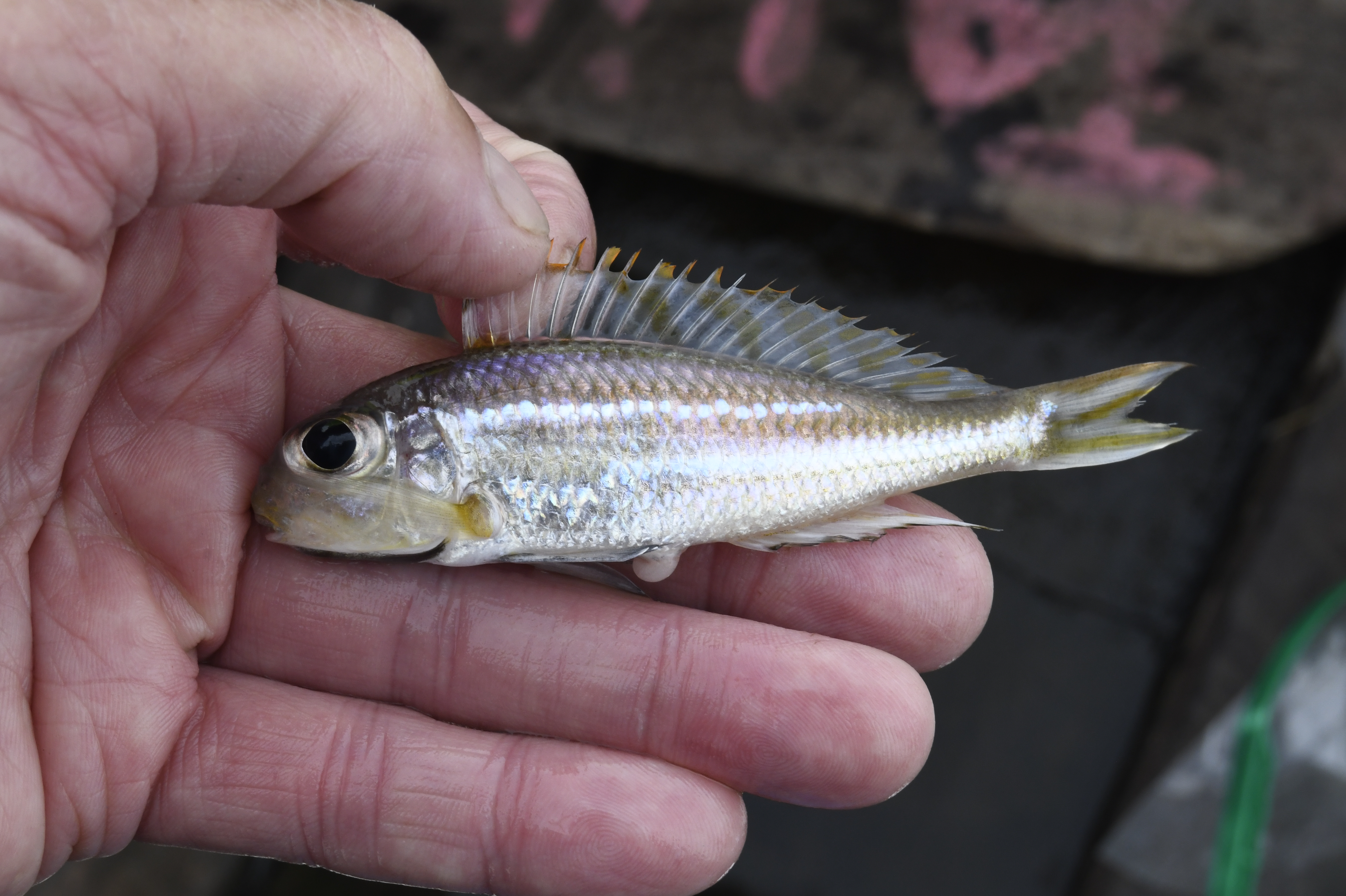
This is a small, streamlined cichlid: FishBase lists a maximum of about 4 in (10.3 cm) total length, and hobbyist accounts put adults in the 4–4.7 in (10–12 cm) range, with males running slightly larger than females. The body is elongate and laterally compressed with a long caudal peduncle, built for cruising over open sand rather than threading through rockwork. The mouth is distinctly subterminal — set low and angled down — which is the hallmark of a fish that earns its living by sifting substrate.
Colour is understated rather than gaudy. The ground tone is a brownish silver-grey, broken by iridescent blue sheen along the back, over the chest, and on the head, with yellowish lips and lower face. A dark blotch often sits on the gill cover, and faint short bars may show on the flanks. The dorsal fin carries a yellow margin and a row of light-edged ocelli (eye-spots). Males are the showier sex, sometimes flashing a turquoise upper lip and stronger blue-and-yellow markings in the dorsal; females are plainer and more silvery, as is typical of mouthbrooding cichlids where the female must stay inconspicuous while carrying eggs. The long pelvic fins are used like little props to hold the fish steady on the bottom.
Range & habitat
Xenotilapia bathyphila is endemic to Lake Tanganyika — found nowhere else on Earth — and occurs broadly around the lake, which is shared by Tanzania, the Democratic Republic of the Congo, Zambia, and Burundi. FishBase places it in the tropical band between roughly 3°S and 9°S, classifying it as a freshwater, demersal (bottom-associated) species.
It is a sand specialist. The fish lives over open sandy and muddy floors rather than the rocky, reef-like shorelines that many famous Tanganyikan cichlids prefer, and consistent with its "deep-loving" name it tends to occupy the deeper sand flats rather than the shallow wave zone. Like all Tanganyikan cichlids it is adapted to the lake's hard, strongly alkaline water — a pH around 8.5–9 and high mineral content — which is one of the more demanding chemistries in the freshwater world and a defining feature of this ancient rift lake. The sandy substrate is not incidental: it is both the foraging ground and the spawning site, so the texture and depth of that sand shapes where the species can live.
Ecology & diet
X. bathyphila is a benthic invertivore — a sand-sifter. It takes mouthfuls of the upper sand layer, sorts the edible fraction over its gill rakers, and expels the clean sand back out through the mouth and gill openings, a feeding mechanic shared across the sand-dwelling Ectodini. FishBase records its natural diet as copepods and small shrimps, and hobby observations add other small invertebrates and insect larvae winnowed from the substrate; its estimated trophic level of about 3.3 places it squarely as a small carnivore rather than an algae grazer.
Ecologically, this puts the fish in the lake's quiet but important guild of sand-flat foragers that recycle the tiny crustaceans and meiofauna living in and on the sediment. It forms loose schools, which on a featureless sand plain is both a feeding strategy — more eyes and mouths working the bottom — and an anti-predator one, since open sand offers no cover from the lake's many ambush and pursuit predators. FishBase rates its fishing vulnerability as low and its population resilience as high, consistent with a small, fast-maturing fish.
Behavior & breeding
Out of breeding season, X. bathyphila is a gregarious, fairly peaceful schooling fish — far less combative than the lake's territorial rock-dwellers. Aggression is mostly limited to males chasing rival males, and even that softens when the fish are kept in a proper group.
Reproduction follows the mouthbrooding strategy that defines so much of the Tanganyikan radiation. In X. bathyphila the female is the brood-carrier: after a modest clutch (hobby reports cite roughly 20–40 eggs) is laid and fertilized on a cleaned patch of sand, she takes the eggs into her mouth and incubates them for about three weeks, eating little or nothing during that time. There is little or no care once the fry are released. It is worth flagging a genuine subtlety here: the genus Xenotilapia is unusual within the cichlids for including species that evolved biparental mouthbrooding, where both parents share carrying duty, and this trait varies across the sand-dwelling lineage. For X. bathyphila itself the consistent account from keepers and care references is maternal (female-only) mouthbrooding, but the broader genus is a textbook example of how flexible this behaviour can be.
In the aquarium
This is a rewarding but specialist fish, not a beginner's cichlid. The non-negotiables are a large open sand bed and rock-stable water chemistry. Experienced keepers recommend a long tank — at least a 4–5 ft (120–150 cm) footprint for a single-male group, and considerably longer if you want multiple displaying males — because floor area, not height, is what these bottom-oriented fish use. A fine, smooth sand substrate is essential; sharp grit can injure the mouth as the fish sift, and only an inch or so of depth is needed since they sift rather than dig. The water must be kept hard, alkaline, and scrupulously clean, with strong filtration and regular changes.
Keep them in groups of eight or more: they are genuinely gregarious and stay calmer and bolder in numbers. The biggest practical issue keepers report is nerves — Xenotilapia are skittish and prone to bolting, so a covered tank, an opaque background or a wall behind the tank, and a low-traffic location all help; some structure (plants, scattered rocks, even hidden lengths of pipe) gives spooked fish somewhere to scoot. Open-water schoolers from the same lake, such as Cyprichromis, make excellent upper-level tankmates that leave the sand zone to the Xenotilapia. Avoid boisterous, substrate-bullying cichlids that will out-compete or stress them. Note that true X. bathyphila is uncommon and pricey in the trade, and much of what is sold under the "bathyphilus" label is the related undescribed yellow form — worth knowing before you buy.
Conservation
On its own account, Xenotilapia bathyphila is in reasonable shape: the IUCN Red List assesses it as Least Concern (assessment dated 31 January 2006), reflecting its wide distribution around Lake Tanganyika and the absence of any species-specific threat. It is taken in small numbers for the aquarium trade and turns up incidentally in artisanal catches, but collection pressure on this particular fish is not considered a conservation concern.
That individual status, however, sits inside a lake under real strain, and a deep sand-flat forager is exposed to exactly the pressures the basin faces. Lake Tanganyika has warmed steadily over the past century-plus, and that warming strengthens and shallows the lake's stratification, slowing the vertical mixing that lifts nutrients from the depths. O'Reilly and colleagues (2003, Nature, DOI 10.1038/nature01833) estimated that this climate-driven loss of mixing may have cut primary productivity by around 20%, implying roughly a 30% drop in potential fish yields. Cohen and colleagues (2016, PNAS, DOI 10.1073/pnas.1603237113) added a benthic dimension directly relevant to bottom-dwelling species like this one: paleoecological records show sustained warming has shrunk the oxygenated benthic habitat by about 38% in their study areas, with fish and mollusc declines tracking the warming. Layered on top are sedimentation and nutrient loading from deforestation and shoreline development (Cohen et al. 1993), which smother sandy and rocky habitats alike, and a heavy pelagic fishery — built on the clupeids Stolothrissa and Limnothrissa and the predatory Lates — that feeds millions across the four riparian nations and is coordinated, at least on paper, through the Lake Tanganyika Authority. None of this targets X. bathyphila directly, and the species remains Least Concern; but a fish whose entire life depends on oxygenated deep sand has a clear stake in a lake where exactly that habitat is contracting.
Sources
- FishBase — Xenotilapia bathyphila (Poll, 1956)
- GBIF — Xenotilapia bathyphila Poll, 1956
- Catalog of Fishes (Eschmeyer / CAS) — Xenotilapia species record
- IUCN Red List — Xenotilapia bathyphila (Least Concern)
- AquaInfo — Xenotilapia bathyphilus species profile
- tanganyika.si — Xenotilapia sp. 'bathyphilus yellow' (Kekese) profile
- Cichlid Room Companion — genus Xenotilapia
- Cichlid Room Companion — tribe Ectodini overview
- Cichlid-Forum — Xenotilapia bathyphilus care and tankmates (keeper discussion) — community/anecdotal
- Cichlid-Forum — Return to Tangs: making Xenotilapia work (keeper discussion) — community/anecdotal
- Reddit r/Cichlid — New arrivals: Xenotilapia bathyphilus 'Kekese' (keeper anecdote) — community/anecdotal
- Sefc et al. — Mating and Parental Care in Lake Tanganyika's Cichlids (biparental mouthbrooding in Xenotilapia)
- Koblmüller et al. — Evolutionary relationships in the sand-dwelling cichlid lineage (Ectodini) of Lake Tanganyika
- O'Reilly et al. 2003 — Climate change decreases aquatic ecosystem productivity of Lake Tanganyika (Nature)
- Cohen et al. 2016 — Climate warming reduces fish production and benthic habitat in Lake Tanganyika (PNAS)
- Lake Tanganyika: Status, challenges, and opportunities for research (J. Great Lakes Research)