
Taxonomy & naming
Max Poll described this fish in 1942 from Rumonge, on the Burundian shore of Lake Tanganyika, originally placing it in the genus Enantiopus as Enantiopus boulengeri. It has since been folded into Xenotilapia, a genus erected by Boulenger in 1899 within the endemic Tanganyikan tribe Ectodini. The species epithet honors George Albert Boulenger (1858-1937), the prolific Belgian-British ichthyologist whose work at the British Museum first made much of Tanganyika's fish fauna known to science; the genus name blends Greek xenos (strange, foreign) with the Tswana word for fish, a nod to the unusual three-line lateral system and modified pelvic fins of its type species.
The synonymy is a small museum of mid-century confusion. Poll's own Parectodus lestradei (1942) and Xenotilapia materfamilias (1943) are both now treated as junior synonyms of X. boulengeri. The genus has long needed sorting out, and a focused effort came from Takahashi and Nakaya (1997, Ichthyological Research), who revised X. boulengeri together with its close look-alike Xenotilapia sima. Catalog of Fishes and FishBase both carry Poll, 1942 as the valid authority. Within the genus's roughly thirteen to seventeen species, molecular work places X. boulengeri in a clade alongside X. sima, X. bathyphila and X. flavipinnis.
Appearance
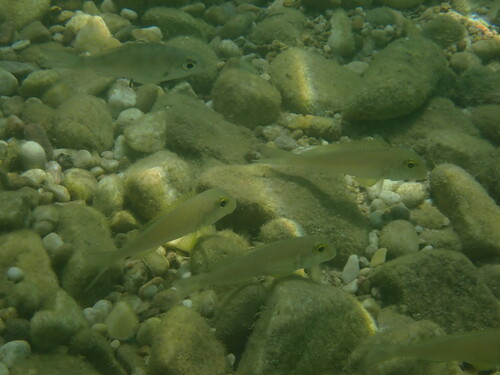
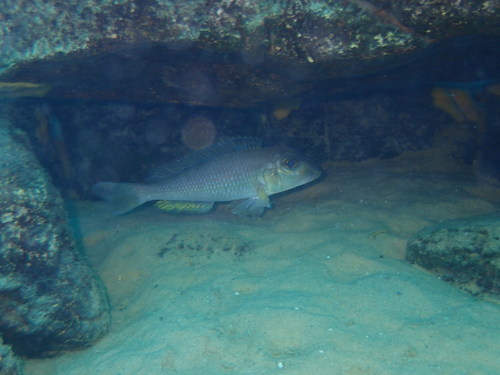
X. boulengeri has the elongate, laterally compressed, slightly down-mouthed build typical of a benthic sand-sifter, but it is stockier than its slim congeners. The body is generally grey to brownish-grey, the head paler and often washed light brown, sometimes with a yellowish smudge on the gill cover; the fins are light, with the leading edge of the dorsal frequently darkening to a near-black margin. Territorial, sexually active males flush far more intense color than the muted females.
Size is the one point where sources part company, and it is worth being precise. The taxonomic and reference literature is consistent: FishBase and the 2025 IUCN assessment both give a maximum of about 15.3 cm (6.0 in) total length, and the careful hobby account at AquaInfo lands at roughly 15-16 cm (6-6.3 in). Some popular sources advertise considerably larger fish, occasionally up to 17-25 cm (6.7-9.8 in); those figures are not supported by the measured literature and likely conflate this species with a congener, so treat the ~15 cm (6 in) ceiling as the dependable one. Males grow noticeably larger than females and carry longer dorsal and anal-fin extensions plus darker edging on the anal and pelvic fins. A diagnostic genus trait, present here, is the three lateral lines (upper, mid-body and caudal) where most cichlids have two.
Range & habitat
The species is a strict Tanganyikan endemic, recorded lake-wide across all four riparian nations: Burundi, the Democratic Republic of the Congo, Tanzania and Zambia. It is a shallow-water animal, occurring from about 2 m down and concentrated over open sand and the sand-and-rubble intermediate zone, typically within roughly the upper 20 m (about 6-66 ft). FishBase classes it as benthopelagic, and in-situ conditions match the lake's famously hard, alkaline water: pH near 7.5-8.5, high mineral hardness, and warm temperatures around 23-26 degrees C (73-79 degrees F).
Like many sand cichlids it occurs as a series of geographic color forms around the lake's perimeter, with populations labeled by collectors after localities such as Cape Kachese, Chituta Bay and Isanga. Because its preferred habitat is the open sandy shelf rather than the rock reefs, it sits in a different ecological compartment from the well-known rock-dwelling mbuna-analogues, and its fate is tied to the health of the shallow sand-floor community.
Ecology & diet
This is a benthic invertebrate feeder that works the substrate the way the whole Ectodine sand guild does: it takes mouthfuls of sand, sorts the edible from the inedible against the gill rakers, and ejects the spoil through the mouth and gill openings. Stomach-content work cited in the hobby literature lists copepods, ostracods, gastropods, small shrimps and insect larvae and adults; FishBase summarizes the diet as copepods and small shrimps and places the species at a trophic level of about 3.3, squarely a micro-carnivore rather than a predator of other fish.
Its most interesting ecological wrinkle is behavioral rather than dietary. Ochi and Yanagisawa (1998, Journal of Fish Biology) documented X. boulengeri resting in clusters around the guarded nests of the substrate-brooding cichlids Lepidiolamprologus attenuatus and L. elongatus. When the researchers experimentally removed the guarding Lepidiolamprologus parents, the X. boulengeri aggregations melted away within days. The payoff is protection: the scale-eating cichlids Perissodus microlepis and Plecodus straeleni, which rasp scales off larger fish, were driven off at a distance by the territorial guardians, while the harmless sand-sifters were tolerated close in. The result is a commensal "safety zone" the sand cichlid exploits at no cost to its hosts.
Behavior & breeding
Outside the breeding season X. boulengeri lives in large, loose schools over open sand. It is peaceful toward other species and not especially shy, though males turn territorial and squabble with rival males when spawning. When breeding, groups move into the intermediate sand-and-rock zone, where a male excavates a shallow crater-shaped sand nest to court passing females. Clutches are modest, on the order of 50-60 eggs.
How the brood is then cared for is the species' longest-running disagreement, and an honest account has to flag it rather than pick a side. FishBase and several hobby references describe biparental mouthbrooding: the female incubates the eggs for about 12 days, then transfers the developing young to the male, who carries them a further 18-20 days. The specialist Tanganyikan reference tanganyika.si, by contrast, calls it a maternal-only mouthbrooder and argues that the biparental reports stem from a historical mix-up in which juvenile X. boulengeri were mistaken for the genuinely biparental Xenotilapia flavipinnis. The broader phylogenetic work supports why this is genuinely hard to settle: Kidd and colleagues (2012, PLOS ONE) showed that within Xenotilapia parental care has flipped repeatedly between polygamous maternal-only and monogamous biparental modes, with three to five independent transitions, and that X. boulengeri sits close to flavipinnis in the tree. In short, both care strategies exist in this clade, and which one X. boulengeri uses is not as settled as a single care sheet implies.
In the aquarium
X. boulengeri reaches the hobby and is offered commercially, but it is not a beginner's fish. Everything good about it depends on getting the floor right: a deep bed of fine sand is non-negotiable, because the sand-sifting behavior that defines the animal cannot happen over gravel, and a fish that can't sift is a stressed fish. Keepers consistently describe it as peaceful but sensitive to stress, doing poorly when housed with boisterous or aggressive tankmates; calmer Tanganyikan companions such as smaller Julidochromis and Neolamprologus suit it far better than rowdy mbuna.
It is best kept as a group rather than a single pair, which spreads out male aggression and brings out the natural schooling behavior. That argues for footprint over volume: experienced keepers and the better references recommend a tank no shorter than about 160 cm (63 in) and on the order of 500-600 liters (130-160 US gal) for a group of six to eight, with open sand framed by rockwork at the edges. Target the lake's water: hard and alkaline, pH around 8-9, with temperatures in the mid-70s Fahrenheit (about 24-26 degrees C). Diet should mirror the wild micro-carnivore habit, fine foods such as cyclops, daphnia and brine shrimp work well; the common mistakes are too small a tank, the wrong substrate, and aggressive tankmates that keep this nervous sand-sifter from settling.
Conservation
X. boulengeri is assessed by the IUCN as Least Concern, most recently re-evaluated on 23 February 2025 (assessor L. Haambiya, reviewed by A. Konings), upholding an earlier Least Concern listing from 2006. It is widely distributed throughout Lake Tanganyika, with no known major threats specific to it; the population trend is recorded as Unknown. It carries no CITES or CMS listing, and although it is collected for the aquarium trade, there is no evidence that trade pressure threatens such a broadly ranged, sand-flat species.
The honest framing is that the fish is secure but its lake is not. Lake Tanganyika holds about 17 percent of the planet's surface freshwater and an extraordinary endemic cichlid fauna, yet it is under measurable strain. O'Reilly and colleagues (2003, Nature) showed that warming surface waters have strengthened stratification and weakened the seasonal mixing that lifts nutrients from the depths, with sediment records implying primary productivity fell by roughly 20 percent and fish yields by perhaps 30 percent. Cohen and colleagues (2016, PNAS) added paleoecological evidence that warming has reduced the oxygenated benthic habitat available to bottom-dwelling animals, with declines in commercially important fishes and endemic molluscs tracking the warming. Shoreline development and deforestation drive sedimentation that smothers the littoral, and the great pelagic clupeid and Lates fishery that feeds four nations is governed jointly through the Lake Tanganyika Authority. For X. boulengeri specifically, the most relevant of these pressures is sedimentation of the shallow sandy shelf it depends on: a fish that earns its living sorting clean sand has a direct stake in keeping the nearshore floor from silting over. For now it remains common and Least Concern, but that status is a snapshot of a strained system, not a guarantee.
Sources
- Xenotilapia boulengeri — Catalog of Fishes (Eschmeyer, California Academy of Sciences)
- Xenotilapia boulengeri — FishBase species summary
- Xenotilapia Boulenger, 1899 — GBIF
- Xenotilapia boulengeri — IUCN Red List (Haambiya 2025, Least Concern)
- Takahashi & Nakaya (1997). A taxonomic review of Xenotilapia sima and X. boulengeri. Ichthyological Research 44.
- Ochi & Yanagisawa (1998). Commensalism between cichlid fishes through differential tolerance of guarding parents toward intruders. Journal of Fish Biology 52:985-996.
- Kidd, Duftner, Koblmuller, Sturmbauer & Hofmann (2012). Repeated Parallel Evolution of Parental Care Strategies within Xenotilapia (Ectodini). PLOS ONE 7(2):e31236.
- O'Reilly et al. (2003). Climate change decreases aquatic ecosystem productivity of Lake Tanganyika, Africa. Nature.
- Cohen et al. (2016). Climate warming reduces fish production and benthic habitat in Lake Tanganyika. PNAS.
- Xenotilapia boulengeri — Cichlid Room Companion species profile (T. Andersen)
- Xenotilapia boulengeri — tanganyika.si species page
- Xenotilapia boulengeri — AquaInfo (John de Lange)
- Mating and Parental Care in Lake Tanganyika's Cichlids (review)
- The Xenotilapia cichlid clan from Lake Tanganyika — r/Cichlid (keeper discussion, sand-sifting husbandry) — community/anecdotal
- Xenotilapia sima from Lake Tanganyika — Cichlid Fish Forum (sand-sifting Xenotilapia keeping) — community/anecdotal
- Enantiopus/Xenotilapia melanogenys keeping experience — r/Cichlid — community/anecdotal