

Taxonomy & naming
Xenotilapia caudafasciata was described by the Belgian ichthyologist Max Poll in 1951, one of a cluster of Tanganyikan sand-cichlids he named from the great Belgian survey collections of the mid-twentieth century. The type locality is Moba Bay, south of Mtoto, on the Congolese (DRC) shore of the lake. The genus name pairs Greek xenos, "strange," with tilapia (itself from a Tswana word for fish); the species epithet caudafasciata translates roughly as "banded tail," a nod to the dark barring males show on the caudal fin. Eschmeyer's Catalog of Fishes and FishBase both list it as a valid species, and the spelling caudafasciata is correct (the variant "caudofasciata" seen in some online summaries is a misspelling).
The genus Xenotilapia sits in the tribe Ectodini, the lake's signature radiation of sand-, mud- and open-water cichlids and one of its most ecologically diverse lineages. Within that genus, caudafasciata is something of an outlier. Its dentition differs from its relatives — the outer teeth are set vertically rather than raked forward — and that peculiarity once raised doubts about whether it truly belonged in Xenotilapia. Both morphological and molecular work have since confirmed that its closest relatives lie inside the genus, so the odd teeth are best read as a feeding specialization rather than a sign of misplacement.
Appearance
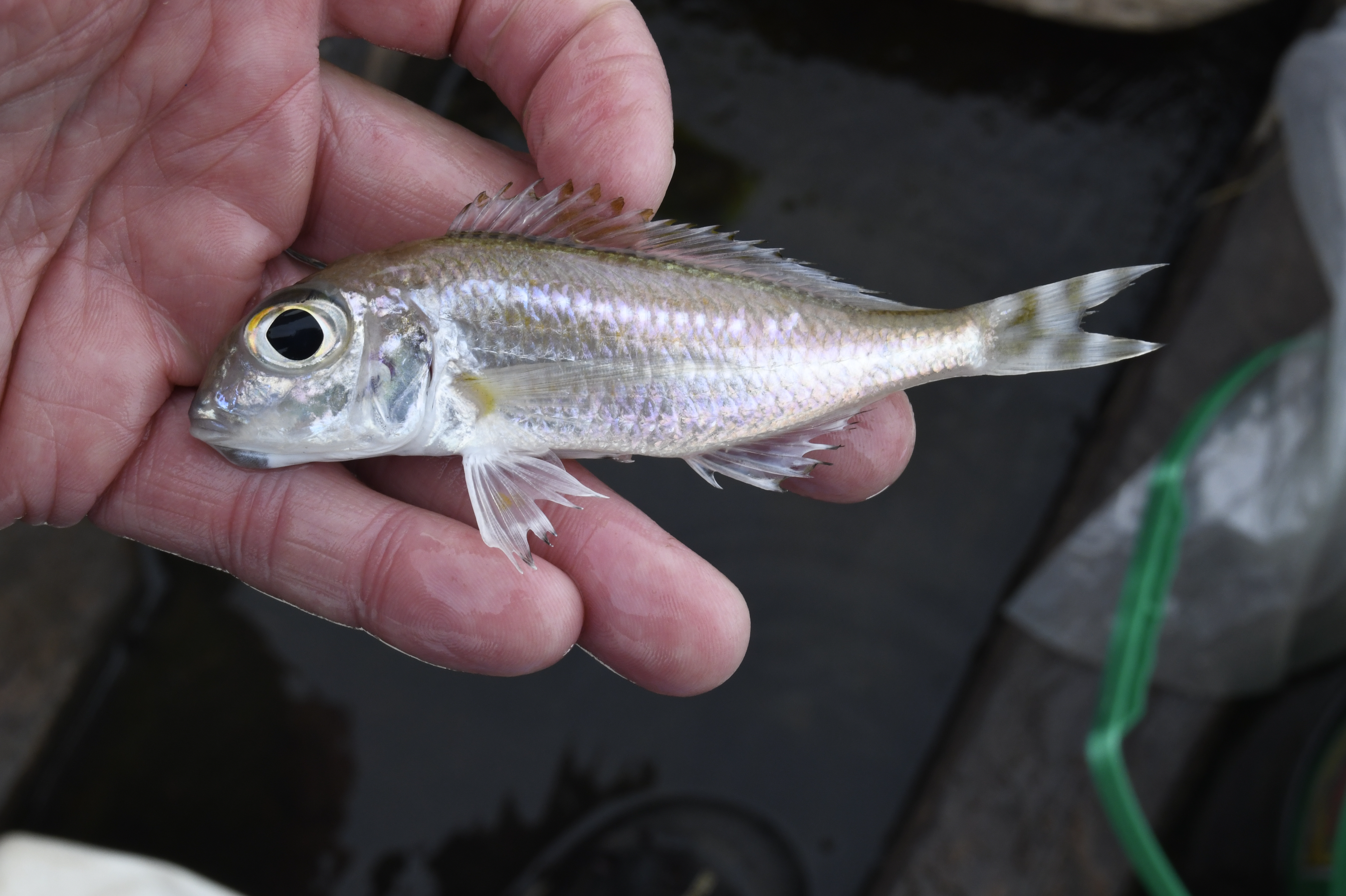
This is a slender, torpedo-shaped cichlid built for life over sand, with a pointed snout, a flat ventral profile, and the large, slightly upward-set eyes typical of fish that hunt prey against a pale substrate. FishBase records a maximum of about 4.1 in (10.5 cm) total length for males and roughly 6.1 in (15.6 cm) for females. That reversal is the species' calling card: X. caudafasciata is, by hobby and field accounts, the only member of its genus in which females outgrow males, with females averaging near 4.7 in (12 cm) standard length and males nearer 4.1 in (10.5 cm).
Coloration is understated rather than gaudy. Females tend toward a clean silvery body with a faint bluish wash in the dorsal fin. Males carry horizontal brownish lines along the flanks, black barring on the caudal fin, and dark margins to the dorsal, anal and pelvic fins; a sexually active male further develops a striking pitch-black throat. The overall effect is metallic and subtle — a fish whose appeal lies in form and movement more than color, and one easily confused at a glance with several congeners until the tail markings and the size difference between the sexes give it away.
Range & habitat
X. caudafasciata is endemic to Lake Tanganyika and, unlike many narrowly distributed rock-dwelling cichlids of the lake, it is found basin-wide, with records from the Congolese, Tanzanian, Burundian and Zambian coasts. It is a creature of the open sandy and muddy floor rather than the rocky littoral. Field accounts place it most commonly at depths of about 165–250 ft (50–75 m), with records down to roughly 330 ft (100 m); it is only rarely encountered shallower than about 115 ft (35 m), and then mostly near river mouths where sediment-laden water mimics its preferred conditions.
That depth band matters for understanding the fish. Lake Tanganyika is meromictic — permanently stratified — with oxygenated, life-supporting water confined to the upper layers above a vast, anoxic deep. A species living at 165–250 ft is essentially hugging the lower edge of the habitable zone, on featureless sand far below the sunlit reefs that draw most aquarium attention. In situ the water there is warm (the lake's surface sits around 75–81 °F / 24–27 °C), highly alkaline, and mineral-rich, with a pH typically near 8.6–9.2 and hard, buffered chemistry — the baseline any keeper has to reproduce.
Ecology & diet
X. caudafasciata is a benthic carnivore, assigned a trophic level near 3.0, and it feeds the way much of its tribe does: by sifting the sand itself. The fish thrusts its snout into the substrate, lifts a mouthful of sand, and sorts it inside the mouth and gill chamber, retaining edible particles and expelling the spent grit through the mouth and gills. Its diet is dominated by small benthic invertebrates — chironomid (midge) larvae especially, along with ostracods and other micro-crustaceans — supplemented by diatoms and other small organisms drawn up with the sand.
The species' unusual vertical dentition is tied to this foraging style and likely lets it work the substrate slightly differently from its sand-sifting relatives, an example of the fine-grained niche partitioning that has allowed so many similar-looking cichlids to coexist on Tanganyika's sand. Ecologically it is a mid-water and near-bottom forager that moves in schools, which both improves foraging efficiency over open sand and offers some protection in a habitat that provides no rocks or shells to hide among — the shoal is the cover.
Behavior & breeding
Socially, X. caudafasciata is a schooling fish, and that grouping instinct is central to its biology rather than incidental. It is comparatively peaceful for the genus: males display and engage in mild competition, but overall aggression runs lower than in many other Xenotilapia, and the species is generally tolerant of other fishes.
Reproduction is by maternal mouthbrooding. Unlike some of its biparental relatives, the male here builds no sand-scrape spawning crater and instead courts and attempts to spawn at more or less random spots on the open bottom. Courtship is intense and sustained — vigorous fin-spread displays and rapid lip movements. The female lays a small clutch of cream-colored, slightly oval eggs about 3 mm across, typically fewer than 40, and takes them into her mouth, where she incubates eggs and developing larvae for roughly three weeks. By the accounts available, she provides no post-release care once the fry are free-swimming, which is consistent with an open-water species that has no defensible refuge to herd young toward.
In the aquarium
X. caudafasciata is a connoisseur's fish, not a beginner's. It appears in the trade only occasionally and tends to be both rare and expensive when it does — a point experienced Tanganyikan keepers make plainly on the forums — so most aquarists will never encounter it for sale. Anyone who does should treat it as an advanced project.
The non-negotiables are space, sand, and water quality. A footprint of at least about 5 ft (150 cm) and a volume of 400 L (roughly 100 gal) or more is a sensible minimum for long-term keeping of a group; this is a schooling, open-swimming fish and is best kept in numbers rather than as a pair. A deep bed of fine sand is essential — it is the fish's feeding substrate, not decoration — and any rockwork should be smooth and pushed to the background, because Xenotilapia have large, fragile eyes that sharp edges can injure. Keepers across the genus consistently report two things: these sand-sifters are skittish, prone to bolting and damaging themselves if startled (a quiet, low-traffic location helps), and they are sensitive to water quality, demanding pristine, stable, hard alkaline water with diligent maintenance. Tankmates should be calm and non-competitive; pushy or boisterous sand-dwellers will outcompete them for the bottom. The honest summary: a beautiful, biologically fascinating fish that punishes shortcuts and is best left to keepers who already have Tanganyikan sand cichlids figured out.
Conservation
The IUCN Red List assesses Xenotilapia caudafasciata as Least Concern (assessment dated 31 January 2006). That status is reasonable for a species that is endemic but lake-wide in distribution rather than confined to a single reef, and that faces no concentrated collection pressure — its rarity in the aquarium trade reflects how hard it is to obtain from deep sand, not heavy targeted harvest. There is no evidence the ornamental trade threatens it.
The more honest framing is that the fish itself is not of concern, but the lake it depends on is under real strain. Lake Tanganyika has been warming, and that warming strengthens the lake's permanent stratification and shrinks the mixing that brings nutrients up from the deep. O'Reilly and colleagues (2003, Nature, DOI 10.1038/nature01833) linked this to a roughly 20% decline in primary productivity and an estimated drop of up to about 30% in fish yields; Cohen and colleagues (2016, PNAS, DOI 10.1073/pnas.1603237113) used sediment records to show declining fish abundance alongside the loss of a substantial share — on the order of 38% — of the oxygenated benthic habitat as the oxygen boundary shoals. Add the sedimentation that smothers near-shore substrates, and the commercially vital pelagic fishery (the clupeids Stolothrissa and Limnothrissa plus Lates) that feeds the four nations sharing the basin, and the picture is of a system being squeezed from several directions, managed across borders through the Lake Tanganyika Authority. For X. caudafasciata, a deep-water benthic feeder living near the lower edge of the oxygenated zone, the relevant threat is precisely that boundary: a shrinking habitable depth band and reduced productivity bear directly on a fish whose niche sits where warm, oxygen-poor deep water meets the habitable layer. It is Least Concern today, but its address is one of the more exposed in a lake under pressure.
Sources
- Xenotilapia caudafasciata — FishBase species summary
- Eschmeyer's Catalog of Fishes (California Academy of Sciences)
- Species in Lake Tanganyika — FishBase ecosystem list
- Xenotilapia caudafasciata — tanganyika.si species profile
- Xenotilapia genus profile — Cichlid Room Companion
- Tribe Ectodini — Cichlid Room Companion
- Lake Tanganyika Aquarium Setup — tanganyika.si
- Return to Tangs, making Xenotilapia work — Cichlid Forum thread — community/anecdotal
- The Xenotilapia cichlid clan from Lake Tanganyika — r/Aquariums — community/anecdotal
- Anyone have experience with Xenotilapia ochrogenys Kipili — MonsterFishKeepers — community/anecdotal
- Feeding Ecology of Lake Tanganyika Cichlids (review)
- O'Reilly et al. 2003 — Climate change decreases productivity of Lake Tanganyika (Nature)
- Cohen et al. 2016 — Climate warming reduces fish production and benthic habitat in Lake Tanganyika (PNAS)
- Lake Tanganyika: status, challenges, and opportunities for research (J. Great Lakes Research)
- All cichlid species (IUCN) — Cichlid Room Companion index
- IUCN Red List — Xenotilapia caudafasciata assessment