Taxonomy & naming
Xenotilapia flavipinnis was described by the Belgian ichthyologist Max Poll in 1985, with its type locality at Ruziba on the Burundian shore of Lake Tanganyika. FishBase and Eschmeyer's Catalog of Fishes both treat the name as valid with no junior synonyms, so the fish carries the same binomial in the literature and the trade alike.
The genus name blends the Greek xenos, "strange," with tilapia (itself from a southern African word for fish), a nod to how oddly these sand specialists sit beside the more familiar tilapiine cichlids. The species epithet is plainer: flavus (yellow) plus pinna (fin), describing the soft yellow wash that can suffuse the fins of a well-conditioned fish and gives it the trade name "yellow sand cichlid."
Xenotilapia belongs to the tribe Ectodini, the sand- and mud-dwelling lineage that is among the most ecologically varied branches of Tanganyika's cichlid radiation. Within that group X. flavipinnis is one of the textbook "sand-dwellers," and like many Tanganyikan cichlids it varies geographically: aquarists recognize numerous location forms (Izinga Island, Chituta Bay, Kagunga, Mtotokainda, and others) that differ mainly in fin and body color rather than in any feature that would split them taxonomically.
Appearance
This is a small, slender, torpedo-shaped cichlid built for life just above the sand. FishBase records a maximum of about 3.6 in (9.2 cm) total length; hobby references commonly cite roughly 3.7 in (9.5 cm), and some Tanganyika field guides stretch the figure to about 4.3 in (11 cm) for the largest wild fish. Most aquarium specimens settle in the 3 to 3.5 in (8 to 9 cm) range.
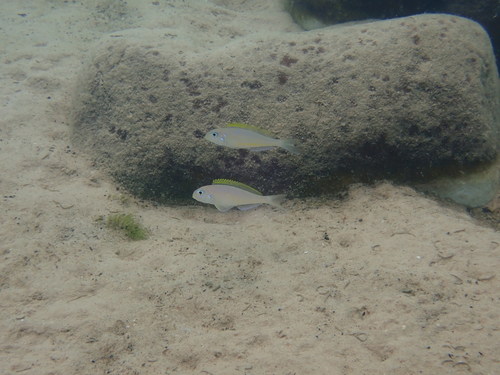
The ground color is a pale, reflective silver to pearly grey that mirrors the sandy bottom it hovers over—useful camouflage for a fish that spends its day in open water with little cover. Depending on the population, the fins and flanks carry varying amounts of pale blue, lilac, or the soft yellow that earned the common name. Sexual dimorphism is subtle: there is no reliable difference in size or shape, though males often show marginally stronger fin color, and experienced keepers sex mature fish by venting (the female's genital papilla is broader than the male's). Against look-alike congeners such as X. spilopterus, the safest identifier in the hobby is usually the documented collection locality rather than any single field mark.
Range & habitat
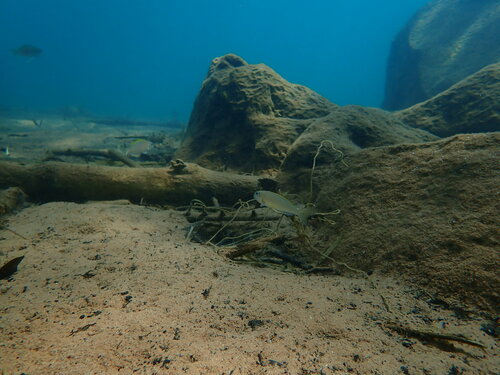
Xenotilapia flavipinnis is endemic to Lake Tanganyika and is distributed essentially lake-wide, with records from all four riparian nations—Burundi, the Democratic Republic of the Congo, Tanzania, and Zambia. It is a creature of the sandy and "intermediate" zones, the open sand flats and the transitional ground where sand meets scattered rock, and it occurs most commonly in the shallows though it ranges into deeper water as well.
The relevant water chemistry is the hard, alkaline signature of the lake itself: FishBase gives a pH band of 8.0 to 9.0 and a hardness range of roughly 9 to 19 dH, with temperatures around 75 to 81 F (24 to 27 C). Tanganyika is famously clear, stable, and oxygen-rich in its upper layer, and X. flavipinnis is adapted to exactly that—keepers consistently report it as intolerant of poor or fluctuating water quality. Because it depends on a clean sand substrate to feed, the species is tied closely to the lake's littoral sand habitat rather than to its rocky reefs.
Ecology & diet
The yellow sand cichlid is a benthic micro-carnivore, assigned a trophic level near 3.5 in FishBase. It feeds by taking mouthfuls of the upper layer of sand, sifting the grains across its gill rakers, and filtering out the small crustaceans, micro-invertebrates, and other meiofauna living in the sediment—then ejecting the cleaned sand. Hobbyists who keep it often describe the action as almost goby-like, the fish methodically working the substrate grain by grain.
In the wild this is a profoundly social behavior. Outside the breeding season X. flavipinnis gathers into foraging schools that can number from dozens to several hundred individuals, drifting across the sand flats and turning over the substrate together. That feeding guild—the open-sand sifters—is a distinct and crowded niche in Tanganyika, which is part of why these fish are so sensitive to competition from other substrate-working species. As small shoaling fish they are, in turn, prey for the lake's larger predatory cichlids and for the pelagic hunters that patrol the inshore zone.
Behavior & breeding
Socially, X. flavipinnis lives a double life. Juveniles and non-breeding adults school peacefully, but as fish mature they pair off, and a pair will carve out and defend a patch of sand against rivals. It is gentle toward unrelated species; the aggression that matters is conspecific, directed at other yellow sand cichlids contesting territory, and it can be intense enough that crowded or under-decorated tanks turn fatal for the losers.
The breeding biology is the species' most remarkable trait. Unlike most Xenotilapia—and unlike the great majority of Tanganyikan cichlids, which are maternal mouthbrooders—X. flavipinnis is a biparental mouthbrooder and serially monogamous. The classic account comes from Yasunobu Yanagisawa's 1986 study in the Japanese Journal of Ichthyology: the female takes up the fertilized eggs first and broods them for roughly a week to twelve days, then transfers the developing young into the male's mouth, which continues incubation until the fry are released at about two to two-and-a-half weeks. Both parents then guard the free-swimming brood—reported at up to around 40 fry—for roughly another two weeks, with the young darting back into the male's mouth at any sign of danger. Research on the species has highlighted the male's leading role in brood defense, which lets the female recover condition faster and re-spawn sooner; pairs frequently stay together across several breeding cycles. Field observations have also documented occasional "farming out," where free-swimming fry are passed to or mixed with another pair's brood.
In the aquarium
X. flavipinnis is a rewarding fish for an intermediate-to-experienced Tanganyika keeper, but it is unforgiving of shortcuts. The non-negotiables are a deep bed of fine, non-sharp sand (so the fish can sift without abrading their gills), a generous open footprint, and pristine, stable water with frequent partial changes—keepers repeatedly note that these fish sulk and stop feeding when conditions slip. A tank of at least 36 in (around 200 L) suits a single pair; more fish or more pairs need substantially more floor space and well-placed rocks to break sightlines.
Stocking is the part people get wrong. The fish are nervous and are notorious jumpers, so a tight-fitting lid is essential. Buy a group—six or more, ideally ten or more—let a pair form, and be prepared to remove surplus fish, because subordinate individuals that are bullied off the substrate can decline and die quickly from stress. For tankmates, the best companions occupy other parts of the water column and don't compete for the sand: open-water shoalers such as Cyprichromis and Paracyprichromis are the classic pairing. Avoid other active sand-sifters and any boisterous or aggressive cichlid that will out-compete or intimidate them. Captive breeding happens but is described by keepers as inconsistent; the fish seem to spawn best when undisturbed, and an aquascape with visual breaks helps multiple pairs coexist by giving a dominant pair a subordinate to chase rather than a wall to corner victims against.
Conservation
Xenotilapia flavipinnis is assessed as Least Concern on the IUCN Red List (Bigirimana, 2006; assessment e.T60714A12397211), on the grounds that it is widespread throughout Lake Tanganyika with no major lake-wide threats identified; its population trend is listed as unknown. The species is harvested only modestly for the aquarium trade—much of what reaches hobbyists is wild-collected or F1—and that pressure is not currently considered a conservation concern. The one threat the assessment does flag is sedimentation, which matters a great deal for this particular fish.
That is where the species' "Least Concern" status has to be read against the strain on the lake as a whole. As a shallow sand-flat specialist that feeds by sifting clean substrate, X. flavipinnis is directly exposed to the shoreline deforestation and erosion that wash silt onto the inshore bottom; sediment that smothers sand degrades exactly the feeding habitat it depends on. Layered on top of that are basin-scale pressures documented in the limnological literature. O'Reilly et al. (2003, Nature, DOI 10.1038/nature01833) showed that a warming climate has increased the lake's stratification and weakened the mixing that lifts nutrients to the surface, with sediment records implying roughly a 20% drop in primary productivity and on the order of a 30% reduction in fish yields. Cohen et al. (2016, PNAS, DOI 10.1073/pnas.1603237113) extended the picture, finding that reduced mixing has shrunk the oxygenated benthic habitat in their study areas by about 38%. These pressures are felt alongside the heavy commercial fishery for the pelagic clupeids (Stolothrissa and Limnothrissa) and Lates that feeds the four nations sharing the lake, a system now coordinated through the Lake Tanganyika Authority. None of this places X. flavipinnis itself in immediate danger—the honest summary is that the fish is secure while the lake it depends on is under real and growing stress, and a sand-flat species is squarely in the path of the sedimentation that stress brings.
Sources
- Xenotilapia flavipinnis (Yellow Sand Cichlid) — FishBase species summary
- Eschmeyer's Catalog of Fishes — Xenotilapia flavipinnis (species record)
- Eschmeyer's Catalog of Fishes — California Academy of Sciences
- Bigirimana, C. 2006. Xenotilapia flavipinnis. IUCN Red List of Threatened Species 2006: e.T60714A12397211
- Yanagisawa, Y. 1986. Parental care in a monogamous mouthbrooding cichlid Xenotilapia flavipinnis in Lake Tanganyika. Japanese Journal of Ichthyology 33(3):249–261 (cited in Sefc 2011)
- Sefc, K.M. 2011. Mating and Parental Care in Lake Tanganyika's Cichlids. International Journal of Evolutionary Biology
- Koblmüller et al. 2007. Evolutionary relationships in the sand-dwelling cichlid lineage of Lake Tanganyika (convergent biparental mouthbrooding)
- Xenotilapia flavipinnis 'Izinga Island' — species, biotope & breeding profile (tanganyika.si)
- Tribe Ectodini — Cichlid Room Companion
- Yellow Sand Cichlid (Xenotilapia flavipinnis) — Maidenhead Aquatics / Fishkeeper.co.uk care profile
- Yellow sand cichlid (Xenotilapia flavipinnis) — Fishipedia species sheet
- Xenotilapia flavipinnis — keeping & breeding thread (community/anecdotal) — community/anecdotal
- Return to Tangs, making Xenotilapia work — keeper experience thread (community/anecdotal) — community/anecdotal
- O'Reilly, C.M. et al. 2003. Climate change decreases aquatic ecosystem productivity of Lake Tanganyika. Nature 424:766–768 (DOI 10.1038/nature01833)
- Cohen, A.S. et al. 2016. Climate warming reduces fish production and benthic habitat in Lake Tanganyika. PNAS 113(34):9563–9568 (DOI 10.1073/pnas.1603237113)
- Lake Tanganyika: Status, challenges, and opportunities for research — review (ScienceDirect)