
Taxonomy & naming
This fish has worn more generic names than almost any cichlid in the lake, and which one is "correct" still depends on whose checklist you consult. George Albert Boulenger described it in 1898 as Ectodus melanogenys, from specimens taken at Moliro Bay in what is now the Democratic Republic of Congo. The species epithet comes from the Greek melas ("black") and genys ("cheek" or "jaw"), and English hobby writers render it as the black-chinned xenotilapia, a nod to the dark bar on the gill cover of displaying males. The genus name Xenotilapia combines the Greek xenos ("strange") with tilapia.
The shuffling began almost at once: Boulenger himself moved the fish to a new genus, Enantiopus, in 1906; Max Poll transferred it to Xenotilapia in 1951; Greenwood (1978) and Poll again (1986) returned it to Enantiopus; and Takahashi's 2003 revision of Xenotilapia placed it back there once more. That is where the disagreement now sits. FishBase and GBIF both list the fish under Xenotilapia melanogenys (following Takahashi 2003), while Eschmeyer's Catalog of Fishes records its current status as Enantiopus melanogenys (following Maréchal and Poll, and Konings 2015/2019). The two names refer to exactly the same fish; an aquarist will most often see it labeled Enantiopus on import lists. It belongs, regardless of genus, to the tribe Ectodini, the Tanganyikan radiation of sand- and open-water mouthbrooders that also contains the featherfins and the other Xenotilapia sand-sifters. A close, still-undescribed relative traded as X. sp. "kilesa" occupies the western Congolese shore.
Appearance
X. melanogenys is built for life over open sand: a very elongate, low-bodied cichlid with a body roughly five to six times as long as it is deep and a noticeably long snout. It reaches about 6 in (15 cm) total length in the wild and can run slightly larger in aquaria, with females staying a little smaller than males. For most of the year the sexes look alike, both clad in a plain reflective silver that mirrors the sand and makes the schooling fish hard for predators to pick out against a sunlit bottom.
The transformation comes with breeding. A displaying male is, in the words of the Cichlid Room Companion account, "a sparkling jewel" — the body lights up with iridescent green, blue and purple, the unpaired and pectoral fins flash yellow, blue and black, and the male flares his gill covers to show a yellow cheek crossed by a dark bar. From the lookalike X. sp. "kilesa" it is separated by its longer lower jaw and snout, and by the absence of the bright yellow throat, chin and lips that the kilesa males show (Konings 1998). Color varies only modestly across the species' wide range — sexually active males may lean more bluish, greenish or purple from place to place, and the number and size of the black spots in the dorsal fin differs between populations.
Range & habitat
X. melanogenys is endemic to Lake Tanganyika and is distributed almost lake-wide, found along the shores of all four riparian nations between roughly 3°S and 9°S. The one conspicuous gap in its range is the western Congolese shore between Kalemie and the Kavala Islands, which is held instead by its undescribed relative X. sp. "kilesa" (Konings 1998).
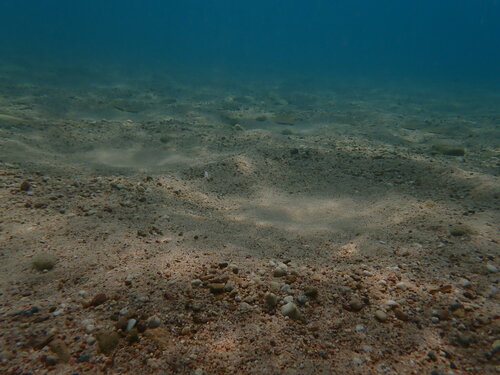
The habitat is consistent and easy to picture: broad, open expanses of sand rather than rock. Outside the breeding season the schools live over deeper sand, with a recorded maximum depth of about 130 ft (40 m); when breeding sets in they move up into much shallower, brighter water, which is where divers and aquarists most often see the spectacular nesting arenas. Like the rest of the lake's littoral fish it lives in hard, alkaline, oxygen-rich water; FishBase records a pH of about 7.5-8.5, hardness up to roughly 20 dH, and temperatures around 77°F (25°C) and up. This tight tie to the open sand flat — not the celebrated rocky reef — is the single most important fact about the species, and it places X. melanogenys in the lake's sand-dwelling guild alongside Callochromis, Aulonocranus and the other Xenotilapia.
Ecology & diet
Functionally, this is a sand-sifting micro-carnivore. The schools work methodically over the substrate, taking in mouthfuls of sand and straining out the small animals living among the grains. Max Poll's classic 1956 study of the lake's cichlids found the stomachs packed with copepods and ostracods, and shrimps have also been recorded; FishBase places the fish at a trophic level near 3.2, the low-carnivore band typical of an invertebrate sifter rather than an algae grazer. Its slender body and long snout suit that picking, probing style of feeding over flat sand.
In the community it is a small, abundant forager that converts the meiofauna of the sand flats into fish biomass and, in turn, feeds the lake's larger piscivores — its safety lies in numbers on terrain that offers nowhere to hide. One genuinely interesting wrinkle of its biology is the cohesion of the school: Konings reports that the members of a single school tend to stay together for life. Because a school forms when a brood of females releases their fry more or less simultaneously, its members are all roughly the same age and later come into breeding condition together — which is what makes the synchronized colonial spawning possible. The smaller Xenotilapia ochrogenys has even been observed attaching its own breeding to the colonies of X. melanogenys.
Behavior & breeding
Out of the breeding season X. melanogenys is a peaceable, gregarious schooler with little of the territorial aggression that defines the lake's rock cichlids. The drama is reserved for spawning, and it is worth the wait. The fish is a colonial, lek-breeding, polygamous maternal mouthbrooder: males gather to build breeding arenas of saucer-shaped sand nests set right next to one another, each nest roughly 20 in (50 cm) across, often with a small central pit about 6 in (15 cm) wide where spawning actually happens. There is a documented geographic twist here — Eysel (1990) noted that males from Zambia build saucer nests without the central pit, while males from Burundi dig the pit.
Courtship is pure theater. Rivals are chased off with every fin erect, but a passing female is wooed with the fins clamped and the male lying almost on his side in his nest, flashing his colors and extending his buccal cavity in what looks like a mimicry of a brooding female. When a female enters, the pair circle, she lays a few eggs, the male fertilizes them, and she takes them up into her mouth. Only the female broods. Konings reports clutches of roughly 30 to 80 eggs with fry released after about three weeks; aquarium keepers tend to report smaller broods, on the order of 15 to 25 fry released around four weeks (about 28 days) after spawning, with no parental care once the fry are free-swimming. As with many open-arena spawners these are the headline facts; exact clutch sizes and brooding times shift with female size and conditions, so treat the numbers as ranges rather than constants.
In the aquarium
This is a specialist's fish rather than a beginner's, and the requirements are non-negotiable. It needs a long, open-footprint tank with a deep bed of fine sand and very little else; experienced keepers describe a 4 ft (about 55 US gal / 208 L) tank as a bare minimum for a group and a 5 ft (150 cm) or longer tank as the real target, because the point of keeping these fish is to give several males room to build their nests side by side. Keep them in a group of at least eight, with two or more males so they display and compete, and skip the gravel — sand is essential for the nest-building that is the whole show. Bright lighting matters too: keepers consistently report that a dim tank simply will not trigger breeding, and that males jockey for the brightest spot on the bottom.
Water should mirror the lake — hard, alkaline, well-oxygenated, around pH 8 or above and roughly 75-81°F (24-27°C). Despite their lack of aggression they are nervous, flighty fish: a sudden movement at the glass or the lights snapping off can send them bolting, and in the wild their escape is a sprint to deeper water that a tank cannot provide, so they risk crashing into glass or rockwork. A tight lid and a calm location help. The honest mistake to avoid is stocking them with pushy rock-dwellers, which out-compete them for floor space and leave them stressed and washed-out; the keepers who succeed pair them only with peaceful open-water species such as Cyprichromis or Paracyprichromis, or keep them in a species tank. Feed a carnivore's diet — frozen or live invertebrates such as cyclops, mysis, artemia and non-bloodworm mosquito larvae condition them far better than flake alone, though they will greedily take prepared foods. Reported lifespan in the hobby is on the order of three to five years, and they generally begin spawning at about a year old.
Conservation
On the IUCN Red List, the species (assessed under the name Enantiopus melanogenys) was reclassified from Data Deficient to Least Concern in the 2025-2 update — a reassessment that reflects better information rather than a recovering population. That status is consistent with what is known about the fish: it is endemic but distributed almost lake-wide, common to very abundant where it occurs, and judged by FishBase to have low fishing vulnerability and high biological resilience. It is collected for the aquarium trade (FishBase lists its aquarium use as commercial) and taken incidentally in local fisheries, but neither pressure is concentrated enough to threaten a widespread, fast-reproducing sand-sifter at present.
That said, "Least Concern" describes the species, not the lake it depends on, and Lake Tanganyika is under real strain. Warming surface waters are stabilizing the lake's stratification and weakening the seasonal mixing that lifts nutrients from the deep: O'Reilly and colleagues (2003, Nature) inferred a roughly 20% decline in primary productivity, with an implied drop in fish yields on the order of 30%, and Cohen and colleagues (2016, PNAS) used sediment records to link the warming to losses of commercially important fish and to a substantial shrinkage of oxygenated bottom habitat. Sedimentation from deforested catchments has long been recognized as a degrader of the shallow littoral (Cohen et al. 1993), and a four-nation pelagic fishery for clupeids (Stolothrissa and Limnothrissa) and Lates feeds millions of people across Burundi, Tanzania, the DRC and Zambia, managed — imperfectly — through the Lake Tanganyika Authority. For X. melanogenys specifically, the sharpest of these pressures is the inshore one: as a fish of the open sandy shallows, it is exposed to shoreline sedimentation smothering the clean sand its nesting and feeding require, more than to the offshore warming story that bears hardest on deepwater and pelagic species. The candid summary is that this is a secure species today, living in a lake whose long-term trajectory deserves watching.
Sources
- Eschmeyer's Catalog of Fishes — melanogenys (Ectodus), current status Enantiopus melanogenys (Boulenger 1898)
- FishBase — Xenotilapia melanogenys summary
- GBIF — Xenotilapia melanogenys (accepted; Enantiopus melanogenis a synonym), taxon key 2369805
- Andersen, T. (2005) — A sparkling jewel: Xenotilapia melanogenys (Boulenger, 1898), Cichlid Room Companion
- Takahashi, T. (2003) — Systematics of Xenotilapia (Perciformes: Cichlidae) from Lake Tanganyika, Ichthyological Research 50(1):36-47
- Ronco et al. (2019) — The taxonomic diversity of the cichlid fish fauna of ancient Lake Tanganyika
- IUCN Red List 2025-2, Table 7 — Species changing status: Enantiopus melanogenys (DD to LC)
- O'Reilly et al. (2003) — Climate change decreases aquatic ecosystem productivity of Lake Tanganyika (Nature)
- Cohen et al. (2016) — Climate warming reduces fish production and benthic habitat in Lake Tanganyika (PNAS)
- Britton (thesis, UCL) — Assessing human impacts on Lake Tanganyika cichlid fish (trophic/habitat guild of E. melanogenys)
- Seriously-Fish-style profile — The Aquarium Wiki: Black Chinned Xenotilapia (Xenotilapia melanogenys)
- tanganyika.si — Enantiopus melanogenys localities, biotope and images
- AquariaCentral — Cichlid of the Month: Enantiopus melanogenys (keeper account, nest-building, broods) — community/anecdotal
- Cichlid-Forum — Enantiopus melanogenys tankmates (community discussion) — community/anecdotal
- Reddit r/Cichlid — Enantiopus/Xenotilapia melanogenys keeper experiences — community/anecdotal
- Cichlid-Forum — Sand-sifter & Cyp tank advice (Enantiopus stocking discussion) — community/anecdotal