
Taxonomy & naming
The species was described by the prolific Belgian-British ichthyologist George Albert Boulenger in 1914, working from fish collected on the Stappers expedition to lakes Tanganyika and Moero. Boulenger originally placed it in the genus Enantiopus, as Enantiopus ochrogenys, with the types coming from Kilewa Bay on the Congolese (DRC) shore of the lake; the surviving syntypes are held in London (BMNH) and at the Royal Museum for Central Africa in Tervuren (MRAC 11549). The Catalog of Fishes and FishBase both list the valid name today as Xenotilapia ochrogenys (Boulenger, 1914), the move into Xenotilapia following the genus-level work of Maréchal and Poll and later authors. The genus name blends the Greek xenos, "strange," with tilapia, a southern-African vernacular for these fishes; the species epithet ochrogenys points to the ochre or yellowish cheek of breeding males.
The most important taxonomic wrinkle is recent and matters for anyone reading older sources. For decades "Xenotilapia ochrogenys" was treated as a single, lake-wide species with many regional color forms. That broad concept has since been split: the southern populations were separated out as Xenotilapia singularis, leaving X. ochrogenys proper restricted to the northern two-thirds of the lake. The two are close siblings, sympatric (co-occurring) in a narrow overlap zone around Kalya in Tanzania and between Moba and Kalubamba on the Congolese coast, which is exactly the situation that confirms they are distinct biological species rather than ends of a cline. The cleanest field separation is in the males: X. singularis males carry three to five conspicuous black blotches along the flank, which X. ochrogenys males lack. Because the hobby trade still ships many of these fish under the old name — and under trade tags such as 'Ndole,' 'Mzuri' (Swahili for "beautiful") and various locality labels — a fair number of tanks sold as "ochrogenys" are in fact singularis, a point experienced keepers raise repeatedly.
Within the lake's fauna, ochrogenys belongs to the tribe Ectodini, the great radiation of sand- and open-water cichlids that also contains Cyathopharynx, Ophthalmotilapia, Enantiopus and the rest of Xenotilapia. Molecular work on the tribe (Kidd and colleagues, 2012) places Xenotilapia and Enantiopus as closely intertwined lineages — Enantiopus is in fact nested inside Xenotilapia genetically — and shows that brood-care strategy has flipped back and forth across the group several times over the last few million years.
Appearance
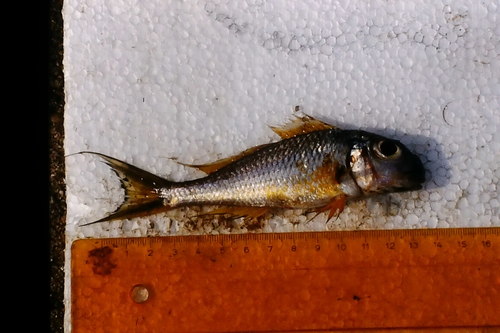
Out of breeding dress, X. ochrogenys is an unshowy fish: a slim, slightly elongate, silvery-sand body that all but vanishes against the pale lakebed it lives on. This camouflage is the point. The IUCN account notes that non-breeding males share the females' sandy, silvery coloration precisely because it gives them optimum concealment on open sand, where there is nowhere to hide from above. The species is small — FishBase gives a maximum of about 4.3 inches (11 cm) total length, while field and hobby references describe males reaching roughly 4.5 to 4.7 inches (about 12 cm) and females staying a touch smaller. Juveniles reach 7 to 8 cm in their first year and are sexually mature at that size, so this is a fast-maturing, short-lived fish by cichlid standards.
The transformation comes with breeding. A ripe, displaying male develops intense coloration — the yellow-ochre cheek that gave the fish its name, along with brighter fins and body sheen — which one biotope account interprets as an adaptation to the very shallow, wave-stirred water the species favors: in turbid, sun-dappled shallows a vividly colored male is simply easier for a female to find and assess. This pronounced difference between the sexes, strong in breeding condition and faint outside it, is the dichromatism typical of a polygynous fish. The single most useful look-alike check is against the southern sibling X. singularis: if a male shows a row of bold black side-blotches, it is singularis, not ochrogenys.
Range & habitat
X. ochrogenys is endemic to Lake Tanganyika — found in that lake and nowhere else on Earth — and, since the split from X. singularis, is confined to roughly the northern two-thirds of the basin. The IUCN assessment, following Konings, gives the southern limits of its range as Kalubamba on the Congolese (DRC) side and Kalya in Tanzania, and lists it from Burundi, the DRC and Tanzania. It does not reach the Zambian far south, which is singularis territory.
This is a shallow-water sand specialist in the most literal sense. It lives over fine sandy bottoms, often in sheltered bays, and is most common in very shallow water — typically the top 65 feet (20 m) or so, and only occasionally as deep as about 165 feet (50 m). It will sometimes use beds of the aquatic plant Potamogeton as cover. That preference for the warm, sunlit, wave-washed sand shelf, rather than the rocky reefs that hold most of the lake's flashier cichlids, defines almost everything about the fish, from its camouflage to its feeding to its exposure to human pressures.
Like all Tanganyikan cichlids it is built for hard, alkaline, thermally stable water. FishBase records a pH at or above 7.0 and a hardness of around 10 dH or more, with temperatures of about 75 to 79 degrees Fahrenheit (24 to 26 degrees Celsius) — the familiar Tanganyikan envelope. One nuance the hobbyists add is worth keeping: because ochrogenys lives in the shallowest, most exposed zone, its home water naturally swings in temperature and chemistry faster than the deeper, more buffered habitat of a fish like Cyathopharynx, which may be part of why keepers find it comparatively hardy.
Ecology & diet
Functionally, X. ochrogenys is a sand-sifter, the feeding style that defines its tribe. It forages by gliding low over the bottom, taking mouthfuls of sand, sorting the edible from the inert inside the mouth and expelling the clean sand back out through the mouth and gill openings. What it is after is the small invertebrate life buried in and on the sediment: chironomid (midge) larvae, aquatic worms, ostracods and copepods (tiny crustaceans) make up the bulk of the diet according to biotope accounts, and FishBase places it at a trophic level of about 3.2 — a modest carnivore working the bottom of the food web rather than a predator of other fish.
It does this socially. Outside the breeding season the species gathers into foraging schools of up to about thirty individuals that move together over the sand, and remarkably, the IUCN account notes that most members of a given school stay together for life. That makes it a conspicuous part of the shallow sand community — a shoal of small silver fish constantly working the lakebed — and it forages alongside other sand-dwellers rather than defending feeding turf. Its ecological role is straightforward: a shallow-water grazer of the meiofauna and macroinvertebrates that the sand flats produce, and in turn prey and protein for larger predators and, as it happens, for the people who fish the shore.
Behavior & breeding
For most of the year this is a peaceable, gregarious schooling fish with little obvious aggression. The territorial, combative side of X. ochrogenys appears only around spawning, and then briefly and intensely. The breeding system, described in detail in the Konings-based account the IUCN assessment draws on, is a polygynandrous (multi-mate) one: as the season opens, males stop feeding and concentrate entirely on reproduction, defending temporary territories and, in this and closely related forms, building sand-scrape spawning sites — small heaps of sand arranged in a ring around a shallow central depression — to attract females. Breeding happens in short, concentrated episodes that may last less than a week. A male may spawn with several females in a single day, and, crucially, a single female's clutch is typically fertilized by two or three different males. Within a short window essentially all the females in the population are carrying eggs at once.
From there it is maternal mouthbrooding. The female incubates the eggs and then the larvae in her mouth for roughly three weeks, after which the small fry are released — and large schools of brooding females are often seen gathered near the males' breeding arenas, with synchronized release across the group. Clutch size is small, commonly cited at 10 to 40 eggs, and breeding peaks in the rainy season from about December to May, though it can occur year-round. The young are sexually mature in about a year, in time for the next season.
The brood-care detail deserves a careful note, because the sources are not perfectly aligned. FishBase's biology summary says simply that "females brood their young in the mouth," while its reproduction page states that eggs and larvae "are mouthbrooded by both parents" — an internal inconsistency that reflects the genus's mixed nature. Xenotilapia is one of the rare cichlid lineages containing both biparental mouthbrooders (where male and female share the brooding) and maternal-only mouthbrooders, and the care strategy has switched repeatedly over the group's evolution (Kidd et al., 2012). For X. ochrogenys specifically, the genetic and behavioral study by Kidd and colleagues classified sampled fish (from Kavalla, Congo) as maternal mouthbrooders, and the field account of promiscuous, multiply-sired clutches with females congregating to brood points the same way. We therefore treat ochrogenys as a maternal mouthbrooder within a promiscuous mating system, while flagging that it sits in a genus where the alternative strategy is genuinely present in close relatives. One more field observation is worth recording: the species has been documented sharing spawning arenas with the closely related sand-dweller Enantiopus melanogenys, a reminder of how tightly these two lineages are entwined.
In the aquarium
This is a rewarding but space-hungry fish, and the honest starting point is the tank. A four-foot aquarium is the practical floor, and experienced keepers are blunt that it is only enough for a single dominant male with several females; a six-foot tank "makes a world of difference," because breeding males try to claim very large territories and a confined male will harass everything in reach. Specialist references suggest something in the range of 80 to 100 US gallons (300 to 400 liters) with a minimum length of around 130 to 150 cm for a long-term adult group. Buy a group — eight or more, ideally a dozen — let them sort out a dominant male, and be prepared to remove surplus males, which is where most of the trouble starts. The genuine consensus from keepers is that fatal male-on-male fighting, not delicacy, is the main way colonies fail.
The setup should match the biotope: a deep bed of fine sand, open swimming space, excellent water quality, and little or no rock — a few smooth stones can help break a big tank into territories and sight-lines, but this is not a rockwork fish. Keep the water hard and alkaline (keepers run pH around 8.5 successfully) and warm, near 78 degrees Fahrenheit (about 26 degrees Celsius), and prioritize low nitrate through generous water changes; keepers consistently link clean, low-nitrate water to avoiding the wasting "slimming disease" that can afflict Tanganyikan sand-sifters, and several report that a large water change itself triggers spawning. Two practical cautions recur: these fish are determined jumpers, so a tight lid is essential, and they want the substrate to themselves, so they pair badly with other bottom-dwellers (shell-dwellers, lamprologines) competing for the same floor.
For tankmates, the time-tested answer is open-water company that stays out of the sand: Cyprichromis and Paracyprichromis schooling in the upper tank are the classic match. The fish themselves are not picky feeders — they take quality prepared and frozen foods readily. Breeding is achievable but humbling: spawns are small, the fry are famously tiny and well camouflaged, first-time mothers frequently eat the clutch, and several keepers note that females seem to have only a two-to-three-year productive window, so a colony benefits from growing out replacements. None of this is beginner territory, but for an intermediate Tanganyikan keeper with a long tank, a busy, shimmering school of sand-sifters with a brief annual fireworks display of breeding color is an unusually engaging centerpiece.
Conservation
X. ochrogenys is currently assessed by the IUCN Red List as Least Concern (assessed 28 April 2025; Sibomana & Fernando 2025, assessment e.T272648574A272648950), the same category it held in an earlier assessment. The reasoning is simple: it is widespread across the northern two-thirds of the lake and, away from beach-seine grounds, still a common fish of the shallow sandy habitat. Its population size and trend are formally unknown. The one threat the assessment singles out is over-fishing by local fishers using beach seines, which sweep the shallow sand zone the species lives in; it is also taken in modest numbers for the ornamental trade. Neither pressure is currently judged enough to move it out of Least Concern, and the assessors' main recommendation is more research on its population.
That clean status for the species sits inside a lake under real and growing strain, and for a shallow sand specialist the lake-level pressures are not abstract. Lake Tanganyika is warming and mixing less. O'Reilly and colleagues (2003, Nature) used sediment-core carbon-isotope records to argue that this warming-driven stratification has cut primary productivity by roughly 20 percent over the past century, implying something like a 30 percent decline in potential fish yield — with climate, more than fishing, as the primary driver. Cohen and colleagues (2016, PNAS) reconstructed the consequence for the lakebed directly, finding that reduced mixing has depressed algal production and shrunk the oxygenated benthic habitat by about 38 percent in their study areas, with declines in fish and molluscs tracking the warming rather than the nets. A fish that feeds on sand-dwelling invertebrates and lives in the productive, oxygenated shallows is exposed to exactly that squeeze on benthic productivity and habitat.
The other basin-wide pressure that bears on it is sediment. Much of Tanganyika's catchment has been deforested, and silt washing off cleared slopes settles onto the nearshore bottom, degrading the clean sand flats and the invertebrate communities a sifter like ochrogenys depends on — the same sedimentation process documented to reduce shallow-water diversity elsewhere in the lake. All of this plays out across a shared waterbody managed, since the 2003 Convention on the Sustainable Management of Lake Tanganyika and its Lake Tanganyika Authority, by four nations — Burundi, the DRC, Tanzania and Zambia — whose coordinated reach over fishing, land use and climate adaptation remains thin and underfunded. The accurate summary is the modest one: X. ochrogenys itself is not threatened today, but it is fully exposed to the slow, lake-scale changes — warming, lost benthic productivity, shoreline sedimentation, and intensive shallow-water netting — that the science has been documenting for two decades, and its future will follow the health of the lake as a whole.
Sources
- Eschmeyer's Catalog of Fishes — ochrogenys, Enantiopus (Boulenger 1914), valid as Xenotilapia ochrogenys
- FishBase — Xenotilapia ochrogenys (Boulenger, 1914)
- FishBase — Reproduction summary, Xenotilapia ochrogenys
- GBIF — Xenotilapia ochrogenys (Boulenger, 1914), accepted taxon (speciesKey 2369825)
- Kidd, Duftner, Koblmüller, Sturmbauer & Hofmann 2012 — Repeated Parallel Evolution of Parental Care Strategies within Xenotilapia (PLoS ONE 7(2):e31236)
- O'Reilly et al. 2003 — Climate change decreases aquatic ecosystem productivity of Lake Tanganyika (Nature 424:766–768)
- Cohen et al. 2016 — Climate warming reduces fish production and benthic habitat in Lake Tanganyika (PNAS 113(34):9563–9568)
- Lake Tanganyika: Status, challenges, and opportunities for research (J. Great Lakes Research, basin review)
- IUCN Red List — Xenotilapia ochrogenys (Sibomana & Fernando 2025; e.T272648574A272648950), Least Concern
- Cichlid Room Companion — Xenotilapia ochrogenys species profile (Thomas Andersen, curator)
- tanganyika.si — Xenotilapia ochrogenys (biotope, diet, breeding, distribution, after Konings)
- tanganyika.si — Xenotilapia singularis 'Ndole' (sibling species; ochrogenys/singularis split detail)
- PlanetCatfish Cat-eLog — Xenotilapia ochrogenys (type locality, IUCN summary)
- Cichlid-Forum — 'Xenotilapia Ochrogenys Ndole - First Spawn' (keeping/breeding experience, community/anecdotal) — community/anecdotal
- Cichlid-Forum — 'General Info Help: Xeno. Ochrogenys Ndole' (sizes, tank size, tankmates, breeding, community/anecdotal) — community/anecdotal
- Australian Cichlid Association forums — 'Ochrogenys Ndole' (keeper photos/experience, community/anecdotal) — community/anecdotal