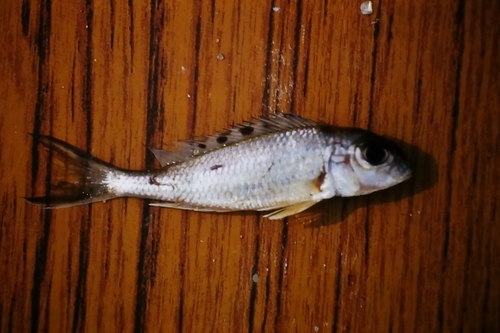


Taxonomy & naming
Xenotilapia ornatipinnis was described by the Belgian-British ichthyologist George Albert Boulenger in 1901, in the Annals and Magazine of Natural History, from material collected at Kibwesi on Lake Tanganyika; the syntype series rests in the Natural History Museum, London (BMNH) with a specimen in Paris (MNHN). Eschmeyer's Catalog of Fishes lists the name as valid, and it has been carried forward unchanged through the standard references — Maréchal & Poll's CLOFFA treatment (1991), Takahashi's tribal revision (2003), and Konings' field guides (2015, 2019).
The genus name blends the Greek xenos, "strange," with tilapia (itself from a Tswana word for fish), a nod to how oddly these slender, big-eyed cichlids sit against the typical tilapia body plan. The epithet ornatipinnis joins Latin ornatus ("adorned") and pinna ("fin") — "ornate-finned." In the trade it is usually sold simply under its scientific name, sometimes tagged with a collection locality such as 'Burundi' or 'Karago'; the hobby moniker "pearl from the deep" comes from a Cichlid Room Companion profile by Juan Miguel Artigas Azas.
Xenotilapia sits within the tribe Ectodini, an endemic Tanganyikan radiation that ichthyologists treat as the lake's most ecologically varied sand-and-mud lineage. Within that tribe the genus is large and almost certainly not monophyletic in the way the name implies — it spans schooling open-sand fish, pair-bonding specialists, and deepwater forms — and several keepers and researchers expect future work to split it. The lake as a whole holds on the order of 200-plus valid cichlid species, and Xenotilapia is one of its more speciose sand-dwelling genera.
Appearance
This is a modest-sized, streamlined cichlid. FishBase gives a maximum of about 5 in (12.5 cm) total length, and hobby sources converge on the same range, with dominant males reaching roughly 5 in (13 cm) and females staying smaller, often nearer 4 in (10 cm). The body is silvery to grey-beige on the flanks — understated camouflage against pale sand — with the genus's hallmark large eyes, an adaptation read by hobbyists and authors alike as a sign of life in dim, deeper water.
The interest is in the fins, as the name promises. Males develop yellow and sometimes black marks in the dorsal, anal, and caudal fins, and the dorsal can flush a purplish, oil-on-water iridescence that shifts with the angle of the light. Sexual dimorphism is real but subtle: males run a bit larger and finnier and color up most strongly, while females are plainer. That low-key dimorphism, plus genuine geographic variation between populations, makes confident field identification harder than for the lake's gaudier rock-cichlids — these are fish best separated by locality data and fin detail rather than a single diagnostic flash of color.
Range & habitat
Xenotilapia ornatipinnis is endemic to Lake Tanganyika and, per the IUCN assessment, the major affluent river deltas around it; it is recorded from all four lake nations — Burundi, the Democratic Republic of the Congo, Tanzania, and Zambia. FishBase places it broadly across the lake (roughly 3°S to 9°S); some hobby accounts emphasize the northern half, which may reflect collection effort as much as true range.
This is an open-sand fish, not a rock-dweller. It lives over the sandy and intermediate bottoms below the rocky littoral, and the depth band is where it earns the "deep" in its nickname. The IUCN assessment cites an upper limit near 33 ft (10 m) and a lower limit near 197 ft (60 m); hobby and collecting accounts push the extreme considerably deeper, with reports down to around 525 ft (160 m). Several observers note a daily vertical shuffle — deeper by day, shallower at night. As a Tanganyikan endemic it lives in hard, alkaline water: the lake runs high in pH (around 8.5–9) and well buffered, the in-situ conditions any keeper has to reproduce.
Ecology & diet
Functionally, X. ornatipinnis is a benthic invertebrate feeder that works the sand. FishBase places it at a trophic level near 3.1 — a low-order carnivore — and lists small crustaceans and insect larvae among its food; hobby natural-history accounts specifically name copepods and dipteran ("mosquito") larvae. Like many sand-sifting Ectodini, it takes mouthfuls of substrate and sorts edible meiofauna from grit, a feeding mode that ties the fish tightly to clean, well-oxygenated sand.
Its schooling habit is part of its ecology rather than just behavior: FishBase records that it forms schools over sandy bottoms, and grouping over open ground is a sensible anti-predator strategy where there is no rock to bolt into. In community terms it is a mid-water-to-bottom forager of the sand zone, neither apex predator nor algae-grazer, and its low FishBase fishing-vulnerability score is consistent with a small, fast-maturing fish of no real food-fishery interest.
Behavior & breeding
Xenotilapia ornatipinnis is a biparental mouthbrooder — the breeding strategy that makes the genus scientifically interesting. After a pair spawns on the sand, the eggs are fertilized and quickly taken up and brooded orally; in the well-studied members of this clade the female carries the eggs and early larvae for a stretch before transferring part or all of the brood to the male, so both parents shoulder the carrying. A phylogenetic study of the genus (Kidd and colleagues) found that biparental care has arisen repeatedly and independently within Xenotilapia — on the order of three to five separate transitions from maternal-only care — making it a textbook case of rapid, labile evolution of parental strategies rather than a single ancestral invention.
In practical terms, clutches are small — hobby accounts report up to roughly 50 eggs — and fry are released free-swimming after about 18 days, then fend for themselves. Outside spawning the fish are gregarious schoolers; breeding pairs tend to separate from the group and hold a small territory on the sand, using scattered stones as boundaries. This is not an aggressive cichlid: it is generally peaceful toward other species, with the friction that exists being intraspecific jostling among males and pairs rather than the territorial warfare of mbuna or Lamprologus.
In the aquarium
X. ornatipinnis is a fish for the experienced Tanganyika keeper, not a beginner's first cichlid — and the reason is temperament and sensitivity rather than aggression. Keepers consistently describe the deepwater Xenotilapia as delicate and badly skittish: housed in a high-traffic spot, or startled by lights snapping on or off, they panic and "carpet-surf," injuring themselves against the glass or lid. Several keepers also flag them as unusually sensitive to water quality. The honest read from the forums is that these are rewarding but unforgiving fish, and the deepwater morphs can be expensive, which raises the stakes on every mistake.
The setup that works mirrors the wild: a long tank with a generous open footprint and a soft sand bed, a few stones only as territory markers, and rock-solid hard, alkaline water (high pH, well buffered) kept pristine with disciplined water changes. Plan for a group rather than a single pair — hobby guidance suggests something like six to eight fish in a tank on the order of 4–5 ft (about 130 cm or longer), and keeping more than one male tends to bring out better color. Dimmable or timer-controlled lighting genuinely helps with the panic problem. Feed small carnivore fare — frozen or live brine shrimp and bloodworm rotated with quality flake or granules. Tankmates should be calm, non-competitive sand- or open-water Tanganyikans; boisterous, food-aggressive cichlids will outcompete and stress them.
Conservation
Xenotilapia ornatipinnis is assessed by the IUCN Red List as Least Concern (assessment 2025-2, last assessed 22 February 2025; it was also Least Concern in the 2006 assessment). The rationale is its wide distribution across Lake Tanganyika and the affluent river deltas: local threats exist but are not judged to cause significant population impact, and its population trend is listed as unknown. There is a modest ornamental-trade harvest — it is collected for the aquarium hobby and the deepwater morphs command high prices — but no evidence that collection is depressing the species at the lake scale.
That species-level security sits inside a lake that is genuinely under strain, and the honest framing is to hold both facts at once. Lake Tanganyika is warming: O'Reilly et al. (2003, Nature, doi:10.1038/nature01833) linked rising temperatures to stronger stratification, weaker vertical mixing, and an estimated ~20% drop in primary productivity, with knock-on declines in fish yields. Cohen et al. (2016, PNAS, doi:10.1073/pnas.1603237113) used paleoecological records to show warming has tracked declines in commercially important fishes and endemic molluscs and an estimated loss of roughly a third of the lake's oxygenated benthic habitat as the oxygen-poor deep layer expands upward. Sedimentation from shoreline deforestation and erosion (Cohen et al. 1993) degrades the clear sandy and rocky habitats near shore, and a heavy pelagic fishery for clupeids (Stolothrissa and Limnothrissa) and the predatory Lates feeds millions across the four basin nations, now coordinated under the Lake Tanganyika Authority.
For a clean-sand specialist that feeds by sifting well-oxygenated substrate and ranges into deep water, two of those pressures bear most directly: sedimentation that smothers and clouds its sand habitat, and the upward squeeze of the oxygenated zone, which compresses the deep benthic band such a fish exploits. None of that has yet moved the needle on its Red List status — X. ornatipinnis remains Least Concern — but its long-term security is tied to the health of a lake whose littoral and deep-benthic habitats are measurably changing.
Sources
- Eschmeyer's Catalog of Fishes — Xenotilapia ornatipinnis (species record)
- FishBase — Xenotilapia ornatipinnis (summary page)
- FishBase — Xenotilapia ornatipinnis territory/distribution list
- IUCN Red List — Xenotilapia ornatipinnis (Mushagalusa 2025, e.T60719A47211499)
- Kidd et al. — Repeated Parallel Evolution of Parental Care Strategies within Xenotilapia (Lake Tanganyika)
- Koblmüller et al. — Evolutionary Relationships in the Sand-Dwelling Cichlid Lineage of Lake Tanganyika
- Sefc — Mating and Parental Care in Lake Tanganyika's Cichlids (review)
- Ronco et al. — The taxonomic diversity of the cichlid fish fauna of ancient Lake Tanganyika
- Cichlid Room Companion — Xenotilapia ornatipinnis: The Pearl from the Deep (J. M. Artigas Azas; public page)
- Cichlid Room Companion — Tribe Ectodini overview (public page)
- AquaInfo — Xenotilapia ornatipinnis (natural history & care)
- tanganyika.si — Xenotilapia ornatipinnis (locality variants & images)
- Fishipedia — Xenotilapia ornatipinnis
- Cichlid-Forum — "Return to Tangs, making Xenotilapia work" (keeper discussion) — community/anecdotal
- O'Reilly et al. 2003 — Climate change decreases aquatic ecosystem productivity of Lake Tanganyika (Nature)
- Cohen et al. 2016 — Climate warming reduces fish production and benthic habitat in Lake Tanganyika (PNAS)