Taxonomy & naming
Xenotilapia papilio was described in 1990 by the German diver and aquarist Heinz H. Büscher, who collected the type specimens at Tembwe (Deux) on the eastern Congolese shore of Lake Tanganyika, roughly 40 km south of Moba. The original description appeared in the German hobby-science journal Die Aquarien- und Terrarien-Zeitschrift (DATZ 43(5):289-293). Catalog of Fishes, FishBase, and the IUCN all treat "Büscher, 1990" as the valid name and authority; a 1993 date occasionally seen in the trade is simply an error.
The genus name Xenotilapia blends the Greek xenos ("strange") with an African vernacular word for fish, while the species epithet papilio is Latin for "butterfly" — a reference to the patterned, fin-flaring display the fish performs. Within the lake's species flock, papilio belongs to the tribe Ectodini, the largely sand-dwelling "sand cichlids" of Tanganyika. It is a member of a tight cluster of look-alikes: the closely related Xenotilapia cf. papilio (a blue-pelvic-finned form ranging from Kapampa in the DRC to Katete in Zambia, once treated as the separate "papilio katete"), the undescribed X. sp. "papilio sunflower" with its solid-yellow pelvic fins, and the superficially similar X. leptura (formerly Asprotilapia leptura), which is sympatric but separable by its tricuspid rather than bicuspid teeth. True X. papilio is recognized by yellow pelvic fins marked with black.
Appearance
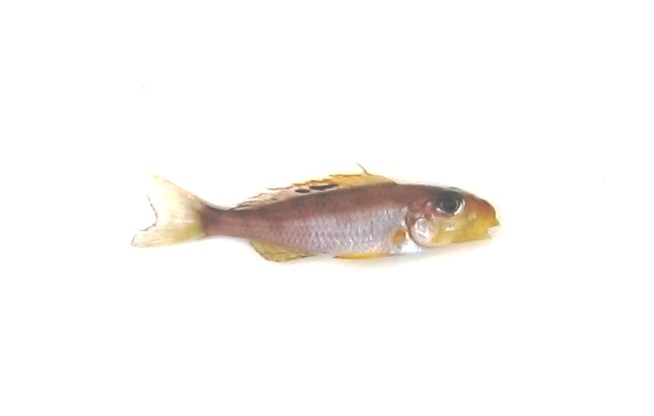
This is a small cichlid. FishBase and the IUCN both cite a maximum of about 7.8 cm (3.1 in) total length from the original material, while aquarium accounts routinely report fish reaching 8-10 cm (3-4 in); the higher figures likely reflect well-fed captive adults. The body is elongate with a flat, long head and a small underslung mouth — the build of a fish that works its food off the substrate.
The ground color is a grayish beige washed with silvery-blue speckling along the flanks, set off by yellow in the pelvic fins and the leading edges of the dorsal and anal fins. Two geographic variants are well known to hobbyists: at the type locality, Tembwe Deux, the dorsal fin is boldly stippled with black and white, whereas at Kanoni to the north the adults carry a clean yellow dorsal with little or no black. Sexual dimorphism is slight — there is no reliable external difference in color or finnage, and the most useful cue is that a ripe female shows a slightly fuller belly. Males are sometimes described as marginally more robustly built.
Range & habitat
Xenotilapia papilio is endemic to Lake Tanganyika and, as currently defined, has one of the smaller ranges among the lake's cichlids: it is confirmed only along the southwestern (Congolese) coast between Tembwe (Deux) and Kanoni. The IUCN flags its presence in Zambia and Tanzania as uncertain, because several differently colored populations in the southern lake may belong to this species or to undescribed relatives — a taxonomic question still unresolved.
What sets papilio apart is its habitat. Most Xenotilapia are open-sand specialists, but papilio is one of the genus's few rock-dwellers. Büscher took the type specimens in shallow rock at only 3 m, yet the species is more typically found deeper, down to around 40 m, on rocky substrate where the stone is coated with a layer of fine sediment and sand. That sediment film is the key — it is what the fish feeds on. The water it lives in is the hard, alkaline, oxygen-rich water characteristic of Tanganyika: FishBase gives a pH of roughly 7.5-9.0 and warm temperatures around 24-28 °C (75-82 °F).
Ecology & diet
Papilio is a sediment-sifting micro-invertebrate feeder. Rather than grazing the open sand flats like its schooling cousins, it works the thin layer of detritus and sand that settles on deeper rocks, taking in mouthfuls of substrate and filtering edible particles out through its gill rakers. Stomach analyses from the original description record small crustaceans, insect larvae, filamentous algae, and ingested sand. The dominant prey are tiny benthic crustaceans: detailed accounts put ostracods (seed shrimp) at the great majority of the diet — on the order of 90 percent — with copepods, other small invertebrates, and scraped algae making up the rest. FishBase estimates a trophic level near 3.1, consistent with a low-level invertebrate predator rather than a true herbivore or piscivore.
Ecologically, then, papilio occupies a narrow niche at the sand-rock interface, exploiting a food layer that the lake's many rock-grazing and open-water cichlids largely ignore. It shares this transitional zone with other specialists, including the look-alike X. leptura, with which it co-occurs without apparent competition for the same exact food.
Behavior & breeding
Socially, papilio breaks from the genus pattern in a second way: it does not form the large foraging schools typical of sand-dwelling Xenotilapia. Subadults travel in small groups of a handful of fish, but mature individuals settle into pairs that hold and defend a territory on the upper face of a large rock, and they appear to stay together even outside of breeding. It is among the more aggressive and territorial members of the genus, especially toward its own kind.
Reproduction is the species' showpiece. X. papilio is a biparental mouthbrooder — both parents share brood care, an uncommon strategy even among Tanganyika's mouthbrooders. Courtship is typically initiated by the female, who circles the male with all fins erect; the pair spawns on a quiet patch of sand near a rock, the female laying eggs in small batches of around five that the male fertilizes before she takes them up. Clutches are small, rarely more than 15-20 eggs. The female broods the eggs and larvae for the first roughly 8-13 days, then transfers part or all of the brood to the male's mouth, and both parents continue to feed while carrying young. Fry are released about three weeks after spawning and are guarded by both parents for at least another two weeks, darting back into a parent's mouth when threatened.
In the aquarium
Specialists are unanimous that papilio is not a beginner's fish — beautiful, fascinating, expensive, and difficult in equal measure. The core problem is intraspecific aggression, which intensifies sharply once a pair forms and begins breeding. Experienced Tanganyikan keepers report serious aggression even in large tanks; one long-time hobbyist noted ongoing trouble in tanks as big as 210 gallons, and the common advice is to design the system around a single dominant pair. The usual approach is to start with a group of five to eight juveniles in a long tank — at least 130-150 cm (about 4-5 ft) of length and 300 L (roughly 80 gal) or more — let pairs form naturally, and then break up the rock work with caves and visual barriers to cut the line of sight between rivals. Crucially, once a pair bonds, move the stressed bystanders rather than the pair, because relocating a new pair can break the bond.
The fish demands clean, stable, hard alkaline water and is notably sensitive to declining quality, so consistent water changes and good filtration are non-negotiable. The substrate should be fine sand. Tankmates are a real constraint: papilio will harass other Xenotilapia and its near-relatives (the "sunflower" and "katete" forms, and gentler species like X. flavipinnis) as competitors, and those calmer fish tend to lose and waste away. It often does better alongside more assertive Tanganyikans — smaller Neolamprologus, Paracyprichromis — that can hold their own without picking a fight. Diet in captivity should be varied and invertebrate-rich: cyclops, black mosquito larvae, occasional brine shrimp, and quality prepared foods, supplemented by the algae it grazes from rockwork. Keepers also warn that it is an accomplished jumper and dislikes being netted, so a covered tank and a gentle hand at capture matter.
Conservation
The IUCN Red List assessed Xenotilapia papilio as Data Deficient in 2025 (assessor L. Haambiya). The category reflects genuine uncertainty rather than safety: the species combines a very small confirmed range — a single stretch of the southwestern Congolese shore — with unresolved questions about whether southern populations in Zambia and Tanzania belong to it, and almost no data on population size or trend. The assessment flags sedimentation from deforestation on the steep rift-valley slopes, water pollution, and collection for the aquarium trade as plausible pressures, while noting that a narrow-range, habitat-specialized fish like this is inherently more exposed to local disturbance. Papilio is genuinely valued in the trade for its looks and its mouthbrooding behavior, so collection is worth watching even if its scale is unquantified.
Those concerns sit inside a lake under measurable strain. Lake Tanganyika has been warming and mixing less: O'Reilly et al. (2003, Nature) linked climate warming to a roughly 20 percent decline in primary productivity, with knock-on losses to fish yields, and Cohen et al. (2016, PNAS) found that warming has been accompanied by a substantial loss — on the order of 38 percent — of the oxygenated benthic habitat that bottom-dwelling fish and invertebrates depend on. Shoreline deforestation drives sedimentation that smothers exactly the sediment-on-rock interface papilio forages over (Cohen et al. 1993), even as the lake's clupeid (Stolothrissa, Limnothrissa) and Lates fishery — the protein base for four bordering nations and the focus of cross-border management under the Lake Tanganyika Authority — feels its own pressure. For a deep-living rocky-littoral specialist, the most relevant of these is the degradation of benthic, oxygenated, low-sediment rock habitat: papilio is not itself a fishery target, and it is not formally listed as threatened, but its small range and exacting habitat mean the lake's broader decline bears directly on it. The honest summary is that the species' status is unknown, the lake's trajectory is not encouraging, and better distribution and population data are the first thing it needs.
Sources
- FishBase: Xenotilapia papilio
- Eschmeyer's Catalog of Fishes (California Academy of Sciences)
- FishBase point/occurrence data for Xenotilapia papilio
- IUCN Red List: Xenotilapia papilio (Haambiya 2025, Data Deficient)
- Büscher, H.H. 1990. Xenotilapia papilio n. sp., ein neuer Cichlide aus dem Tanganjikasee (DATZ 43(5):289-293)
- Andersen, T. 'Beautiful as a Butterfly: Xenotilapia papilio Büscher, 1990' — Cichlid Room Companion
- tanganyika.si — Xenotilapia papilio 'Kanoni' species/biotope sheet
- ForAquarist — Lake Tanganyika cichlids: Xenotilapia papilio portrait
- Fishipedia — Xenotilapia papilio fish sheet
- Cichlid-Forum: 'Return to Tangs, making Xenotilapia work' — community/anecdotal
- Cichlid-Forum: featherfin/Xenotilapia tankmate aggression discussion — community/anecdotal
- Reddit r/Aquariums: 'The Xenotilapia cichlid clan from Lake Tanganyika' — community/anecdotal
- O'Reilly, C.M. et al. 2003. Climate change decreases aquatic ecosystem productivity of Lake Tanganyika (Nature)
- Cohen, A.S. et al. 2016. Climate warming reduces fish production and benthic habitat in Lake Tanganyika (PNAS)
- University of Kentucky: Lake Tanganyika fisheries declining from global warming